Real Estate Lead Reactivation Example: From Dormant Record to Clear Next Action
See a practical real estate lead reactivation example covering list selection, call flow, qualification fields, outcomes, guardrails and agent handoff.
In this guide
- A worked buyer reactivation example with segment selection, call flow and outcomes
- How to build outcomes before writing the script
- How guardrails protect the customer experience and team time
Real Estate Lead Reactivation Example: From Dormant Record to Clear Next Action
A real estate lead reactivation example is most useful when it shows the full operating model, not only the script. It should show what happens to the lead before the call, what the caller needs to learn, how outcomes are recorded, and who acts next. Otherwise, an old database simply becomes another list of calls with vague notes and no reliable follow-up.
For an agency, reactivation is not about pushing every past enquiry towards an inspection. It is a structured way to find people whose circumstances, timing or property needs may have changed. Some will be active now. Some will need a later check-in. Others should not be contacted again. The workflow needs to make those distinctions quickly and respectfully.
The workflow at a glance
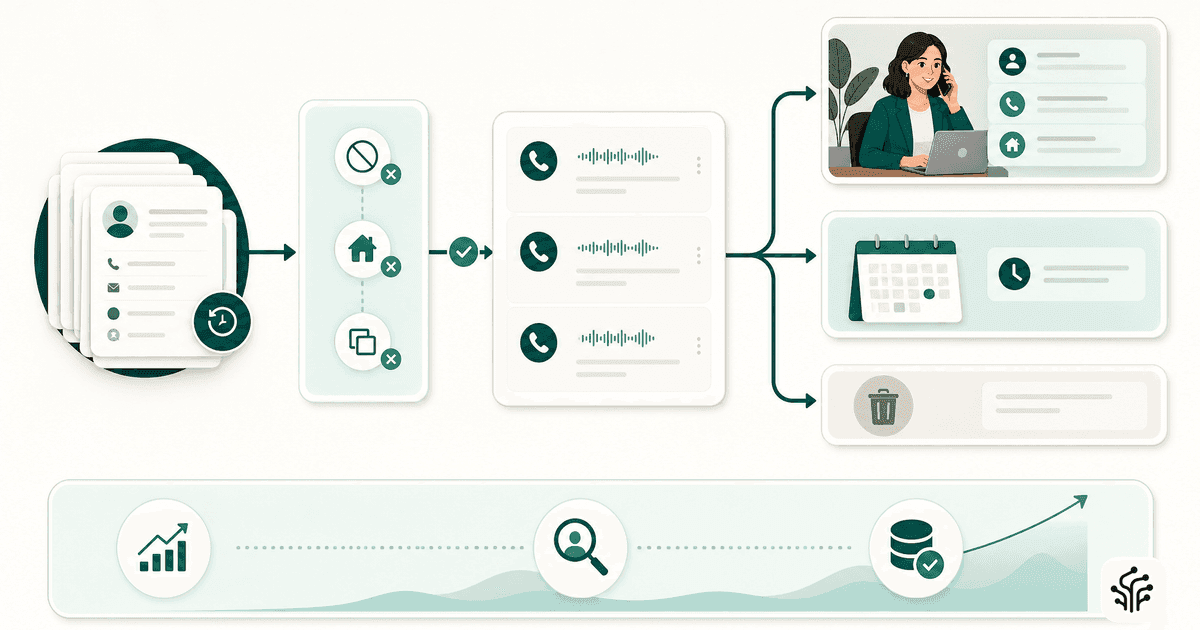
A practical buyer reactivation journey looks like:
segment → clean the list → contact → update current position → assign outcome → route or schedule next action
The purpose is not to force every old lead back into an active pipeline.
It is to make the database more accurate while identifying people whose circumstances have genuinely changed.
For the broader strategy behind reactivating past buyer records, see past buyer reactivation for real estate.
A real estate lead reactivation example
Consider a buyer enquiry from nine months ago. The prospect downloaded a suburb report and spoke with the agency briefly, but did not attend an inspection or submit an offer. Their CRM record says only: "Looking around, may buy later."
That note does not tell a sales agent whether the person is still renting, whether they have bought elsewhere, what locations matter, what budget range is relevant, or whether they are comfortable receiving future contact. Calling without a clear purpose can feel random. Ignoring the record altogether leaves potential demand buried in the CRM.
A better reactivation workflow starts by selecting a defined lead segment. In this case, the agency could include buyer enquiries aged between six and 18 months, exclude leads marked do-not-contact, remove records with recent sales activity, and prioritise contacts whose original enquiry was within the agency's active service area.
The call has a simple objective: establish whether the buyer is still considering a move and, if so, capture enough information to route a useful next action.
Example call flow
The opening should be direct, brief and transparent about why the person is being contacted. For example:
"Hi Sam, this is [name] calling on behalf of [Agency]. You previously enquired about property in the Inner West. I'm getting in touch to see whether you're still considering a purchase, or whether your plans have changed. Is now an okay time for a quick chat?"
This approach gives the prospect context and permission to continue. It does not pretend there is a new listing when there is not, and it gives them an easy way to decline.
If Sam is still looking, the next questions should update only the fields that affect a meaningful follow-up. The caller might ask whether they are actively searching, which suburbs they are considering, their preferred property type and bedroom count, their expected buying timeframe, and whether they would like relevant opportunities or a conversation with an agent.
The call does not need to become a full buyer consultation. If the person is early in their search, a short conversation and a future follow-up date may be the right outcome. If they are ready to inspect, a human agent should receive a clear brief and act promptly.
If Sam has already bought, the outcome is equally valuable. The CRM can be updated rather than leaving the record in an endless reactivation queue. If Sam asks not to be contacted, that preference should be captured immediately and respected across future workflows.
What the workflow should capture
The difference between a useful reactivation call and a generic check-in is the structure behind it. Every completed call should produce a defined outcome, not just a transcript for someone to interpret later.
For a buyer reactivation campaign, useful fields commonly include current buying status, target locations, property requirements, likely timeframe, whether finance arrangements are in place, interest in an agent conversation, and preferred contact timing. The agency may also capture a short free-text note for context, such as "lease ends in October" or "waiting for current home to sell".
Those fields support action. A buyer looking within 30 days and open to a call can be routed to an agent with a concise summary. A buyer planning for next year can be placed into an approved, lower-frequency nurture process. A contact who has purchased or opted out should be removed from the active list.
It is tempting to ask for every possible detail because the person is already on the phone. That can make a reactivation call feel like an interrogation. Ask only what the next team member genuinely needs to know. More fields are not better if they reduce completion rates or produce unreliable answers.
Build outcomes before writing the script
A script is easier to control when the end states are agreed first. The outcome model should be designed before the wording of the call. For this campaign, the agency might use outcomes such as:
- Active buyer - agent follow-up requested
- Active buyer - receive suitable properties
- Considering a move later - scheduled check-in
- No longer looking or has purchased
- Not interested or do not contact
- No answer or callback requested
Each outcome should trigger a specific operational step. An active buyer who requests a call should not sit in a general inbox. The assigned agent needs a notification, call summary, captured requirements and a clear service-level expectation for follow-up. A scheduled check-in needs a date, not a vague "call again sometime".
This is where a controlled AI voice workflow can help. An AI voice agent can work through an approved call structure, capture answers consistently, create a transcript and summary, and assign the selected outcome. The human team remains responsible for high-intent conversations, nuanced advice and relationship-building. Automation handles the repeatable first pass so agents can focus attention where it is most useful.
Add guardrails before calling any list
Old records are often messy. That is why lead reactivation should begin with list hygiene and clear calling rules, not a bulk upload and hope for the best.
Review the source of each lead, the age of the record, previous contact history and any existing contact preferences. Exclude do-not-contact records, recent enquiries already being handled, duplicates and contacts with incomplete or questionable data. Your team should also decide when a call needs human review, such as a complaint, a request for a specific staff member, an unusual property situation or unclear intent.
The wording matters too. Avoid language that assumes the prospect is still in the market or creates artificial urgency. The caller should be able to acknowledge a no, offer an appropriate callback, and end the conversation cleanly. A well-designed workflow protects the customer experience as much as it protects team time.
Before launch, test the call with realistic scenarios: an interested buyer, a buyer who has purchased, someone who is busy, a person who challenges why they were contacted, and someone who asks not to hear from the agency again. Review the transcript, fields and routing after each test. If a question creates confusion or an outcome does not lead to a clear next action, fix it before the campaign reaches more contacts.
For a broader look at how AI calling workflows fit into property operations, see AI calling workflows for property teams.
Measure quality, not just call volume
A large number of completed calls does not prove that a reactivation campaign is working. The more useful measures are contact rate, meaningful conversation rate, percentage of records updated, active buyers identified, agent follow-up completion, appointments or inspections booked, and opt-out or complaint signals.
Review a sample of call recordings and summaries regularly. Look for patterns: perhaps prospects are confused by the opening, the timing question is too broad, or agents are not acting quickly enough on qualified callbacks. The aim is to improve the workflow, not to treat the agent, AI or human, as a black box.
DialoGrove is designed for this kind of structured process: teams can define what the agent asks, the fields it captures, the outcomes it assigns and the calls that need review. That visibility makes it easier to run reactivation activity with consistency while retaining human judgement where it matters.
The best reactivation campaign is often quieter and more selective than teams expect. It does not chase every old enquiry or force every conversation towards a booking. It identifies the people whose plans have changed, gives agents a usable reason to follow up, and leaves the CRM more accurate after every call.