What Australia's AI Safety Institute Tells Businesses About Safe AI Deployment
Australia's AI Safety Institute focuses on testing capabilities, agentic systems and real-world harms. Here is what businesses can learn about safer AI deployment.
In this guide
- Why testing the final answer is not enough when AI agents plan, use tools and take actions
- Capability mapping: what the system can actually do vs what you intended it to do
- A practical safe deployment framework: capability → control → test → deploy → monitor → review
A business can have an AI policy, a risk register, a vendor assessment and a sign-off process, and still miss the most important question:
What can this system actually do in the real world?
That is the useful shift in perspective behind Australia's AI Safety Institute.
The Institute's job is not simply to write policy. Its stated role is to monitor, test and analyse advanced AI capabilities, risks, harms and trends. It focuses on how systems behave, what risks emerge as capabilities grow, and what happens when AI starts acting through tools, platforms and real-world workflows.
For businesses deploying AI, the lesson is straightforward.
Safe deployment is not just about preventing a bad answer.
It is about understanding:
- what the system can do
- what it can access
- how it behaves in realistic conditions
- how its risks change as capabilities grow
- what happens when it acts through tools
- how harms show up after deployment
- what needs to be tested before something goes wrong
That is a much more practical standard than saying an AI system has been "reviewed" or "approved".
What Australia's AI Safety Institute actually does
Australia's AI Safety Institute was established to analyse emerging AI capabilities, risks, harms and trends.
Its three stated goals are to:
- analyse and test new AI models and applications
- support regulators and agencies responding to emerging AI risks and harms
- shape safe AI development, deployment and international governance in Australia's interests
The Institute also monitors frontier model capabilities, including AI agents that can act autonomously to pursue goals, and highly capable generative systems that produce text, images, video and other content.
That matters because capability changes the risk.
A system that only drafts text creates one type of problem.
A system that can:
- browse
- call tools
- retrieve sensitive data
- update records
- trigger workflows
- communicate with customers
- take actions without step-by-step human approval
creates a different one.
The stronger the capability, the more important it becomes to test behaviour rather than rely on policy alone.
Safe AI deployment starts with capability, not intention
Most businesses begin with intention.
They ask:
What do we want the AI to do?
That is necessary, but incomplete.
A safer deployment process also asks:
What is the AI actually capable of doing?
Those are not always the same thing.
A customer-service agent may be intended to answer questions.
But if it also has access to:
- CRM data
- calendars
- internal knowledge
- account records
- workflow actions
- external APIs
then its effective capability is much broader than "answering questions".
The same applies to an internal coding assistant, claims triage workflow or lead qualification agent.
The business use case may be narrow.
The connected system may not be.
That is why capability mapping matters.
A practical review should identify:
- what the system can see
- what it can say
- what it can change
- what tools it can call
- what actions it can trigger
- what happens without human approval
- what happens when instructions conflict
- what happens when external input tries to manipulate it
Safe deployment begins with the real system boundary, not the product description.
Testing the final answer is not enough for agents
One of the Institute's strongest practical signals comes from its work on agentic evaluations.
Australia participated in a joint international testing exercise focused on AI agents that can plan, choose steps, use tools and carry out tasks.
The exercise covered risks such as:
- leakage of sensitive information
- fraud
- cybersecurity threats
Its key lesson is important for businesses: if an AI agent can take actions, testing only the final answer is not enough.
You also need to understand how the system got there.
An agent might produce an apparently acceptable outcome while:
- accessing data it did not need
- using an unsafe tool path
- exposing sensitive information
- taking unnecessary actions
- following manipulated instructions
- creating side effects that are not obvious in the final response
That changes what evaluation should look like.
For ordinary software, teams often test:
- input
- output
- expected result
For agentic AI, they also need to test:
- decision path
- tool use
- permissions
- intermediate actions
- data access
- escalation behaviour
- recovery when something goes wrong
A good result reached through a bad process is still a bad system.
Real-world harms matter more than lab confidence
Australia's AI Safety Institute also says it will monitor how AI is used across society and the economy, and study the actual effects on families, communities, businesses and society.
That matters because many AI risks do not show up clearly before deployment.
A system may pass a test set and still create problems once it encounters:
- real customers
- messy data
- unexpected requests
- changing behaviour
- adversarial input
- unusual edge cases
- high-volume use
This is one reason safe deployment cannot stop at pre-launch approval.
Businesses need a way to observe:
- failures
- complaints
- unusual outputs
- repeated overrides
- data leakage events
- unexpected tool use
- review rates
- near misses
- patterns that only appear at scale
The practical question is:
What are we learning from the system after it goes live?
If the answer is "we have not had any major incidents", that is not the same as monitoring.
Safe deployment needs evidence, not reassurance
The Institute's work is grounded in measurement, evaluation and testing.
That is useful because AI governance often becomes too abstract.
Organisations create:
- policies
- principles
- committees
- risk statements
- responsible AI frameworks
Those things matter.
But they do not tell you whether the system:
- leaks data
- follows malicious instructions
- misuses tools
- behaves unpredictably in edge cases
- fails when multiple agents interact
- creates risks that only appear in real use
A mature safety approach connects governance to evidence.
For example:
| Governance claim | Evidence question |
|---|---|
| The system is safe | What has been tested? |
| Humans remain in control | Where exactly do they intervene? |
| The AI has limited access | Which permissions have been verified? |
| Sensitive data is protected | Has leakage been tested? |
| The workflow is monitored | Which behaviours and incidents are tracked? |
| The system can be stopped | Has fallback or shutdown been tested? |
Policies describe intent.
Testing shows whether the system behaves accordingly.
Agentic systems need a different safety model
The Institute explicitly focuses on AI agents that can act autonomously to pursue goals.
This is a major shift for business AI.
A chatbot waits for a prompt and returns a response.
An agent may:
- decide what step comes next
- use a tool
- retrieve more information
- update a system
- trigger another workflow
- continue working toward a goal
That makes permission design much more important.
The safety question becomes:
What is this agent allowed to do, and under what conditions?
A practical control model should define:
- allowed tools
- prohibited actions
- approval boundaries
- data access
- escalation rules
- action limits
- logging
- human override
- shutdown or fallback
The more autonomy a system has, the less acceptable vague control language becomes.
"Human oversight" is not enough.
"Guardrails" is not enough.
The operating rules need to be visible.
Multi-agent systems create risks that single-agent testing can miss
The Institute also points to research on how advanced AI systems behave in complex or multi-agent environments.
That matters because businesses are increasingly connecting:
- routing agents
- specialist agents
- research agents
- workflow agents
- customer-facing agents
- human reviewers
A single component may behave correctly in isolation and still create problems once connected to others.
For example:
- one agent passes incomplete context to another
- two agents interpret the same instruction differently
- an escalation is lost
- permissions expand across the chain
- sensitive information moves further than intended
- nobody owns the final decision
This is not just an AI problem.
It is a system design problem.
A multi-agent workflow should be evaluated as a whole:
- what context moves between agents
- which agent owns each decision
- where handoff can fail
- what happens when agents disagree
- which actions are reversible
- where a human can intervene
Safe AI deployment is about systems, not isolated prompts.
Why real-world context changes the result
The Institute's focus on real-world harms also exposes a weakness in generic AI testing.
An AI system can behave well in a controlled demo and poorly inside a real business process.
Context changes risk.
A voice agent that answers general FAQs is different from one that:
- qualifies a financial enquiry
- books appointments
- updates a CRM
- handles opt-outs
- routes vulnerable customers
- escalates complaints
The same model can be low risk in one workflow and much higher risk in another.
That means safety cannot be assessed at the model level alone.
It also needs to be assessed at the use-case level.
A useful deployment review should ask:
- Who is affected?
- What decisions are influenced?
- What systems are connected?
- What can go wrong?
- How quickly can harm spread?
- Can the outcome be reversed?
- Does a person review the result?
- What happens when the AI is uncertain?
The consequence of failure should shape the level of control.
What businesses can take from the Institute's approach
Australia's AI Safety Institute is not a checklist provider for every business.
But its operating model suggests a better way to think about AI deployment.
1. Measure capability before relying on intent
Do not stop at the stated use case.
Map the system's actual access, tools, actions and dependencies.
2. Test realistic failure modes
Test:
- manipulation
- data leakage
- unsafe tool use
- unexpected behaviour
- edge cases
- recovery
3. Evaluate the process, not just the answer
For agents, inspect:
- the path taken
- tools used
- permissions exercised
- intermediate actions
4. Monitor what happens after launch
Track:
- exceptions
- incidents
- overrides
- complaints
- repeated failures
- behaviour changes
5. Assess the whole workflow
Do not test one model or agent in isolation when the real system depends on:
- other agents
- external tools
- human handoffs
- provider integrations
- business rules
6. Match control to consequence
A low-impact assistant and a customer-facing autonomous workflow should not have the same safety process.
How this connects with APRA's AI warning
The AI Safety Institute and APRA are looking at different parts of the problem.
APRA's warning is mainly about governance, assurance, operational resilience, cyber risk and supplier dependence in regulated financial institutions.
The AI Safety Institute focuses more directly on capabilities, evaluation, emerging harms, agentic systems and the science of understanding how advanced AI behaves.
The overlap is significant.
Both point toward the same operating lesson:
AI safety cannot rely on a one-time approval and a policy document.
The APRA question is:
Can the organisation govern this system as it changes?
The AI Safety Institute question is:
Do we actually understand what this system can do, how it behaves and how it can fail?
Businesses need both.
A practical safe deployment framework
A useful starting point is:
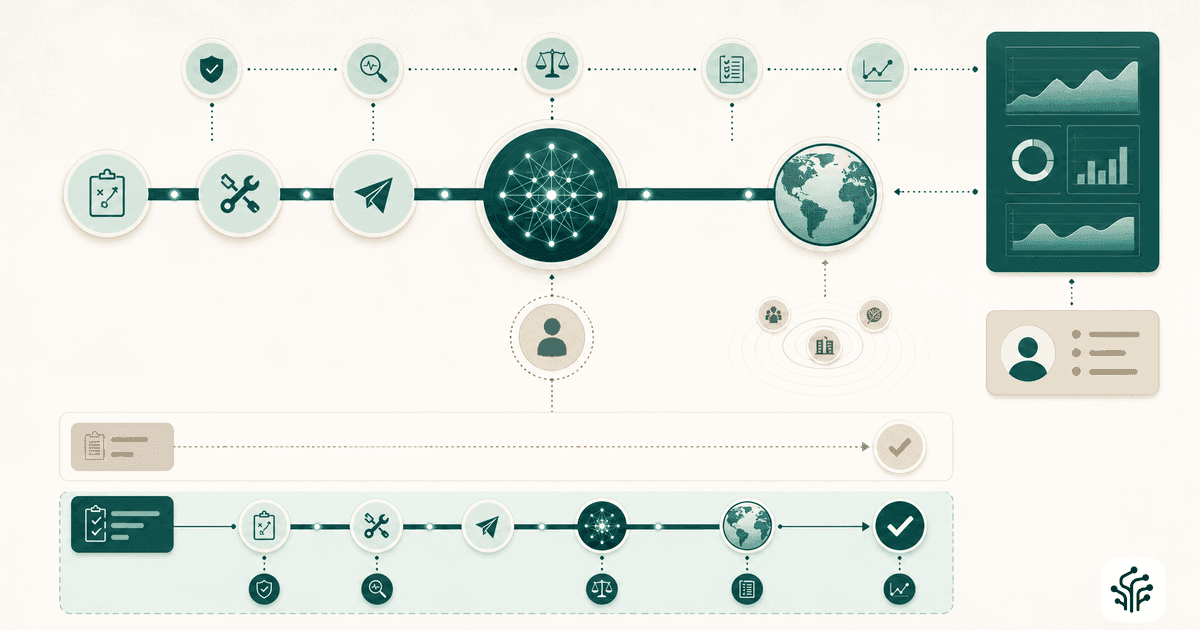
capability → control → test → deploy → monitor → review
Capability
What can the system actually do?
Control
What is it allowed to do?
Test
How does it behave under realistic pressure and misuse?
Deploy
What human and operational safeguards are active?
Monitor
What changes, failures and harms are visible?
Review
What happens when the system or environment changes?
This is not a one-off process.
The loop continues for as long as the AI system remains in use.
The real lesson
The most useful thing Australia's AI Safety Institute tells businesses is not that AI should be slowed down.
It is that safe deployment requires understanding the real system, not the imagined one.
Do not just ask whether the model is good.
Ask what the system can do.
Do not just test the answer.
Test the path.
Do not just approve the launch.
Monitor what changes.
Do not just say a human is involved.
Design where they intervene.
Do not just write a policy.
Build evidence that the system behaves the way the business believes it does.
That is what safe AI deployment starts to look like when AI moves from a demo into the real world.