Mortgage Lead Qualification Software That Works
How mortgage lead qualification software helps teams qualify borrowers faster, capture structured data, and route leads to the right broker with context.
A mortgage enquiry is only valuable if someone follows up properly. That sounds obvious, but it is still where many brokers and finance teams lose momentum.
A borrower fills in a form. They may be looking to purchase, refinance, understand borrowing capacity, compare options, or simply work out whether now is the right time to speak with someone. If the next step depends on who is available, who remembers to call, or how well someone writes notes in the CRM, the process is already fragile.
That is the operational gap mortgage lead qualification software should solve.
Not by making follow-up louder. Not by pushing every borrower into the same generic sales sequence. The real value is making mortgage lead follow-up faster, more consistent, easier to review, and more useful for the broker who eventually takes over.
At DialoGrove, we look at mortgage lead qualification as a workflow, not just a phone call. The call matters, but so does the playbook behind it, the fields captured, the outcome assigned, the handoff to the right person, and the next action created after the conversation.
What mortgage lead qualification software should actually do
Mortgage lead qualification software should help your team understand whether a lead is contactable, relevant, ready, and worth immediate human attention.
That sounds simple, but good mortgage qualification depends on structure.
A useful workflow should help answer questions such as:
- Is the borrower looking to purchase, refinance, invest, consolidate debt, or explore options?
- How soon are they hoping to move forward?
- Have they spoken to a broker or lender already?
- Are they employed, self-employed, or still gathering information?
- Do they have a property in mind?
- Are they after a first conversation, a borrowing estimate, or a booked appointment?
- Is there missing information that a broker needs before calling back?
- Does the conversation need human review before the next step?
The answers shape what happens next. A borrower actively purchasing in the next month should not sit in the same queue as someone who is researching for later in the year. A refinancing enquiry with clear urgency should be handled differently from a casual comparison lead. A borrower asking something outside the approved workflow may need to be routed to a human rather than pushed through automation.
Good mortgage lead qualification software should not just collect these answers. It should turn them into structured outputs the team can use.
That means the result should not be a vague note like:
Keen to chat. Call back.
It should be closer to:
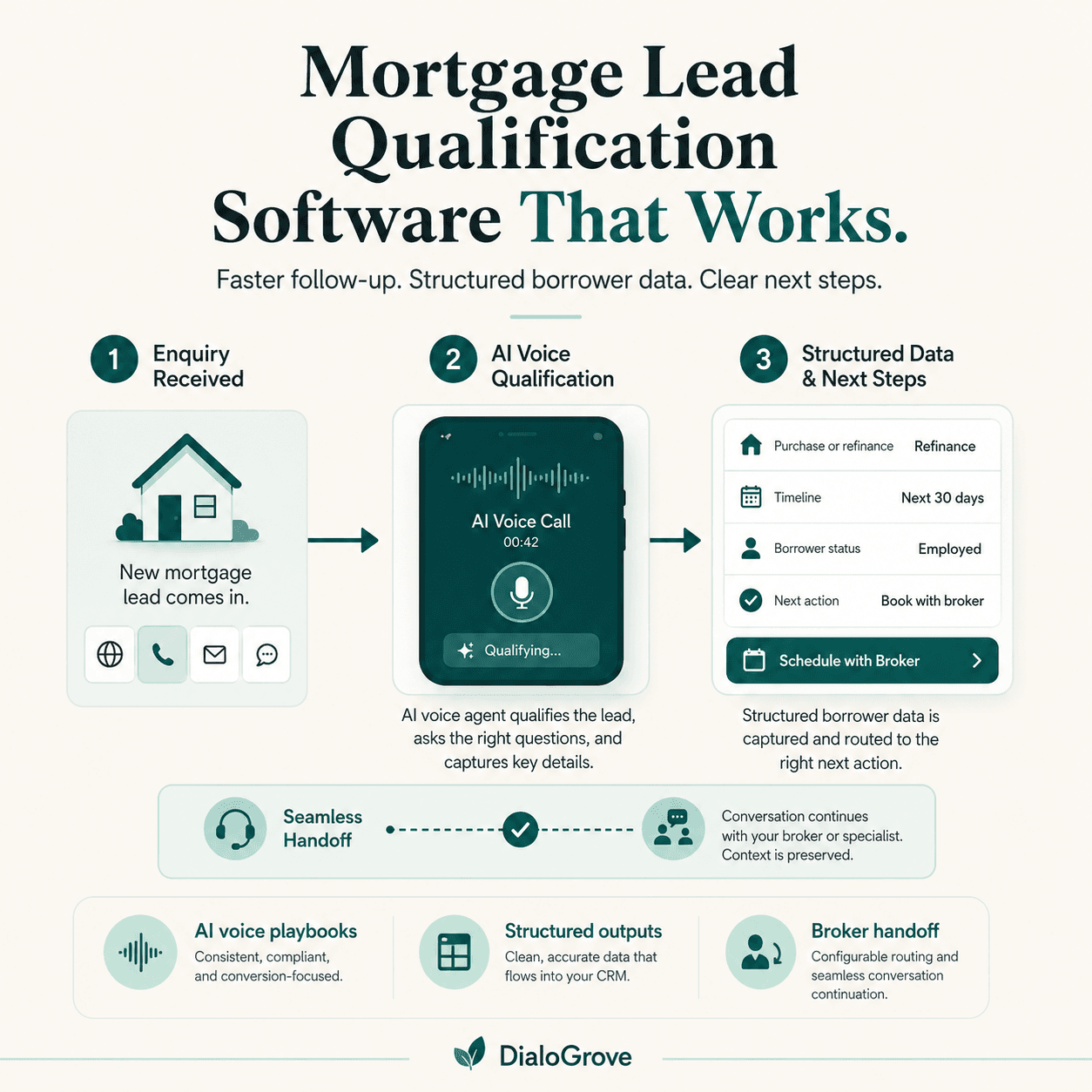
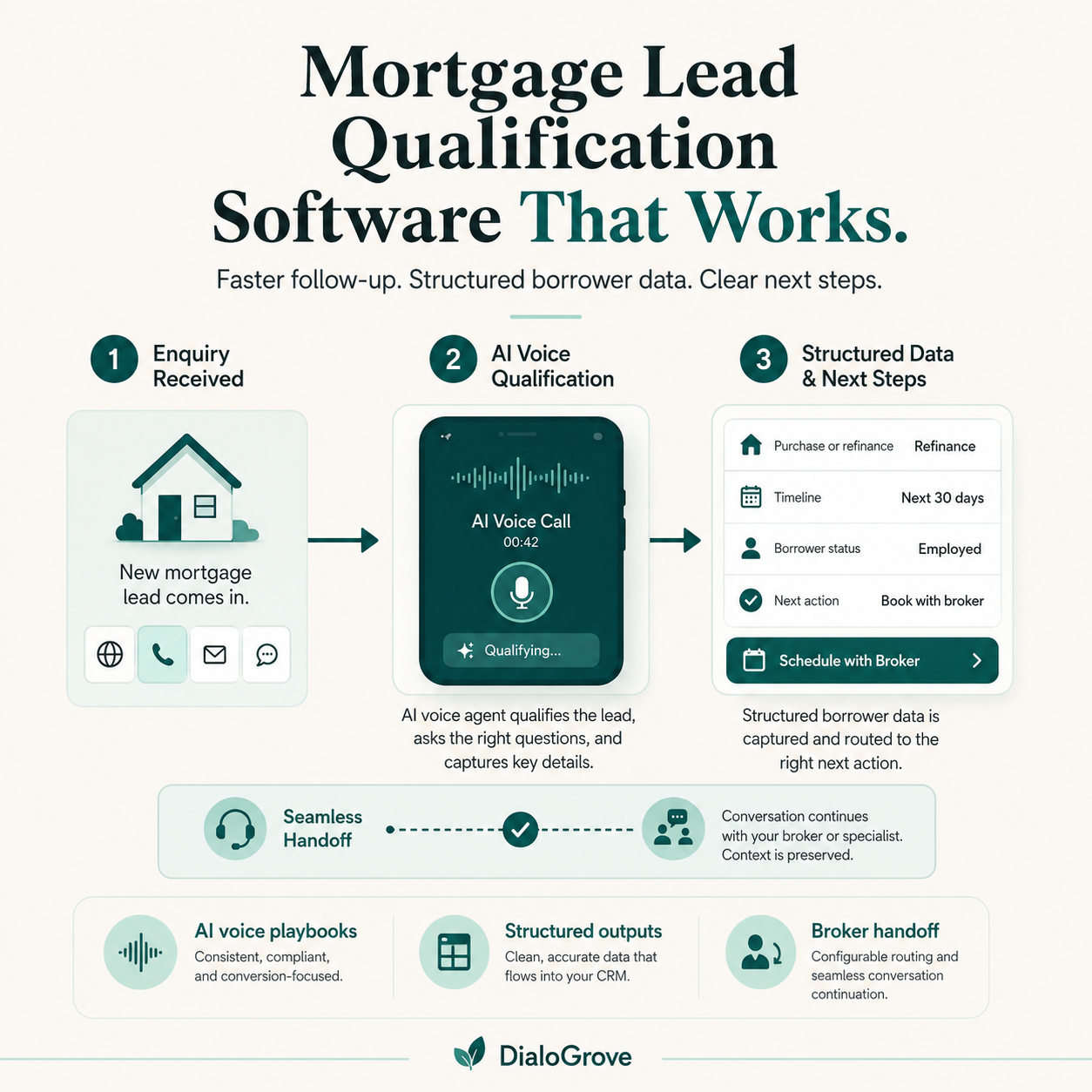
- Lead type: refinance enquiry
- Intent: active
- Timeframe: within 30 days
- Current lender: captured
- Broker callback: recommended
- Missing information: income details
- Review flag: borrower asked a policy-specific question
- Next action: assign to broker for same-day callback
That is the difference between storing a call and running a qualification workflow.
Why mortgage teams struggle without structure
Most mortgage teams already know the questions they should ask. The harder part is asking them consistently, capturing the answers cleanly, and making sure the lead moves to the right next step.
When qualification depends completely on manual effort, quality can swing with workload.
One team member calls within five minutes. Another gets to the enquiry the next day. One person asks about timing, purpose, current situation, and next steps. Another leaves a short note and moves on. One lead gets booked properly. Another gets left in the CRM with no clear owner.
This is not always a people problem. Often, it is a system design problem.
Mortgage teams are dealing with a mix of lead types:
- purchase enquiries
- refinance enquiries
- first-home buyer questions
- investor enquiries
- rate review requests
- pre-approval conversations
- old database reactivation
- incomplete web form leads
- missed call follow-up
- borrowers who are not ready yet
Each of these needs a slightly different path. Treating them all as generic "mortgage leads" creates noise.
This is where workflow-led AI voice agents can help, if they are implemented carefully. The goal is not to replace the broker relationship. The goal is to handle the repeatable first-touch qualification work with more consistency, then hand the right context to a person when human judgement matters.
The difference between lead capture and lead qualification
A website form captures interest.
Qualification tests intent, fit, timing, and next step.
That distinction matters because mortgage pipelines often contain mixed-quality enquiries. Some borrowers are ready for a broker conversation now. Some are just trying to understand the process. Some have submitted forms across multiple providers. Some have enough urgency to justify immediate attention. Others should be nurtured, reviewed, or paused.
Without qualification, every lead looks roughly the same until someone manually investigates.
That creates two problems.
First, strong opportunities can wait too long.
Second, brokers spend time on conversations that could have been screened, clarified, or routed earlier.
Mortgage lead qualification software should help teams sort this mix without creating a black box. Your team should be able to see what the agent was meant to ask, what was captured, how the outcome was assigned, and when a human should step in.
This is an important part of how DialoGrove is designed. The platform is built around playbooks, structured call outcomes, review queues, and next actions. A mortgage qualification workflow should be visible and reviewable, not a mystery hidden behind an AI call.
Why playbooks matter more than generic prompts
A common mistake with AI voice is assuming the prompt is the product.
It is not.
A prompt might tell an AI agent to "call the mortgage lead and qualify them". That is not enough for a serious mortgage workflow.
A mortgage playbook should define the job more clearly:
- what type of enquiry the agent is handling
- what the agent should confirm first
- which qualification questions matter
- which fields must be captured
- what the agent should avoid saying
- when the agent should continue the conversation
- when the agent should hand off to another agent or a human
- what outcomes are valid
- what next actions should be created
- what should trigger review
This is where DialoGrove's playbook-led approach is useful. The platform is designed so teams can configure agent behaviour around a specific workflow rather than relying on open-ended improvisation.
For mortgage businesses, that might mean separate playbooks for:
- new purchase enquiries
- refinance follow-up
- first-home buyer discovery
- dormant database reactivation
- missed call recovery
- document follow-up
- appointment booking
- post-enquiry callback
The workflow can stay natural for the borrower, while the business still gets consistent qualification and structured outputs behind the scenes.
Conversation continuation and handoff
Mortgage conversations do not always follow a straight path.
A borrower might start by asking about refinancing, then mention they are also considering buying an investment property. Someone might answer initial qualification questions but then ask for a person to call back. Another borrower may need to be moved from a general qualification flow into an appointment booking flow.
This is why conversation continuation and handoff matter.
DialoGrove supports configurable conversation handoff at the agent configuration level. That means teams can design how a conversation should continue when the caller's intent changes or when another workflow is better suited to the next step.
For example:
- a general mortgage enquiry can continue into a broker appointment booking flow
- a refinance lead can be handed to a specialist workflow if the borrower is ready now
- a borrower with missing information can be routed into a follow-up or review path
- a conversation that reaches a sensitive or unclear point can be flagged for human review
- a lead that needs a live person can be handed off with context rather than starting from scratch
The customer experience should feel continuous. The borrower should not feel like they are being bounced around because the system lost track of the conversation.
From the team's side, the handoff should preserve context. The next person or workflow should know what was already asked, what was captured, and why the call was routed that way.
That is the practical difference between simple automation and a real mortgage lead qualification workflow.
What to look for in mortgage lead qualification software
The best mortgage lead qualification software is built around operational clarity rather than flashy AI claims.
If you are assessing options, the first question should not be:
Can this software make calls?
It should be:
Can this software support a qualification workflow our team would actually trust?
Here are the areas that matter.
1. Workflow visibility
Your team should be able to understand the call logic before it goes live.
What will the agent ask? What will it capture? What outcomes can it assign? What should happen if the borrower is unsure, not ready, or asks for something outside the workflow?
This is especially important for mortgage businesses because conversations can quickly move into areas that need care. AI should not guess, provide financial advice, or make unsupported claims. A controlled workflow should capture intent and route appropriately when human judgement is needed.
2. Structured borrower data
Transcripts are useful, but they are not enough.
A mortgage team needs structured information such as:
- enquiry type
- purchase or refinance intent
- buying or refinance timeframe
- employment type
- current lender if relevant
- property stage
- preferred callback time
- appointment readiness
- missing documents or information
- review flags
- recommended next action
This is what helps brokers act quickly without re-reading a long transcript or listening to every call.
3. Review queues and human oversight
Not every call should be fully automated from start to finish.
Some calls are straightforward. Others need review because the borrower gave mixed signals, asked a complex question, or provided incomplete information.
DialoGrove is designed around human review where it matters. The operating model should be simple:
AI handles repeatable first-touch work. Humans review, advise, and close where judgement matters.
That keeps automation useful without removing control.
4. Routing and next actions
A qualification workflow is only useful if it connects to what happens next.
A warm borrower should move to the right broker or queue. A not-ready lead should be nurtured. A missing-document case should trigger a different follow-up. A do-not-contact request should be respected. A booking-ready borrower should be moved toward an appointment.
This is where mortgage lead qualification software should connect calls to operational next steps, not just call logs.
5. Integrations that support the workflow
Most mortgage teams already use a CRM, calendar, or lead management system. Qualification software should fit into that environment where possible.
DialoGrove supports integration-led workflows and can push structured outcomes into supported systems. Where a customer's CRM or workflow tool is not already available, the platform is designed so new integrations can be assessed and added based on API access and business priority.
The important thing is that the call should not create more admin. It should reduce manual follow-up work by giving the team cleaner data and clearer next actions.
Where AI voice agents fit
AI voice agents can be valuable for mortgage teams when the job is narrow, controlled, and useful.
Good use cases include:
- calling new web enquiries quickly
- qualifying purchase or refinance intent
- confirming contactability
- collecting missing details
- reactivating older enquiries
- following up missed calls
- booking a broker callback
- routing not-ready leads into nurture
- flagging uncertain calls for review
This is not the same as asking AI to replace a broker.
Mortgage advice, complex financial judgement, trust-building, and closing still belong with qualified people. AI voice workflows are better suited to the repeatable front end of the process: contact, clarify, capture, route, and prepare.
That is why the design of the workflow matters more than the novelty of the voice.
A controlled AI voice workflow should make it clear:
- what the agent is allowed to do
- what it should not do
- what information it must capture
- when it should stop and route to a human
- how the result is reviewed
- how the next action is triggered
If those controls are missing, the software may create faster activity without better outcomes.
Common mistakes when choosing mortgage lead qualification software
One common mistake is buying for features instead of workflow outcomes.
Dashboards, AI branding, and call volume can look impressive. But the real question is whether the system helps your team decide who needs attention, what was learned, and what should happen next.
Another mistake is skipping workflow design.
Before implementation, the team should agree on:
- what counts as qualified
- which borrower details matter most
- what should be routed to a broker
- what should go to admin or review
- what should be nurtured
- what should stop completely
- which questions the AI should not try to answer
A third mistake is assuming more automation always means better operations.
Sometimes automation helps. Sometimes it just makes a messy process move faster. If your team cannot inspect outcomes, correct errors, refine the playbook, or review handoffs, you may simply create a new bottleneck.
Good mortgage lead qualification software should make the process cleaner, not more confusing.
The real business case
Mortgage lead qualification software is not only a sales tool. It is an operations tool.
The business case is usually built around:
- faster first response
- more consistent qualification
- cleaner borrower information
- better broker prioritisation
- fewer vague CRM notes
- clearer ownership
- more reliable follow-up
- stronger review and compliance control
- less manual admin after calls
This matters in high-volume pipelines where speed-to-lead and consistency affect revenue. It also matters in smaller teams where every missed day of follow-up can leave good enquiries sitting idle.
The right system does not remove judgement. It supports judgement with better timing, better data, and clearer routing.
For a mortgage team, the question is not only:
How many leads do we have?
It is:
Do we trust what happens after each lead arrives?
If the answer depends on who is available, how busy the team is, or whether someone enters notes properly, the issue is not effort. It is system design.
How DialoGrove approaches mortgage lead qualification
DialoGrove is built for lead-heavy teams that depend on timely phone follow-up, structured qualification, and clear handoff.
For mortgage workflows, that means the platform can support:
- AI voice agents for first-touch qualification
- configurable playbooks for different enquiry types
- structured borrower outputs
- call summaries and outcomes
- review flags and human oversight
- conversation continuation across workflows
- configurable handoff at agent setup
- routing to the right next action
- CRM and calendar workflow integrations where supported
- auditable records of what happened and why
The product is not designed as a generic calling gimmick. It is designed to help teams turn calls into usable workflow outcomes.
That matters because mortgage qualification is not just a conversation. It is a decision point.
A borrower has shown intent. The business needs to respond quickly, ask the right questions, capture the right information, and move the lead to the right path.
When that happens consistently, brokers get better context, operations gets cleaner queues, and borrowers get a more professional follow-up experience.
That is what mortgage lead qualification software should do.