Open Home Follow-Up: How Agencies Turn Inspections Into Buyer Intelligence
A practical guide to building an open home follow-up system that classifies attendees, captures buyer feedback, and turns inspections into vendor-ready insight.
In this guide
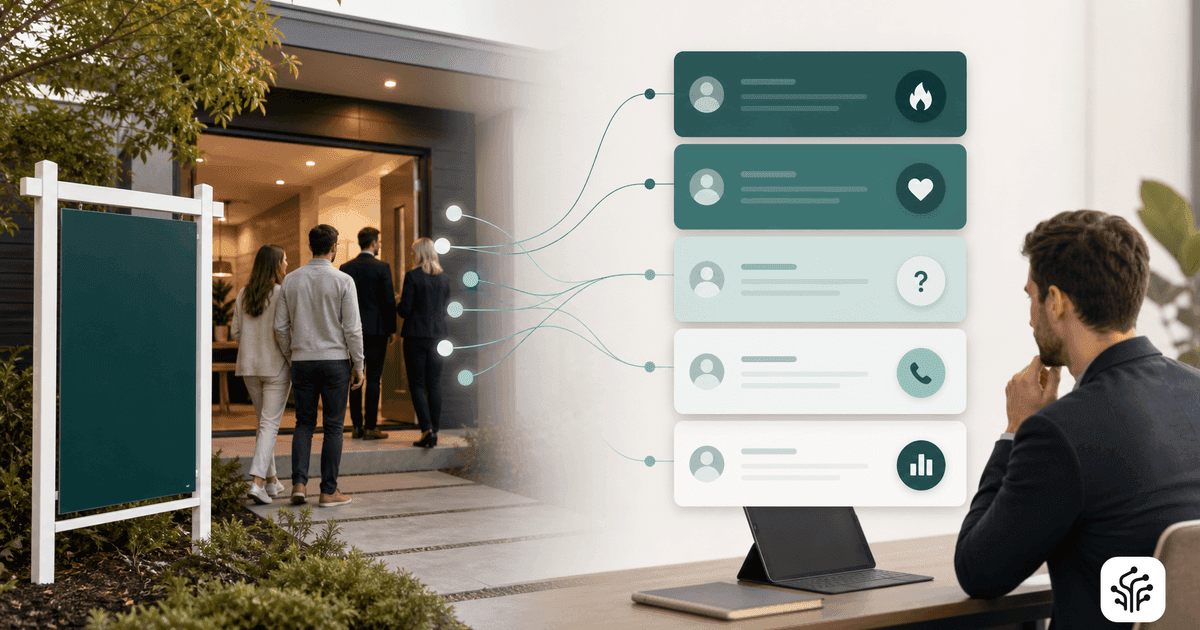
- 5 attendee types: hot, warm, curious, cold, not suitable — with signals and next actions
- How to turn attendee feedback into vendor-ready campaign intelligence
- Manual calls vs SMS vs AI voice: the channel comparison for open home follow-up
Open home follow-up is not just a courtesy call.
Done well, it tells an agency who is interested, who has concerns, who is comparing price, who needs a human call, and what feedback should be taken back to the vendor.
That is the difference between chasing attendees and building buyer intelligence.
Most agencies already know they should follow up after inspections. The harder part is doing it consistently, quickly, and in a way that produces useful information instead of scattered notes.
A busy Saturday can create dozens of follow-up conversations. Some attendees are ready to act. Some are curious. Some are comparing properties. Some are not suitable. Some have a concern that the vendor should hear.
If all of that ends up as vague notes, missed calls, or "seemed interested", the agency loses value.
A better open home follow-up process should help the team answer three questions:
- Who needs a human call now?
- What did buyers actually think of the property?
- What can we tell the vendor with confidence?
That is the real job.
What every attendee should tell you
Open home follow-up should not feel like interrogation.
It should feel like a short, useful check-in after the inspection.
The agency is not trying to collect every possible detail. It is trying to capture enough information to understand interest, objections and next action.
After every inspection, the team should be able to answer:
- Did the attendee like the property?
- What stood out to them?
- What did not work for them?
- Are they still interested?
- Are they comparing it with other properties?
- Do they have a pricing question?
- Do they want a call from the agent?
- Are they ready to inspect again, request documents or make an offer?
- Are they not suitable for this property but potentially suitable for another one?
The exact wording can vary. The important thing is that the answers are captured in a structured way.
A sentence like "buyer seemed interested" is not enough.
A better record would say:
Liked the location and layout. Concerned about the second bedroom size. Asked whether the vendor would consider offers before auction. Wants the agent to call tomorrow afternoon.
That is useful.
It gives the agent context. It gives the vendor feedback. It gives the team a clear next step.
For the broader definition and question breakdown, the existing article on what open home follow-up is should remain the beginner guide.
This article is about how to turn that follow-up into an operating system.
Classifying attendees after an open home
Not every attendee deserves the same follow-up.
That sounds obvious, but many agencies still treat open home lists too evenly. Everyone gets a similar call, a similar note, or a similar SMS.
That is not how buyer intent works.
A better process classifies attendees based on what they said and what should happen next.
Hot attendees
Hot attendees show clear buying intent.
They may say they are interested in making an offer, want the contract, ask specific price or auction questions, request a private inspection, or ask the agent to call them urgently.
Typical signals:
- strong interest in the property
- budget appears aligned
- finance or buying position is relatively clear
- asks about offer process, contract, auction or vendor expectations
- wants a prompt agent callback
Recommended action:
The agent should call as soon as possible.
This is not the group to leave sitting in a generic nurture sequence. AI or automation can capture the signal, but a human should own the next conversation.
Warm attendees
Warm attendees are interested, but not yet urgent.
They may like the property but need to discuss it with a partner, compare another listing, check finance, or attend a second inspection.
Typical signals:
- positive feedback
- some hesitation
- timing is not immediate
- wants more information
- may want another inspection
- has one or two concerns
Recommended action:
Send useful follow-up, answer simple questions, and schedule a human callback if needed.
Warm buyers are often where structured follow-up helps most. They are not ready enough to chase aggressively, but they are too valuable to ignore.
Curious attendees
Curious attendees are browsing.
They may live nearby, be early in the search, or be trying to understand the market.
Typical signals:
- no clear buying timeframe
- weak or unclear budget
- attended out of curiosity
- not ready for a callback
- interested in future listings
Recommended action:
Add them to the right nurture path, capture preferences if relevant, and avoid over-servicing them.
They might not be useful for this campaign, but they can still become future buyers or sellers.
Cold attendees
Cold attendees are not interested in the property.
They may say the layout does not work, the price is too high, the location is wrong, or they have already ruled it out.
Typical signals:
- clear negative feedback
- no callback wanted
- not interested in similar properties
- timing or budget does not align
Recommended action:
Do not waste urgent human follow-up time.
Still capture the reason. Cold feedback can be valuable when it repeats across multiple attendees.
Not suitable attendees
Not suitable attendees are not a fit for this property, but that does not mean they are worthless.
They may want a different suburb, different property type, different budget range, or different inspection time.
Typical signals:
- wrong location
- wrong size
- wrong price range
- wrong property type
- investment need does not match the listing
- rental or owner-occupier mismatch
Recommended action:
Route them to a better-fit listing, buyer database segment, or future campaign.
This is where agencies often miss opportunity. A buyer may be wrong for this property but right for the next one.
The attendee action matrix
A useful open home follow-up process should produce a simple action matrix.
| Attendee type | Main signal | Best next step | Human urgency |
|---|---|---|---|
| Hot | Wants contract, callback, offer guidance or second inspection | Agent call now | High |
| Warm | Interested but has questions or hesitation | Follow-up message or scheduled call | Medium |
| Curious | Browsing or early-stage | Nurture and preference capture | Low |
| Cold | Not interested in this property | Record reason, no urgent action | Low |
| Not suitable | Wrong fit but may fit another listing | Route to better segment | Medium if strong buyer |
This is where the follow-up becomes useful.
The goal is not to call everyone forever.
The goal is to know where human effort should go first.
From attendee feedback to property-level intelligence
Individual calls are useful.
Patterns are more useful.
If one buyer says the bedrooms feel small, that is a note.
If seven buyers say the same thing across two weekends, that is a campaign signal.
Good open home follow-up should help the agency see repeated patterns such as:
- price expectation is below the guide
- buyers like the location but question the floor plan
- buyers like the property but are waiting for finance approval
- many attendees are investors rather than owner-occupiers
- buyers are comparing one specific competing listing
- interest is high, but urgency is low
- many buyers want a second inspection
- several people ask the same vendor or contract question
This is the difference between raw feedback and buyer intelligence.
Raw feedback says:
A few people had concerns about price.
Buyer intelligence says:
Across 18 follow-up conversations, 9 buyers raised price as the main hesitation. Five of those buyers liked the property but felt the guide was slightly above comparable listings they inspected this month.
That gives the agent a stronger basis for the vendor conversation.
It does not replace the agent's judgement. It gives the agent better evidence.
How buyer feedback strengthens the vendor conversation
Vendors do not just want activity.
They want confidence.
They want to know whether the campaign is working, what buyers are saying, whether price expectations are aligned, and what the agent recommends next.
A weak vendor update sounds like this:
We had good numbers through the open. A few people seemed interested. We will keep following up.
That may be true, but it is not very useful.
A stronger update sounds like this:
Fourteen groups attended. Five are warm or hot. Three asked about next steps, two raised price concerns, and one requested a second inspection. The strongest feedback was location and natural light. The most common hesitation was bedroom size. I recommend we call the top five today and monitor whether the price concern repeats next weekend.
That is a different conversation.
It shows the vendor that the agent is not just running opens. The agent is reading the market.
Open home follow-up should help the agent walk into the vendor update with:
- attendance quality
- buyer intent
- repeated objections
- price guide sentiment
- callback requests
- second inspection interest
- offer or contract questions
- recommended next actions
Over a full campaign, this becomes even more valuable.
After inspection one, the agency may only have early signals.
After inspection three, patterns start to appear.
After inspection six, the feedback can support a clearer pricing, marketing or negotiation conversation.
Example: feedback across a campaign
Here is a simple example.
After the first inspection
The first open attracts 12 groups.
Follow-up shows:
- 2 hot buyers
- 4 warm buyers
- 3 curious attendees
- 3 cold or not suitable
- repeated positive feedback on location
- early concern about price from 2 buyers
Vendor update:
Good early turnout. Two buyers need immediate follow-up. Price came up twice, but it is too early to treat that as a pattern.
After the third inspection
The campaign has now had 39 groups through.
Follow-up shows:
- 5 hot buyers across the campaign
- 11 warm buyers
- 8 price-related objections
- 6 comments about bedroom size
- 4 requests for second inspection
- 3 buyers comparing the same nearby listing
Vendor update:
Buyer interest is real, but we are now seeing repeated hesitation on price and bedroom size. The strongest buyers are still engaged, but several are comparing the nearby listing. We should keep pressure on the warm group and review feedback after the next open.
After the sixth inspection
The agency has enough feedback to see the campaign clearly.
Follow-up shows:
- fewer new hot buyers
- repeated price concern
- several warm buyers not moving forward
- continued positive feedback on location
- low urgency among newer attendees
Vendor update:
The campaign is attracting people, but buyer urgency is softening. The feedback is now consistent. Location is working. Price and room size are holding buyers back. We should discuss whether the current strategy is still creating enough urgency.
That is vendor-ready feedback.
It is not a transcript dump. It is structured market intelligence.
Manual calls vs SMS vs AI voice
There is no single perfect follow-up channel.
The right choice depends on volume, urgency, team capacity and the depth of feedback needed.
Manual calls
Manual calls are best when the relationship is high-value or the conversation needs judgement.
They are especially useful for hot buyers, serious sellers, offer conversations and sensitive cases.
Strengths:
- best for trust and nuance
- allows the agent to read tone
- good for high-value follow-up
- best for negotiation or pricing questions
Weaknesses:
- hard to scale after busy weekends
- notes can be inconsistent
- low-value calls take agent time
- easy to delay when agents are busy
Manual calling should not disappear.
It should be focused where it matters most.
SMS follow-up
SMS is useful for quick touchpoints.
It can confirm interest, send a link, ask for a simple response, or remind someone about next steps.
Strengths:
- fast
- low effort
- easy to send at scale
- useful for simple prompts
Weaknesses:
- limited depth
- low-quality replies
- hard to capture nuanced objections
- easy for serious buyers to ignore
- not ideal when the agency needs feedback for the vendor
SMS works well as part of the process, but it rarely gives the full picture.
AI voice follow-up
AI voice works best for structured first-pass conversations.
It can call more attendees quickly, ask consistent questions, capture answers, classify intent, and flag who needs the agent.
Strengths:
- scalable
- conversational
- captures richer feedback than SMS
- produces structured notes
- helps classify attendees
- frees agents to focus on higher-value calls
Weaknesses:
- should not answer pricing or negotiation questions
- needs clear guardrails
- must hand off to humans when needed
- needs review for sensitive or high-value cases
AI voice is not a replacement for manual calls.
It is a filter and preparation layer.
Channel comparison
| Channel | Best for | Weakness | Where it fits |
|---|---|---|---|
| Manual call | Hot buyers, offers, pricing, relationship work | Hard to scale | Human follow-up after classification |
| SMS | Quick touchpoints and simple confirmations | Shallow feedback | Reminders and low-friction responses |
| AI voice | First structured feedback at scale | Needs guardrails | First pass before human prioritisation |
A mature agency does not need to choose only one.
It can use all three.
AI voice can make the first pass, SMS can support simple follow-up, and agents can spend their time on the people who need a human conversation.
Where AI helps and where the agent must step in
The safest open home AI workflow has clear boundaries.
AI can help with:
- asking how the inspection went
- capturing likes and dislikes
- identifying interest level
- noting pricing questions
- recording callback requests
- classifying attendees
- producing structured summaries
- flagging review cases
The agent should handle:
- pricing advice
- offer guidance
- negotiation
- contract discussion
- vendor strategy
- appraisal-style judgement
- sensitive complaints
- high-value relationship conversations
This boundary matters.
It protects the agent relationship.
It also makes the AI more useful, because the AI is not trying to do work it should not do.
For the broader principle, see the guide to AI voice agents for real estate. For the operational detail after each AI call, see what happens after AI open home follow-up calls.
Example DialoGrove open home follow-up flow
A structured open home follow-up workflow might look like this.
1. Prepare the campaign
The agency selects the property, inspection date, attendee list, agent, and approved call behaviour.
The AI needs enough context to make the call feel relevant, but not so much freedom that it starts giving advice.
2. Call attendees
The AI makes the first structured follow-up.
It asks how the inspection went, captures feedback, checks interest and records whether the attendee wants the agent to call back.
3. Capture structured outcomes
Each call produces a record.
That record should include interest level, feedback, objections, questions, callback request, review flags, transcript and recording.
4. Review important cases
Hot buyers, pricing questions, complaints or uncertain answers should be reviewed.
The goal is not full automation. The goal is controlled follow-up.
5. Prioritise human calls
The agent sees who needs attention first.
Hot and warm attendees move up the list. Cold or not suitable attendees do not consume the same time.
6. Prepare the vendor update
The agency can use aggregated feedback to prepare a clearer vendor conversation.
The vendor hears more than "we had good numbers".
They hear what buyers actually said.
Open home follow-up checklist for agencies
A good open home follow-up system starts before the first call.
Before the inspection
- Confirm the property address and inspection time.
- Decide what buyer feedback matters for this listing.
- Define what counts as hot, warm, cold or not suitable.
- Prepare approved follow-up questions.
- Set rules for pricing, offer and contract questions.
- Decide who receives urgent callbacks.
- Decide what should trigger human review.
On the day of the inspection
- Capture attendee details clearly.
- Link attendees to the right property and inspection.
- Record any in-person notes from the agent.
- Mark known buyers, neighbours, investors or repeat attendees where relevant.
Within 24 hours
- Follow up while the inspection is still fresh.
- Ask for likes, dislikes, interest and questions.
- Capture whether they want a callback.
- Identify hot or warm attendees.
- Flag pricing or offer questions for the agent.
Within 72 hours
- Review unresolved follow-ups.
- Check whether hot buyers have received human calls.
- Compare feedback themes.
- Update CRM or campaign notes.
- Prepare vendor-facing feedback.
Before the vendor update
- Summarise attendee numbers.
- Separate activity from intent.
- Highlight repeated objections.
- Identify price guide sentiment.
- List agent callbacks and second inspection requests.
- Recommend next actions.
Across the campaign
- Track whether feedback is changing.
- Compare early and later inspection sentiment.
- Watch for repeated objections.
- Monitor whether buyer urgency is rising or falling.
- Use feedback to support vendor conversations.
How to brief an AI playbook for open home follow-up
An open home AI agent should not be given a vague instruction like "call attendees and ask if they are interested".
That is too loose.
The playbook should define the job clearly.
Useful context includes:
- property address
- suburb
- inspection date
- selling agent
- campaign stage
- price guide, if approved for reference only
- auction date or sale method, if relevant
- key property features
- approved follow-up questions
- what the AI should not answer
- what should trigger a human callback
- what should trigger review
The guardrails matter as much as the questions.
For example, the AI should know that if someone asks about price, negotiation, contract terms or vendor expectations, it should not guess.
It should capture the question and tell the attendee the agent will follow up.
The goal is not to make the AI sound like a better agent.
The goal is to make sure the real agent receives better information.
FAQ
How soon after an open home should you follow up?
Ideally, follow-up should happen while the inspection is still fresh.
For serious buyers, same-day or next-day follow-up is best. For broader feedback capture, the first 24 hours are usually the most useful window.
The longer the delay, the more likely the buyer has forgotten details, inspected another property, or lost momentum.
What is the difference between open home follow-up and general lead follow-up?
General lead follow-up is usually about qualifying a new enquiry.
Open home follow-up is tied to a specific property inspection.
That means the conversation should capture feedback about that property, not just general buyer intent.
The agency should learn what the attendee thought, what they liked, what stopped them, and whether the property is still relevant.
Can AI voice agents handle open home follow-up without damaging the agent relationship?
Yes, if the role is narrow and clear.
The AI should not pretend to be the selling agent. It should not negotiate, advise or answer questions outside its scope.
It should collect first-pass feedback and hand important questions back to the human agent.
That makes it a preparation layer, not a relationship replacement.
What feedback fields are most useful to capture?
The most useful fields are usually:
- interest level
- likes
- dislikes
- price sentiment
- objections
- buying timeframe
- finance readiness
- callback request
- questions for the agent
- next action
The exact fields should depend on the campaign and the agency's sales process.
How should agencies handle attendees who do not want to be contacted?
Respect that preference.
If someone does not want further contact, the system should record it clearly and avoid continued follow-up unless there is a valid reason and the agency's process allows it.
A good follow-up system should help with both engagement and restraint.
How does open home follow-up help with vendor retention?
Vendors want to know what is happening.
A structured follow-up process gives the agent clearer feedback to share.
Instead of only reporting attendance numbers, the agent can explain buyer sentiment, repeated objections, price concerns, callback activity and campaign momentum.
That helps the vendor feel informed, not just updated.
Final takeaway
Open home follow-up is not just admin after a Saturday inspection.
It is one of the best chances an agency has to understand the market around a listing.
The best process does not treat every attendee the same. It captures useful feedback, classifies buyer intent, flags human follow-up, and turns scattered conversations into vendor-ready insight.
AI can help with the first structured pass.
The agent still owns the relationship.
Open home follow-up is one workflow in a broader set of AI calling workflows for property teams.
That balance is what makes open home follow-up valuable.