What Is Open Home Follow Up in Real Estate?
How open home follow up turns inspection attendance into structured buyer feedback, interest classification, property-level intelligence, and clear next actions.
Open home follow up is the process of contacting people who attended a property inspection, understanding their level of interest, capturing useful buyer feedback, and deciding what should happen next. It is one of the most important parts of a real estate sales workflow, but it is also one of the easiest to handle inconsistently.
An open home creates a short window of buyer attention. People have just walked through the property. They have fresh impressions. They may be comparing it with other homes. They may have a price expectation, a concern, a buying timeline, or a reason they are not ready to act. If the agency does not follow up quickly, that feedback can disappear into memory, scattered notes, or no call at all.
A good open home follow up process is not just about asking, "Are you interested?" It should help the agency understand the market response to the listing.
That includes questions such as:
- Did the attendee like the property?
- What did they like or dislike?
- Are they actively looking or casually browsing?
- Do they have finance ready?
- Are they considering making an offer?
- How does their value expectation compare with the price guide?
- Do they want a callback from the agent?
- Should they be nurtured, prioritised, or removed from follow-up?
- What does the feedback say about the property, campaign, and pricing strategy?
This is where open home follow up becomes more than a sales task. It becomes a source of buyer intelligence.
Why open home follow up matters
Real estate teams often spend significant effort getting people to an inspection. Listings are promoted, enquiries are answered, inspection times are managed, and agents work the room on the day.
But the inspection itself is only one part of the sales process.
The follow-up is where interest is tested.
An attendee who seemed quiet at the inspection may be a serious buyer. Someone who appeared enthusiastic may have major price concerns. Another attendee may not want this property but may be a strong buyer for the next listing. Without structured follow-up, those signals are easy to miss.
Open home follow up helps agencies:
- qualify serious buyers
- understand objections
- capture feedback while it is fresh
- identify likely next actions
- improve vendor communication
- support pricing conversations
- route hot buyers to agents quickly
- maintain contact with future buyers
- avoid relying on memory or incomplete CRM notes
For vendors, follow-up also matters because it shows the agency is actively managing buyer interest. When an agent can explain what attendees said, how they responded to the price guide, and what next actions are being taken, the vendor gets a clearer picture of campaign performance.
The current open home follow up process
In many agencies, open home follow up still relies heavily on manual work.
A typical process might look like this:
- Attendees register at the inspection.
- The agent or team reviews the attendee list.
- Calls are divided between agents, assistants, or property consultants.
- Each person calls attendees when they have time.
- Notes are entered into the CRM manually.
- Some callbacks are booked.
- Some feedback is passed to the listing agent.
- Some attendees are marked as not interested or left untouched.
- Feedback is summarised for the vendor, often from mixed-quality notes.
This process can work when inspection volume is low and the team is disciplined. It becomes harder when weekend activity increases.
The challenge is not that agents do not care. It is that open home follow up competes with everything else happening in a real estate business: new listings, vendor calls, buyer appointments, auctions, appraisals, prospecting, property management handoffs, and admin.
That is how good follow-up becomes inconsistent.
How many open home follow up calls does an agency need to make?
The number of open home follow up calls depends on the size of the agency, the number of listings, the number of inspections, and how many people attend each inspection.
The numbers add up quickly.
A small agency might run 5 to 10 open homes on a weekend. If each inspection has 5 to 10 attendees, that can create 25 to 100 follow-up calls.
A mid-sized agency might run 15 to 30 inspections across a weekend. At 8 to 15 attendees per property, that can create 120 to 450 follow-up calls.
A larger or high-volume agency might run 40 or more inspections, especially in active markets. If attendance averages 10 to 20 people per inspection, the team may be looking at 400 to 800 follow-up conversations.
Even if only a portion of attendees need a call, the operational load is still significant.
| Agency type | Weekend open homes | Average attendees per open home | Approximate follow-up calls |
|---|---|---|---|
| Small agency | 5 to 10 | 5 to 10 | 25 to 100 |
| Mid-sized agency | 15 to 30 | 8 to 15 | 120 to 450 |
| Larger agency | 40+ | 10 to 20 | 400 to 800+ |
Most agencies want to follow up within 24 to 72 hours. That means the team may need to complete a large number of calls between Saturday afternoon and Tuesday.
That three-day window matters because buyer intent is still fresh. Wait too long and the attendee may forget key details, speak with another agent, attend other inspections, or lose interest.
This is one of the reasons open home follow up is a strong fit for structured AI voice workflows. The work is time-sensitive, repeatable, and valuable, but often too large to handle manually with consistent quality.
Why manual open home follow up breaks down
Manual follow-up usually breaks down in five places.
1. Calls are delayed
Agents often leave inspections with a long list of people to contact. Some calls happen quickly. Others are pushed into the next day. Some are never made because higher-priority work takes over.
In a competitive market, delay matters. A buyer who felt interested on Saturday may be speaking with another agency by Monday.
2. Questions are inconsistent
One team member may ask detailed questions about interest, price, finance, and next steps. Another may simply ask whether the attendee liked the property.
When questions vary, the feedback becomes hard to compare. The listing agent may end up with a set of notes that are too uneven to support strong decision-making.
3. Notes are too vague
CRM notes such as "liked it", "maybe interested", "call later", or "not for them" do not provide enough context.
They do not explain why the attendee felt that way, whether the price was an issue, whether they are actively looking, or whether they could be a buyer for another property.
4. Buyer feedback is not aggregated
Even when individual notes are useful, they are often trapped at the lead level.
The listing agent needs to understand the pattern across all attendees:
- Are buyers warm or cold?
- Is interest improving across inspections?
- Are people responding well to the price guide?
- Are objections consistent?
- Are buyers comparing the property with a specific suburb or property type?
- Are attendees interested but not ready?
- Are there enough serious buyers to justify the campaign strategy?
Without aggregation, feedback becomes anecdotal.
5. Follow-up does not always become action
The call should produce a clear next step. That might be a callback from the listing agent, a buyer nurture workflow, an invite to another inspection, a note for vendor feedback, or no further action.
If the outcome is unclear, the work still falls back on the agent to interpret and decide.
What good open home follow up should involve
A strong open home follow up process should be structured, but it should not feel robotic. The goal is to collect useful information while keeping the conversation natural and respectful.
A good follow-up call usually covers several areas.
Attendance and property context
The caller should know which property the person attended. This avoids an awkward opening and helps the attendee feel the agency is organised.
Example:
"Thanks for coming through 4 Carrowbrook Avenue on Saturday. I just wanted to ask a few quick questions about how you found the property."
Interest level
The call should capture whether the attendee is interested, unsure, not interested, or looking for something different.
This helps separate serious buyers from casual attendees.
Buyer intent
Not every attendee is at the same stage. Some are actively looking. Some are early in their search. Some are neighbours, investors, or people tracking the market.
Buyer intent helps decide whether the lead needs urgent attention or longer-term nurturing.
Buying timeframe
Timing matters. Someone looking to buy in the next month should be treated differently from someone browsing for next year.
Finance position
For serious buyers, finance readiness can help the agent prioritise. The call should not give financial advice, but it can capture whether the person is pre-approved, still arranging finance, or not ready yet.
Price sentiment and value expectation
This is one of the most useful parts of open home follow up.
If the agency has a price guide, attendees can be asked how the property compares with their expectations. Their value expectations can then be aggregated against the guide.
This helps answer questions such as:
- Are buyers seeing value within the guide?
- Are they consistently below the guide?
- Are some buyers willing to go above it?
- Is the market feedback aligned with the vendor's expectation?
- Does the campaign need more education, better positioning, or stronger buyer nurturing?
Objections and concerns
Open home attendees often mention concerns they may not raise during the inspection. Common examples include layout, parking, light, condition, street noise, land size, renovation needs, strata, location, or price.
Capturing these consistently helps the listing team understand market resistance.
Recommended next action
Every conversation should end with a practical outcome.
Examples include:
- call back urgently
- nurture buyer
- invite to second inspection
- send property information
- book appraisal or consultation
- mark as not interested
- do not contact
- flag for human review
The best open home follow up systems do not stop at conversation capture. They turn the call into an operational next step.
Open home follow up is not only about calls
This is the point many teams miss.
Calling attendees is useful, but the real value comes from what is captured, structured, and aggregated after the call.
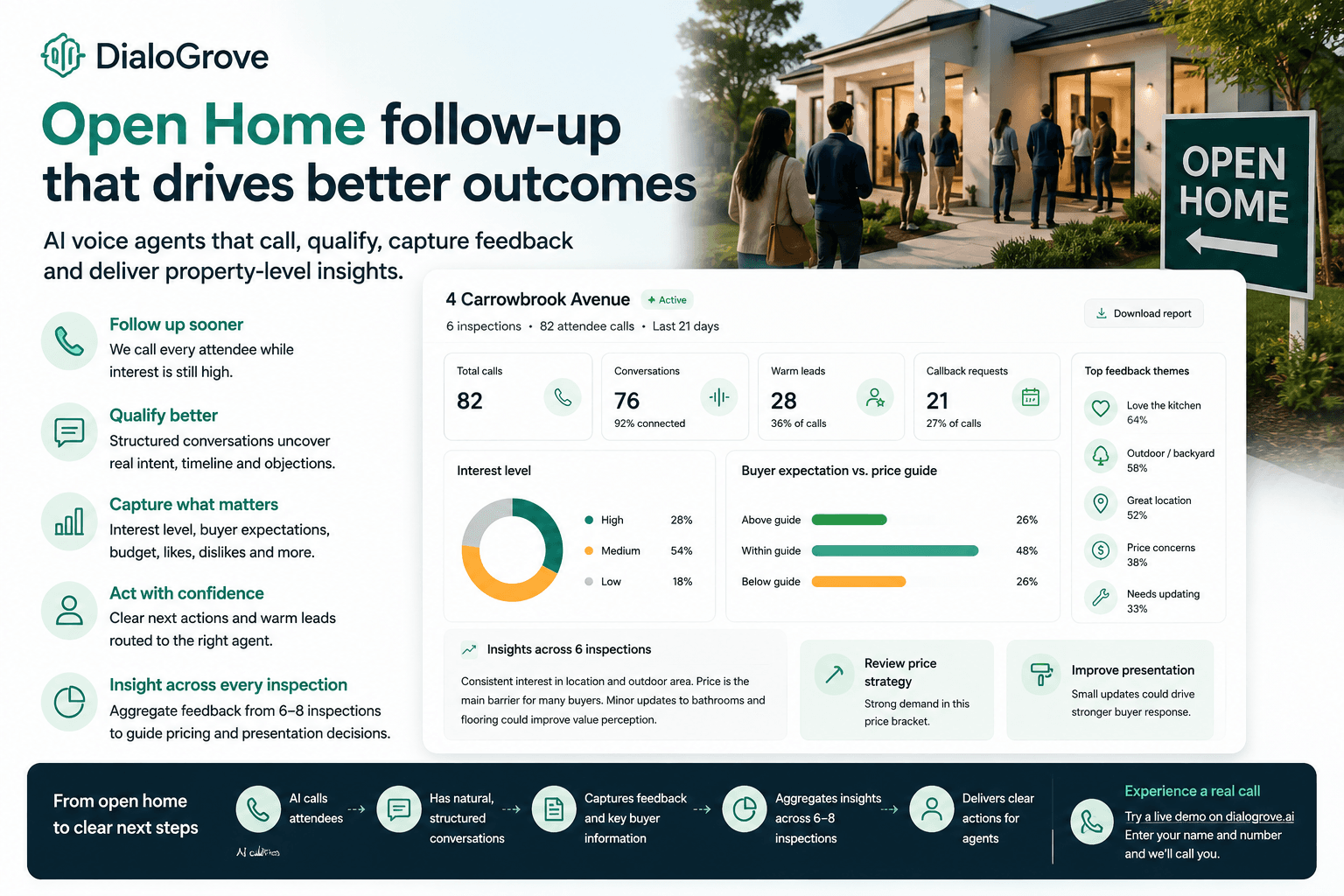
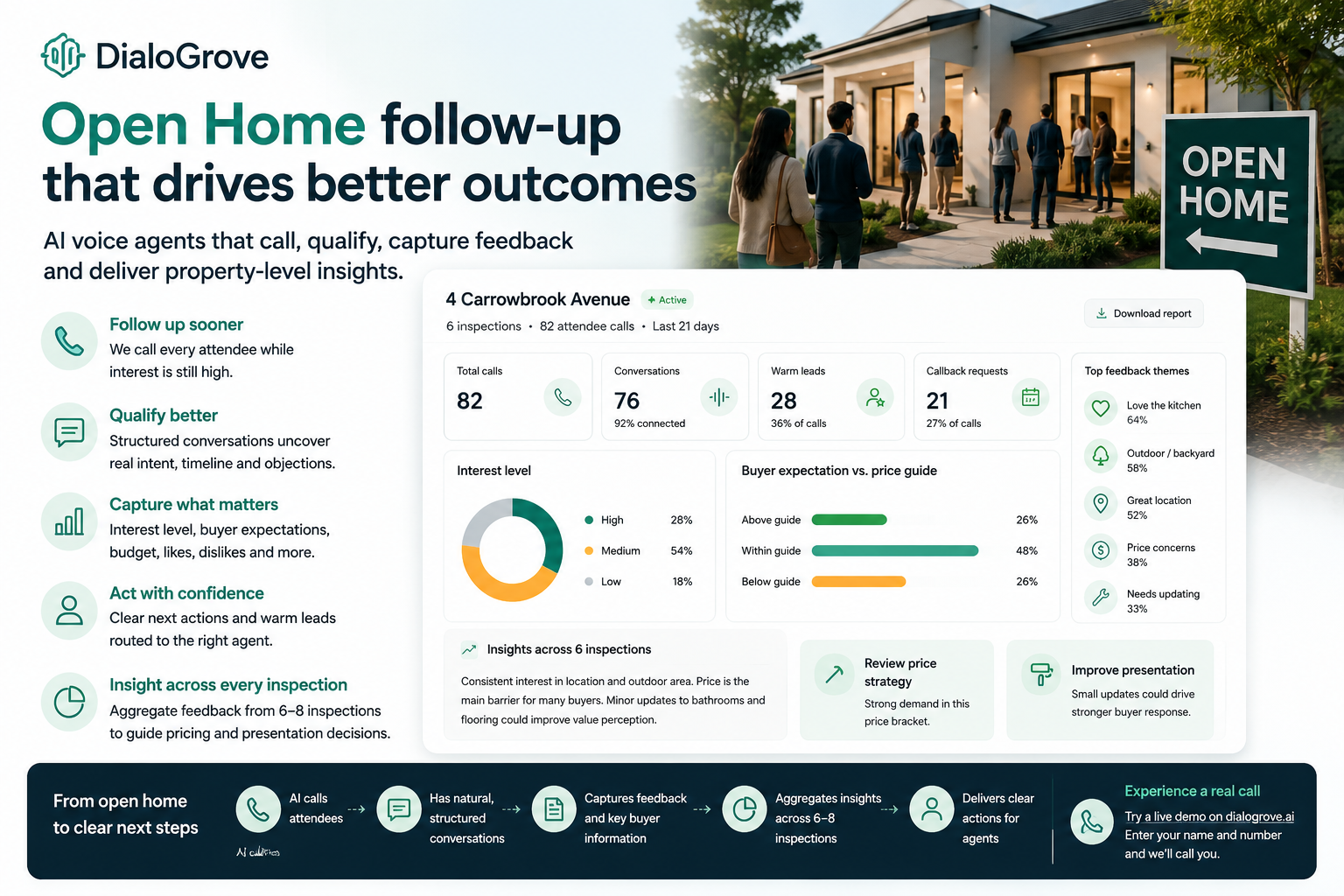
A manual process may produce dozens of individual notes. An operational follow-up system should produce property-level intelligence.
For example, after multiple inspection campaigns for the same listing, the team should be able to see:
- linked campaigns for the property
- how many attendees were targeted
- how many calls were attempted
- how many calls were completed
- call outcomes
- lead temperature
- interest level
- buyer intent
- recommended next actions
- price sentiment
- property fit
- common objections and concerns
- most liked features
- most disliked features
- requested improvements
- other suburbs of interest
- buyer value expectations against the current price guide
This changes the value of follow-up.
Instead of the agency only knowing that calls happened, the team can understand what the market is saying. Across six to eight inspections, this can become a much stronger signal than a handful of disconnected comments after one weekend.
That is useful for:
- listing agents
- vendor updates
- buyer management
- campaign strategy
- price guide discussions
- future prospecting
- matching buyers to other properties
- improving inspection follow-up quality
Open home follow up becomes a feedback engine, not just a calling task.
How DialoGrove approaches open home follow up
DialoGrove is built around AI voice playbooks for lead follow-up and qualification. The Open Home follow-up playbook is designed for the specific workflow that happens after a property inspection.
The aim is not to replace the agent. It is to handle the repeatable first-touch follow-up, capture structured buyer feedback, and give the team clear next actions.
In a typical DialoGrove open home workflow:
- The agency creates an Open Home follow-up campaign.
- The campaign is linked to a property or listing focus.
- Property context is added, such as address, suburb, inspection date, auction date, and price guide.
- The audience is selected, such as attendees from a recent inspection.
- DialoGrove checks whether required context is available before calls go out.
- The AI voice agent calls attendees using the open home playbook.
- Each call captures structured feedback and call outcomes.
- The results are aggregated at the property level.
- The team can review interest, buyer temperature, value expectations, objections, and next actions.
That means one property can have multiple inspection campaigns, but the feedback can still roll up into a connected view.
For many listings, useful market feedback does not come from one inspection alone. It builds over several weekends. A property may run six to eight inspections across a campaign, sometimes more if the listing is high-value, the market is slower, or the vendor needs more buyer feedback before making a pricing decision.
In a manual process, that feedback is often split across inspection lists, agent notes, phone calls, CRM entries, and vendor conversations. By the time the team reaches the sixth or eighth inspection, it can be difficult to compare what buyers said in week one with what buyers are saying now.
For example, an agency may run:
- Inspection 1 on Saturday
- Inspection 2 on Sunday
- Inspection 3 the following weekend
- Inspection 4 after a price update
- Inspection 5 before auction week
- Inspection 6 with a new buyer segment
Each inspection can have its own campaign and attendee list. The property focus brings the results together so the listing team can understand the full buyer response across the campaign, not just a single weekend of calls.
What DialoGrove helps real estate teams solve
Faster follow-up
DialoGrove helps agencies contact attendees sooner, while the inspection is still fresh. This is especially useful when weekend volume is high and staff capacity is limited.
Consistent qualification
The Open Home follow-up playbook guides the conversation so attendees are asked a structured set of relevant questions. This reduces variation between callers and improves the consistency of buyer feedback.
Cleaner CRM and call records
Instead of relying on loose notes, DialoGrove captures structured outputs, summaries, outcomes, and next actions. Where integrations are available, this information can support CRM and workflow updates.
Property-level feedback aggregation
This is one of the biggest differences between simple calling and a real follow-up workflow.
DialoGrove can help teams understand feedback across a listing, not only lead by lead. That includes lead temperature, interest level, buyer intent, value expectation, price sentiment, objections, liked features, disliked features, and recommended next actions.
Better vendor conversations
Vendors often want to know what buyers are saying. A structured follow-up workflow gives the agent more than anecdotal feedback.
Instead of saying, "A few people liked it, but some thought it was high," the agent can explain patterns:
- how many attendees were warm
- how many wanted a callback
- where value expectations sit against the guide
- what objections came up repeatedly
- what features buyers liked most
- whether interest is improving across inspections
That creates more credible vendor updates.
Better price guide and campaign decisions
Open home follow up is not only a buyer management process. It can also help the agency understand whether the current price guide, positioning, and campaign strategy are landing with the market.
When buyer value expectations are captured across multiple inspections, the listing team can compare those expectations against the guide. If most attendees are sitting below the guide, that may point to a pricing gap, a need for better buyer education, or a property presentation issue. If expectations are within or above the guide, that gives the agent more confidence in the campaign direction.
This is especially useful across six to eight inspections because the pattern becomes more reliable than a few individual comments. One buyer saying the property feels overpriced may not mean much. Ten buyers across several inspections saying similar things is different.
The same applies to owner feedback. If attendees repeatedly mention presentation, layout, light, garden condition, paint, styling, access, noise, or repairs, the agent has a clearer basis for telling the vendor what could be improved to support a better result. Instead of passing on vague comments, the agent can share consistent themes from actual buyer conversations.
In that sense, open home follow up can support both sides of the sales process:
- buyers get a timely and relevant follow-up
- agents get cleaner next actions
- vendors get more useful market feedback
- the campaign gets better pricing and presentation insight
Clearer next actions for agents
Agents should not have to listen to every recording or interpret vague notes before acting. A good workflow should show who needs attention and why.
DialoGrove helps surface recommended next actions such as nurture buyer, callback required, interested attendee, human review, or no action needed.
Reusable workflows across campaigns
Open home follow up is repeatable. The campaign details may change, but the workflow pattern is similar.
DialoGrove supports this through playbooks and campaign structures that can be reused across properties, inspections, and lead lists.
The role of AI in open home follow up
AI is useful in open home follow up because the task is repetitive, time-sensitive, and structured.
The AI voice agent can make the first-touch call, ask approved questions, capture responses, and route the result.
But the human agent still matters.
A serious buyer may need a personal call. A nuanced objection may need local market knowledge. A vendor conversation still needs judgement. AI should not replace those moments.
The right model is:
AI handles the repeatable first-touch workflow.
Humans handle judgement, relationship, negotiation, and strategy.
That balance is important. It lets real estate teams scale follow-up without losing control.
What to look for in open home follow up software
If you are reviewing open home follow up software or an AI voice solution, look beyond whether it can make calls.
Ask whether it can support the workflow end to end.
Useful questions include:
- Can it identify which property or inspection the attendee came from?
- Can it use property context in the call?
- Can it capture structured buyer feedback?
- Can it classify interest level and buyer intent?
- Can it record buyer value expectation against the price guide?
- Can it surface objections and liked features?
- Can it recommend next actions?
- Can it aggregate results across multiple inspections?
- Can humans review the outcomes?
- Can the team understand why an outcome was assigned?
- Can it support CRM or workflow updates?
- Can it avoid calling people who should not be contacted?
The strongest tools are not just diallers. They are structured follow-up systems.
Common mistakes with open home follow up
Treating every attendee the same
Not every attendee is a buyer. Some are neighbours. Some are early-stage researchers. Some are serious and ready to move.
The follow-up should identify the difference.
Calling without property context
A generic call feels weak. The caller should know the property, inspection date, and reason for follow-up.
Capturing feedback only as free text
Free text is useful, but it is hard to aggregate. Structured fields make feedback easier to compare across attendees and inspections.
Waiting too long
Open home feedback is most useful when collected quickly. Waiting several days reduces recall and weakens buyer intent.
Not aggregating feedback at the listing level
Individual lead notes are not enough. The listing agent needs to see patterns across the property campaign.
Automating without review
Some outcomes should be checked by a person. A strong workflow keeps human review available where it matters.
A practical open home follow up model
A simple model looks like this:
- Capture attendees.
- Link attendees to the property and inspection.
- Call within 24 to 72 hours.
- Ask structured follow-up questions.
- Capture interest, intent, objections, and value expectation.
- Classify the outcome.
- Recommend the next action.
- Aggregate feedback at the property level.
- Send serious buyers to the right human.
- Use the data to support vendor updates and campaign decisions.
This is not a complicated idea. The difficulty is doing it consistently every weekend, across every listing, without overloading the team.
That is why open home follow up is such a useful place for AI voice workflows. The process is repeatable enough to structure, but valuable enough to matter.
Trying a real open home follow up call
For teams that want to understand how this works in practice, DialoGrove also provides a live demo from the website. A visitor can enter their name and phone number at dialogrove.ai and receive a real-time demo call from an AI voice agent.
The point of the demo is not to show a polished video. It is to let someone experience the call flow directly: how the agent opens the conversation, how it asks follow-up questions, and how the interaction feels from the attendee side.
The real test of open home follow up
The test is not whether every attendee gets called.
The test is whether the team knows what happened afterwards.
After each inspection, can the agency answer:
- who is genuinely interested?
- who needs a callback?
- what did buyers think of the property?
- how did buyers respond to the price guide?
- what objections came up?
- what next actions are required?
- what should be discussed with the vendor?
- how has feedback changed across inspections?
If the answer is hidden in scattered notes, missed calls, and agent memory, the open home follow up process is not doing enough.
A better process turns inspection attendance into structured buyer feedback and clear next actions.
Open home follow-up is one part of a wider real estate AI voice workflow that covers seller leads, buyer enquiries, reactivation and missed calls.
For a practical guide to building a structured open home follow-up system, see our Open Home Follow-Up Guide.
That is what open home follow up should be.