How a Phone Lead Follow Up System Should Work
How a phone lead follow up system turns first-touch calls into structured outcomes with playbooks, review queues, routing, and configurable handoff.
A lead comes in at 4:47 pm. Your team is still on calls, someone flags it for later, and by the next morning the prospect has already spoken to a competitor. That gap is where revenue leaks. A good phone lead follow up system is not just about making more calls. It is about making sure the right call happens quickly, captures the right information, and leads to the right next step.
For businesses that rely on phone conversations, follow-up failure usually looks operational before it looks commercial. Leads sit untouched in the CRM. Notes are patchy. Reps qualify differently. Managers cannot tell which enquiries are genuine, which need another attempt, and which should be routed elsewhere. If the process depends on individual memory and manual effort, it will break under volume.
That is the problem DialoGrove is built around. The product is not just a calling tool. It is a workflow-led AI voice platform that helps teams design, run, review, and improve lead follow-up using playbooks, structured outputs, human review, routing, and configurable handoff.
What a phone lead follow up system is really for
At a surface level, the job seems simple: call new leads, recontact old ones, and move deals forward. In practice, the system has to do more than that. It needs to reduce response time, create consistency in qualification, and turn conversations into usable outputs.
That means every call should produce more than a vague note like "keen, call back next week". A proper phone lead follow up system captures fields your team can act on: intent, timing, budget range, service need, location, objections, preferred contact window, and outcome. Without that structure, follow-up remains noisy and hard to manage.
This matters most in lead-heavy businesses where speed and triage affect revenue. Real estate groups, mortgage brokers, appointment-led services, finance teams, and property operators often have more leads than their staff can call properly. The issue is rarely a lack of demand. It is a lack of controlled, repeatable follow-up.
In DialoGrove, this is handled through AI voice playbooks. Instead of asking an AI agent to "call leads" in a generic way, the playbook defines the scenario, the call purpose, the questions to ask, the information to capture, the safe boundaries, and the next actions that should follow.
For example, a real estate team may use one playbook for buyer enquiry follow-up, another for open home follow-up, and another for vendor appraisal enquiries. A mortgage business may use a different playbook for refinance enquiries, purchase leads, or missing-document follow-up. The point is the same: the system should follow the workflow your team actually needs, not force every lead through the same script.
Why most phone follow-up processes fail
The common problem is not effort. It is inconsistency.
One rep calls within five minutes. Another leaves it until the afternoon. One asks useful qualification questions. Another jumps straight to booking. A third logs almost nothing. Over time, the business ends up with a pipeline full of mixed-quality records and no clear view of what should happen next.
There is also the problem of timing. New leads cool quickly. Older leads get ignored because they feel less urgent. Re-engagement lists sit in spreadsheets for months because no one has the capacity to work through them. Even when teams care about follow-up, manual dialling and manual note-taking create a ceiling.
Technology can help, but only if it is tied to a workflow. Throwing leads into a calling tool without defined outcomes, review rules, routing logic, and auditability just creates faster chaos.
This is where a phone lead follow up system needs to be more than a dialler. It should understand the difference between a new inbound enquiry, a missed callback, a dormant lead, a booked appointment request, and a lead that needs human judgement. Each of those scenarios should have a different workflow behind it.
The core parts of a strong phone lead follow up system
A useful system starts with lead intake. Enquiries should enter one place from forms, campaigns, databases, referrals, CRM records, or uploaded lists, with enough context to shape the call. Source matters. So does recency. So do any known data points that help frame the conversation.
From there, the next layer is call logic. Not every lead should get the same treatment. A new inbound enquiry may need immediate contact and light qualification. A dormant lead may need a reactivation approach. A referral may need a more tailored opening. Good follow-up systems reflect the customer journey rather than forcing one script onto every scenario.
The call itself should follow a clear structure. That does not mean sounding robotic. It means making sure the conversation consistently covers key points, captures buying signals, and assigns an outcome. For example, the outcome might be qualified for human handoff, booked, not ready, unreachable, incorrect number, or do not contact. If those outcomes are not defined up front, the process becomes hard to measure and even harder to improve.
Then comes post-call handling, which is where many teams lose momentum. A system should create transcripts, summaries, captured fields, outcome labels, review flags, and next actions automatically wherever possible. Otherwise, the value of the call gets trapped in recordings no one reviews or in notes no one trusts.
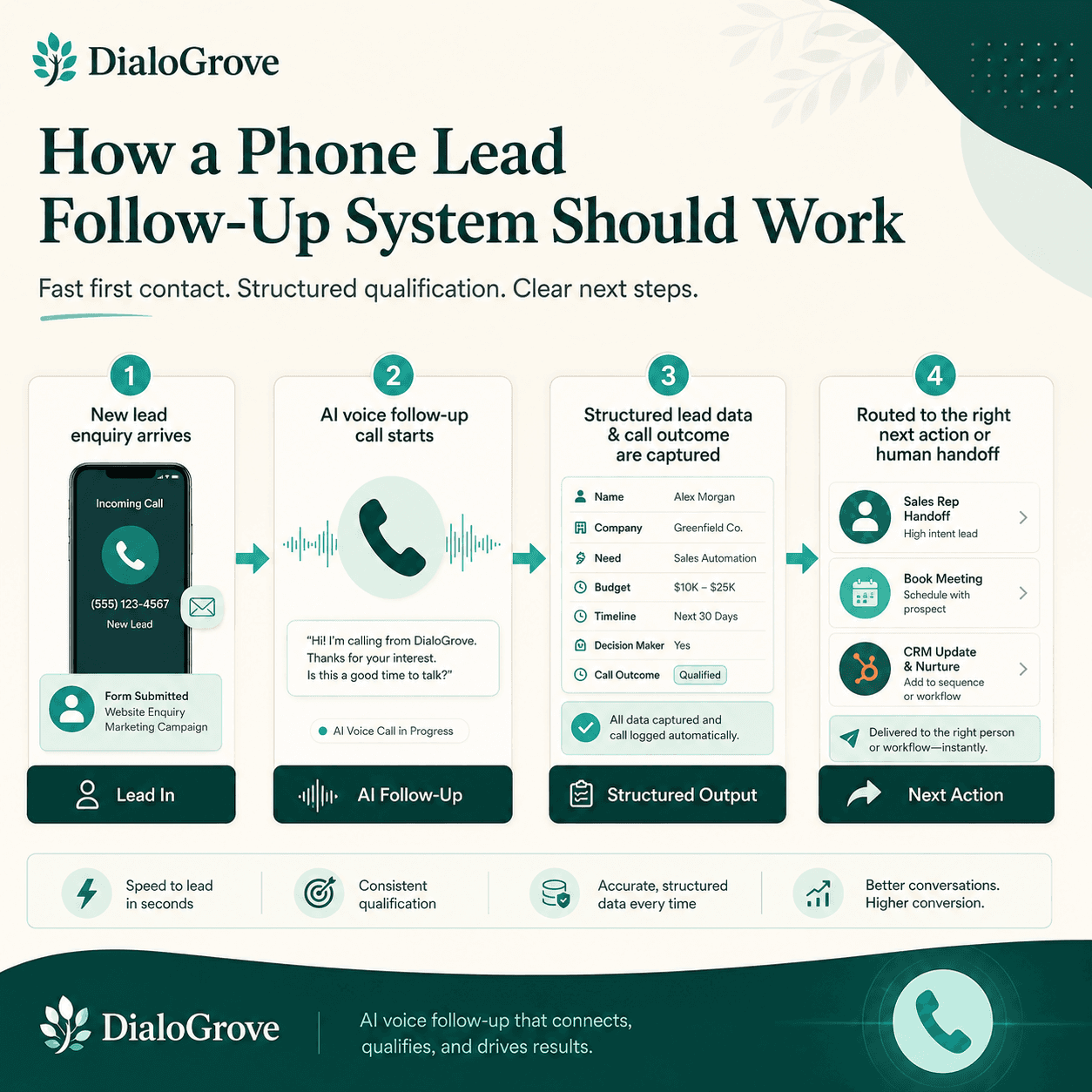
DialoGrove is designed around this full chain:
- Lead enters the workflow.
- The right AI voice playbook is selected.
- The agent makes the first-touch call.
- The conversation is captured and summarised.
- Structured fields are produced.
- The outcome is assigned.
- Review is triggered where needed.
- The lead is routed to the next action.
- The conversation can continue through a handoff when a human, specialist, or another agent is needed.
That last point matters. Follow-up is not always a single call. Sometimes the lead should be transferred or handed over with context preserved. DialoGrove supports conversation continuation with handoff, and this is configurable at the agent configuration level. That allows teams to decide when the AI should continue, when it should route to a person, and how much context should travel with the handoff.
Where AI fits in, and where it does not
AI voice agents can improve a phone lead follow up system, but only when they operate inside clear guardrails. The aim is not to remove humans from the process. The aim is to make first contact faster, qualification more consistent, and call outputs more usable.
This is especially helpful when businesses have lead lists that are too large or too time-sensitive for manual handling alone. An AI voice agent can call promptly, follow a defined workflow, ask approved questions, capture structured responses, and pass the lead to a human when the conversation reaches the right threshold.
That said, not every call should be automated, and not every business needs the same level of automation. High-value, highly nuanced conversations may still need a person earlier in the journey. Sensitive scenarios may require tighter review. It depends on your lead source, your service model, and how much variability exists in your customer conversations.
The safest and most useful approach is controlled automation. That means visibility into what will be asked, what outcomes can be assigned, what triggers human review, how do-not-contact requests are handled, and how the workflow continues after the call.
In DialoGrove, that control is handled through playbooks, agent configuration, review queues, structured outputs, and integration settings. A team can define what the agent is allowed to do, what information it should collect, when to escalate, and what should happen after the conversation. The goal is not a black box. The goal is a repeatable follow-up workflow the business can inspect, trust, and improve.
How to design a phone lead follow up system that actually works
Start by defining the business outcomes before you think about scripts or tools. What counts as a qualified lead in your operation? What information must be captured on every call? What should happen when someone is interested but not ready, asks for a callback, or cannot be reached?
Once those rules are clear, build the call flow around them. Keep it practical. Most businesses do not need dozens of branching paths on day one. They need a reliable opening, a short set of qualification questions, clear call outcomes, and sensible routing.
For a real estate team, that might mean:
- confirming the property or open home the lead enquired about
- understanding buying intent
- capturing preferred suburbs
- asking about budget range
- checking buying timeframe
- noting finance position
- routing high-intent leads to a consultant
- flagging uncertain or sensitive calls for review
For a mortgage team, the same phone lead follow up system might capture:
- purchase or refinance intent
- borrower timeline
- current lender or situation
- employment type
- document readiness
- urgency
- preferred callback time
- whether a broker handoff is needed
For a home services business, the workflow could focus on location, job type, urgency, budget range, availability, and booking suitability.
The industry changes, but the pattern stays the same. The system should turn the call into structured information and a clear next action.
Next, decide where human oversight belongs. Some teams want every booked opportunity reviewed. Others only want exceptions flagged, such as uncertain outcomes, unusual answers, missing information, or signs that the lead should be prioritised. There is no single correct setup, but there should be a deliberate one.
You also need reporting that reflects operations, not vanity metrics. Total calls made means very little on its own. Better measures include speed to first call, contact rate, qualified rate, callback requested rate, booked rate, review rate, and how many records end the day with a clear next action. Those numbers tell you whether follow-up is getting cleaner or just busier.
What to look for in the system you use
A good platform should help you launch quickly without forcing you into a black box. Ready-made playbooks are useful because they reduce setup time, but they still need to be visible and adjustable. You should be able to see the workflow, test it, review draft behaviour, and understand what the system will capture.
Structured outputs matter just as much as call performance. If the result of a conversation is a transcript, a summary, captured fields, buying signals, and a defined outcome, your team can act. If the result is just another recording, your process still depends on someone listening back later.
Routing is another key part of a phone lead follow up system. A qualified lead should not sit in limbo after the call. It should move to the right person, queue, booking step, review process, or nurture workflow. If a conversation needs to continue, the handoff should preserve context so the lead does not need to repeat everything.
That is one of the reasons DialoGrove treats conversation continuation and handoff as configurable workflow behaviour. The team can decide whether a lead should stay with the AI agent, move to a human, be routed to a specialist, or be placed into a review queue. For real businesses, that flexibility matters more than a generic "call completed" status.
Integrations also matter. A phone lead follow up system should not create more admin after the call. Where supported, the output should flow into the tools the team already uses, such as CRM and calendar workflows. If a supported integration is not available yet, the important thing is that the platform captures the structured output cleanly enough to connect it later.
Why playbooks are better than loose prompts
A lot of AI calling tools start with a prompt. That can be useful for testing, but it is not enough for a serious phone lead follow up system.
A prompt may describe what the agent should say. A playbook defines how the workflow should operate.
A strong playbook covers:
- the use case
- the opening context
- required qualification questions
- optional discovery questions
- structured fields to capture
- allowed outcomes
- review triggers
- routing rules
- handoff behaviour
- guardrails
- post-call actions
That structure makes the workflow easier to launch, easier to review, and easier to improve. It also helps avoid the common problem where an AI agent sounds fine on the call but produces an output the team cannot use.
DialoGrove is built around this playbook-led approach. Real estate, mortgage, and other lead-heavy teams can start with a workflow that fits a known scenario, then adjust it for their own process. That is a better foundation than asking teams to build a reliable follow-up operation from a blank prompt.
The real test: can your team trust the output?
That is the question most businesses should ask. Not whether a system can place calls, but whether the outputs are accurate enough, structured enough, and visible enough to support decisions.
If your sales manager cannot tell why a lead was marked qualified, if your ops team cannot review what happened, or if your reps still need to redo discovery from scratch, the follow-up system is not doing its job. The best systems reduce ambiguity. They do not create more of it.
A phone lead follow up system should give your team fewer loose ends, not more. Faster first contact matters. So does consistency. But the real gain comes when every conversation leaves behind something useful: a clear outcome, a reliable record, and an obvious next step.
That is how follow-up stops being a daily scramble and starts becoming an operational advantage.
Where DialoGrove fits
DialoGrove is designed for lead-heavy teams that need faster first-touch follow-up without losing control of the process.
It brings together:
- AI voice agents
- playbook-led call workflows
- structured call outcomes
- transcripts and summaries
- human review queues
- configurable handoff and conversation continuation
- CRM and calendar workflow integrations where supported
- routing and next-action logic
- auditable call records
The product is starting with real estate because the follow-up problem is clear: buyer enquiries, open home attendees, vendor appraisal requests, rental inspection leads, and dormant databases all need consistent follow-up. But the platform itself is broader. The same workflow model can support mortgage, home services, education, healthcare intake, and other lead-heavy businesses.
If your current process still depends on delayed callbacks, scattered notes, and individual memory, the answer is not only to make more calls. It is to build a phone lead follow up system that makes every call easier to trust, route, and act on.