Real Estate AI Calling Assistant That Works
How a real estate AI calling assistant helps teams follow up buyer enquiries, open home attendees, seller appraisals, and database leads with structured workflows.
A property lead goes cold faster than most teams want to admit. The enquiry comes in after an open home, from a property portal, or from a form on a listing page. Someone means to call. Then the day fills up, priorities shift, and by the time follow-up happens, the buyer has moved on or the seller has booked another agent meeting.
That is where a real estate AI calling assistant can be useful. Not as a gimmick. Not as a replacement for agents. And not as a black-box dialler making calls for the sake of activity. The value is in controlled, structured follow-up that helps real estate teams respond faster, qualify more consistently, and understand what should happen next.
In real estate, the problem is rarely lead volume alone. It is inconsistent speed, uneven qualification, and poor visibility after the call. One rep leaves detailed notes. Another writes two words in the CRM. One prospect gets three attempts. Another gets none. If you are managing buyer enquiries, seller appraisals, reactivation lists, rental leads, or post-inspection follow-up, those gaps create waste.
A good real estate AI calling assistant should make follow-up easier to trust, not harder to manage.
What a real estate AI calling assistant should actually do
A useful calling assistant for real estate should do more than place calls and produce a transcript. It should work through a clear workflow with defined outcomes. That means asking the right questions for the lead type, capturing structured fields, identifying buying or selling signals, and assigning a sensible next action.
For a buyer enquiry, that might mean confirming suburb interest, budget range, buying timeframe, finance status, inspection intent, and whether the lead wants a callback from an agent. For a seller lead, it might mean capturing property type, likely sale timeframe, current agent status, motivation, and whether an appraisal should be booked.
For an open home follow-up, the call needs even more property-specific context. The assistant should know which inspection the person attended, which property they saw, the suburb, the inspection date, and any relevant campaign context such as an auction date or price guide. Without that, the conversation can feel generic and the output becomes less useful.
The point is not to make the AI sound clever. The point is to move the lead forward in a way your team can act on.
This is where many teams get caught out. They trial AI calling with a generic script, then wonder why the output is messy. Real estate workflows are not generic. A portal enquiry, a dormant database contact, an open home attendee, a landlord enquiry, and a seller appraisal lead each need different logic, different questions, and different call outcomes.
That is why DialoGrove is built around real estate playbooks rather than blank prompts. A playbook defines the job the agent is meant to do, the information it needs, the fields it should capture, and the next actions available after the call.
Why speed matters, but structure matters more
Fast follow-up matters in property because intent fades quickly. A buyer who enquires on Saturday morning is often comparing several listings. A seller asking for a market update may already be speaking with two agencies. If your first response arrives late, you are starting behind.
But speed on its own is not enough. Calling quickly with no structure just creates a different mess. You may reach more people, but if the conversation does not capture useful information, your agents still have to re-qualify the lead from scratch. Worse, they may call without context and ask the same questions again, which makes the business feel disjointed.
The better approach is speed with usable outputs.
After the call, your team should be able to see what happened, what was captured, what signals matter, and what needs to happen next. That could be an appointment request, a warm handoff, a review queue item, a nurture path, or a follow-up task for the right person.
In DialoGrove, this is where structured outputs become important. The call is not treated as a loose conversation that ends in a vague note. It becomes a structured record your team can review, route, and act on.
For real estate teams, that can include:
- buyer intent
- budget range
- preferred suburbs
- buying timeframe
- finance position
- property interest
- inspection feedback
- seller motivation
- appraisal readiness
- lead temperature
- recommended next action
- review flags
- callback preference
This matters because the output of the call is what your team actually uses.
Where real estate teams usually see value
The strongest use cases for a real estate AI calling assistant tend to be the least glamorous ones. They are the workflows that happen every day, create a lot of admin, and are easy to do inconsistently when the team is busy.
Open home follow-up
Open home follow-up is one of the clearest examples.
After an inspection, a team may have a list of attendees, handwritten notes, portal activity, and a few high-intent buyers who need attention quickly. The problem is not just calling them. The problem is understanding what each attendee thought, how serious they are, what price expectation they have, and what the next step should be.
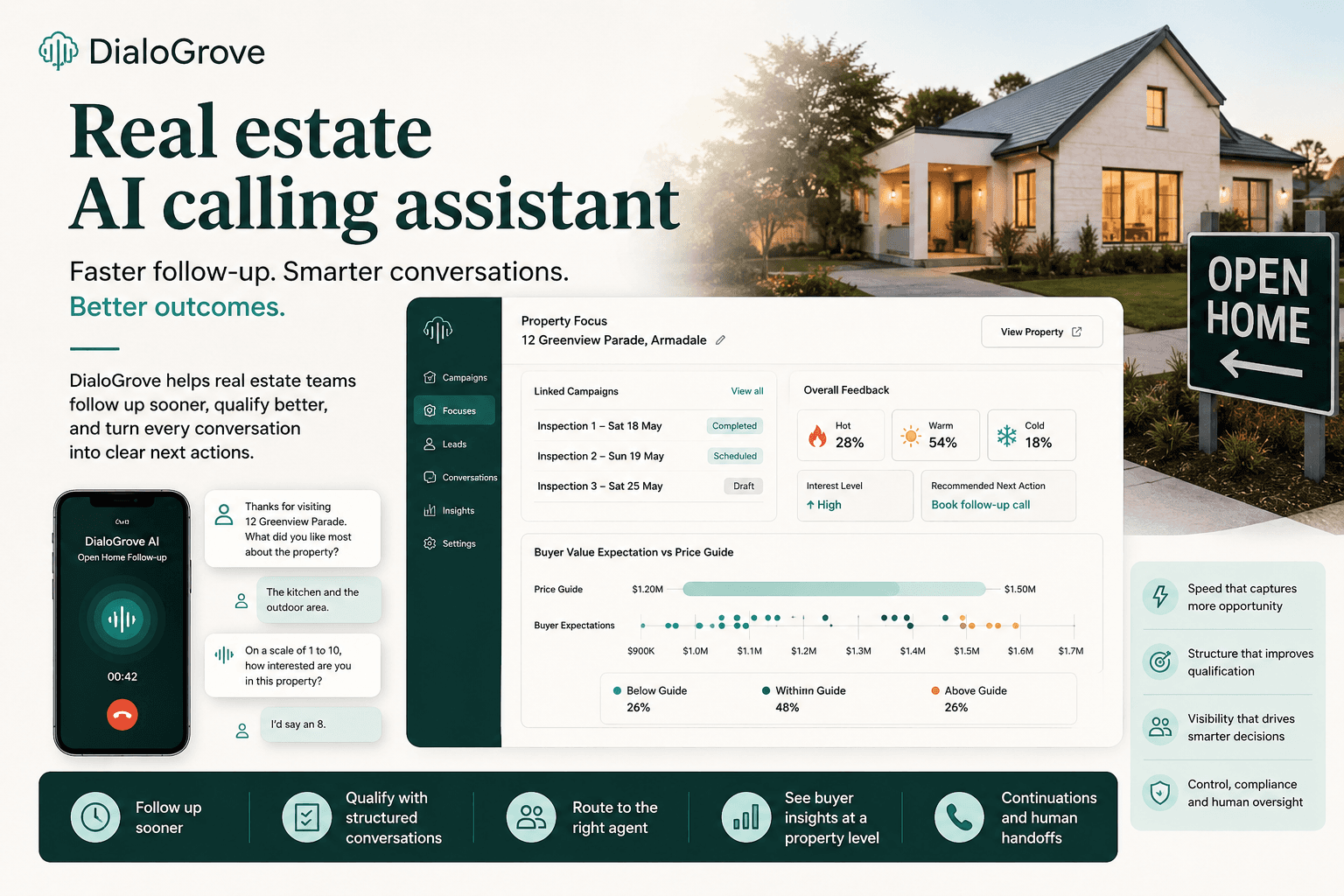
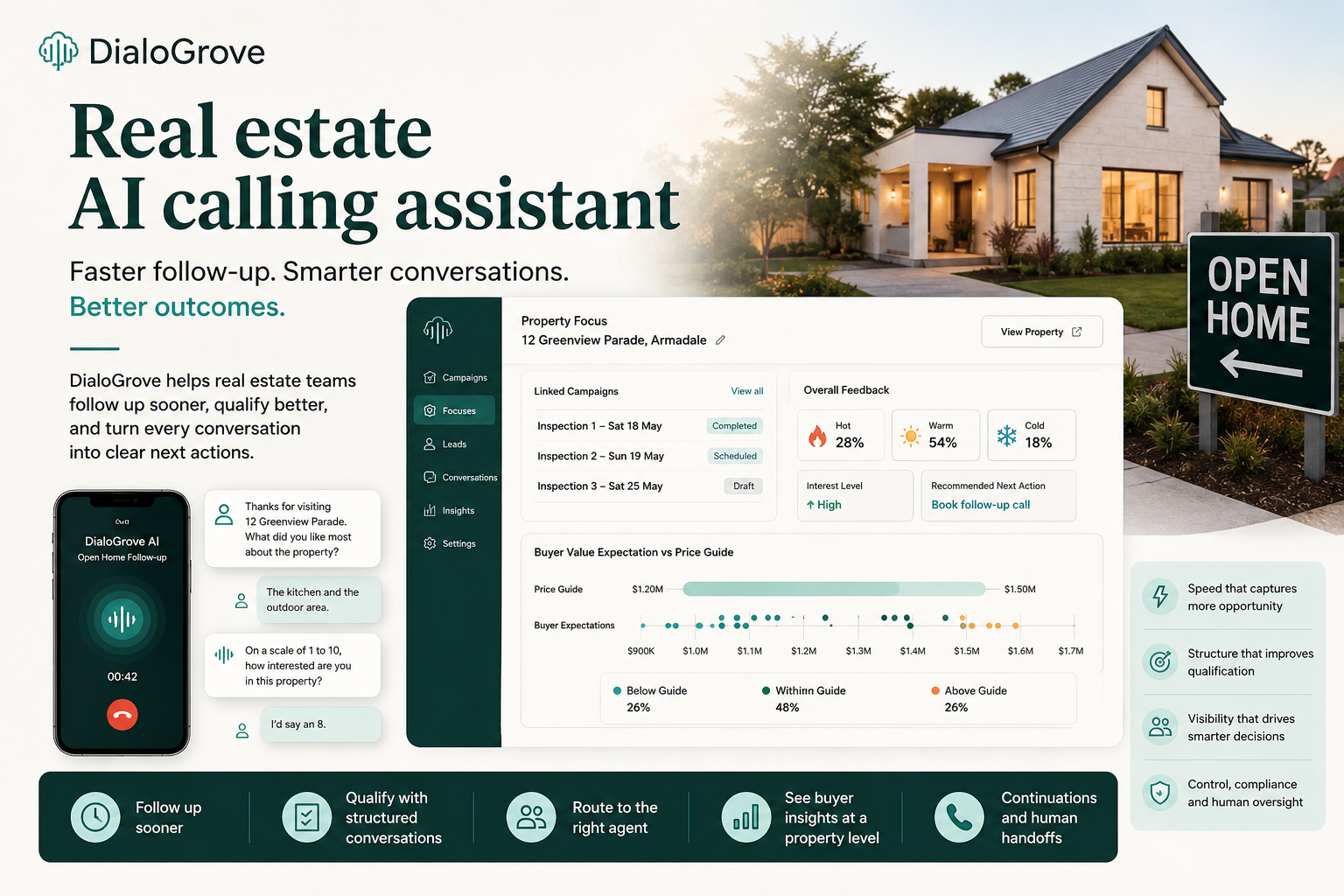
In DialoGrove, an open home follow-up campaign can be linked to a property or listing focus. That matters because a single property may have multiple inspections. One campaign may run for Inspection 1, another for Inspection 2, and another for Inspection 3. The campaign is the follow-up run. The property focus is the connected listing view that brings the feedback together.
That property-level view can become much more useful than a set of isolated calls. It can show linked campaigns, audience activity, buyer feedback, interest levels, lead temperature, recommended next actions, and buyer value expectations compared with the price guide.
For an agency, that means open home follow-up can become listing intelligence. Not just "who did we call?" but "what is the market telling us about this property?"
Buyer enquiry follow-up
Buyer enquiries are another obvious use case. A buyer asks about a listing, books an inspection, or responds to an ad. The real estate AI calling assistant can make first contact quickly, confirm what they are looking for, capture buying criteria, and decide whether the lead should be routed to a consultant, placed into nurture, or flagged for review.
The goal is not to replace the agent. It is to reduce the chance that good buyer intent disappears because the team was busy.
Seller appraisal enquiries
Seller leads need more care, but they can still benefit from structure. A calling assistant can help identify whether the person is a homeowner, where the property is, when they may sell, whether they are speaking with other agents, and whether they want an appraisal or market update.
A strong seller opportunity should still move to a human quickly. The assistant's role is to capture enough context so the agent starts the conversation prepared.
Database reactivation
Most agencies have old leads sitting in the CRM with little chance of being worked manually. A controlled AI voice workflow can re-engage past buyers, previous appraisal requests, older vendor leads, rental contacts, or dormant enquiries and sort genuine opportunities from noise.
This is a practical fit because the volume is often too high for manual follow-up, but the potential value is still there.
Rental and property management enquiries
Rental inspection follow-up, landlord enquiries, and property management leads can also benefit from structured first-touch calling. These workflows need different questions and outcomes from sales campaigns, which is why the playbook matters.
The difference between useful automation and black-box calling
A real estate AI calling assistant becomes risky when nobody can explain what it will ask, how outcomes are assigned, or when a person is meant to review the result. That is how teams lose trust internally and create a poor customer experience externally.
Controlled automation looks different.
You should be able to review the call logic, test the workflow before going live, decide which fields are captured, and define where human oversight sits. You should know how do-not-contact requests are handled, how edge cases are escalated, and what happens when the assistant cannot confidently classify the conversation.
This level of control matters in real estate because lead quality is mixed. Some contacts are ready now. Some are browsing. Some are not the right fit. Some have already spoken to your office. Some ask questions that require local knowledge or a licensed professional.
Good AI voice software should not try to force every conversation through the same path. It should route, pause, continue, or hand off depending on what happens.
DialoGrove supports this kind of workflow-led approach through configurable agents, playbooks, structured outcomes, review queues, and handoff behaviour. Conversation continuation with handoff can be configured at the agent level, so a workflow can move from AI-led qualification to the right human or specialist path when that makes sense.
That distinction is important. Real estate teams do not need an AI that pretends to handle everything. They need an assistant that knows its job, captures the right context, and hands over cleanly when the next step needs a person.
How conversation continuation and handoff should work
In many real estate workflows, the first call does not need to solve everything. It needs to understand enough to route the lead properly.
A buyer who is casually researching may need nurture. A buyer who is pre-approved and interested in a specific property may need a callback from the listing agent. A seller who wants an appraisal this week may need a direct handoff. An open home attendee who raises a pricing objection may need to be flagged for review before the team responds.
That is where conversation continuation and handoff become valuable.
A real estate AI calling assistant should be able to continue the workflow without losing context. If the next step is a human callback, the agent should receive the summary, captured fields, outcome, and reason for the handoff. If the next step is another specialist agent or workflow, the conversation context should move with it.
This prevents the customer from feeling like they have to start again. It also helps the team avoid repeated discovery questions.
For example, after an open home call, the system might capture that a buyer liked the location, thought the price guide felt high, has finance pre-approval, and wants to attend another inspection. The next action should not be a vague "call back". It should be a clear handoff with the buyer's context and recommended follow-up.
How to assess a real estate AI calling assistant
If you are evaluating options, start with operations rather than novelty.
Ask whether the system supports your actual lead flows. Can it handle separate playbooks for open home follow-up, buyer reactivation, seller qualification, inbound discovery, rental enquiries, and appointment booking? Can it produce structured outputs your team can use without listening back to every call?
Then look at visibility. You need transcripts, recordings, summaries, captured fields, and outcome tags that are easy to review. If the only output is a general conversation log, your operators will still be doing manual interpretation after every call.
Testing matters as well. Before any workflow reaches live leads, you should be able to run draft scenarios, hear how the call sounds, and adjust the logic. That helps avoid the common problem where a script looks fine on paper but fails in a real conversation.
Finally, assess the handoff. A real estate business does not need more calls for the sake of calls. It needs clear next actions. That might be sending a qualified seller lead to the listing agent, routing a warm buyer to the sales team, continuing the conversation through another agent, or flagging an uncertain result for review.
If the platform stops at the transcript, it is not solving the whole problem.
What good implementation looks like
The best rollout is usually narrow at first. Pick one lead type with obvious follow-up gaps and measurable value. For many real estate teams, open home follow-up is a strong starting point because the workflow is frequent, time-sensitive, and rich with buyer feedback.
Keep the first workflow focused. Decide exactly what the call should achieve, what property context is required, what data needs to be captured, and what counts as a successful outcome.
For open home follow-up, that may include:
- which property or listing the attendee visited
- inspection date
- auction date if relevant
- buyer interest level
- price expectation
- finance position
- preferred next step
- whether they want a callback
- whether the result needs human review
From there, review real conversations closely. Not just answer rates, but whether the questions were appropriate, whether the outcomes were accurate, whether the captured fields were useful, and whether the handoff helped the team work faster.
Real estate teams often learn quickly that a shorter call with cleaner outcomes performs better than a longer script trying to do too much.
It also helps to involve the people who will receive the outcomes. Agents and operations staff know which notes are actually useful and which tags mean nothing in practice. Their input improves the workflow and increases trust in the system.
This is one reason platforms like DialoGrove focus on ready-made, reviewable workflows rather than a blank prompt and wishful thinking. In phone-based lead handling, good structure usually beats open-ended experimentation.
Why property-level feedback matters after open homes
Open home follow-up is not only about individual lead qualification. It can also help the agency understand the listing.
When buyer feedback is captured consistently, the team can start to see patterns:
- Are buyers warm or cold after inspection?
- Are they objecting to price, layout, location, or timing?
- How do their value expectations compare with the price guide?
- Which buyers need immediate follow-up?
- Which campaign or inspection generated stronger interest?
- What should the listing agent know before the next vendor conversation?
This is where the workflow becomes more strategic. A collection of follow-up calls becomes a property-level feedback loop.
In DialoGrove, that is the idea behind linking campaigns to a property focus. A property can have multiple inspection campaigns, and the feedback can roll up into a connected view. That gives the team a clearer way to understand buyer sentiment across the listing campaign, not just one call at a time.
The real question is not whether AI can call
AI can call. That is no longer the interesting part.
The real question is whether those calls fit your operating model, improve response time without lowering quality, and leave your team with clearer actions than they had before.
For real estate, that means staying practical. Use AI voice workflows where consistency, speed, and structured qualification matter. Keep humans close to the moments that require judgement, trust, and local market nuance. Make sure the workflow can continue or hand off when the conversation needs a person.
If you get that balance right, a real estate AI calling assistant stops being a novelty and starts becoming part of a better follow-up system.
The best test is simple: after each call, does your team know what to do next, and do they trust the information enough to act on it?
For the broader real estate AI voice strategy, see our guide to AI voice agents for real estate.
For the operational playbook on open home follow-up, see our Open Home Follow-Up Guide.
For a dedicated guide to seller lead qualification strategy, see our seller qualification pillar.
For a dedicated real estate workflow on waking up old contacts, see our past buyer reactivation guide.
That is the standard a real estate AI calling assistant should meet.