Buyer Enquiry Follow-Up Process: From First Response to Useful Handoff
Build a buyer enquiry follow-up process with fast response, clear ownership, structured qualification, buying signals and defined agent handoffs.
In this guide
- Why the first call is about preserving intent, not completing the sale
- How to qualify without interrogating the buyer
- How to capture buying signals and route every outcome to a clear owner
Buyer Enquiry Follow-Up Process: From First Response to Useful Handoff
A buyer who submits an enquiry at 8:45 am and hears nothing until the next day has already formed an impression of your business. They may still be interested, but their attention has moved on. A reliable buyer enquiry follow-up process closes that gap by making the first response prompt, the conversation useful, and the handoff clear.
For property, finance and appointment-led teams, this is not simply a sales issue. It is an operational one. Enquiries arrive through forms, portals, campaigns, referrals and old databases. Without clear ownership and a consistent calling workflow, the best opportunities are often the ones that disappear quietly into a CRM.
For a broader view of how AI calling workflows fit into property operations, see AI calling workflows for property teams.
The buyer enquiry journey at a glance
A practical process is:
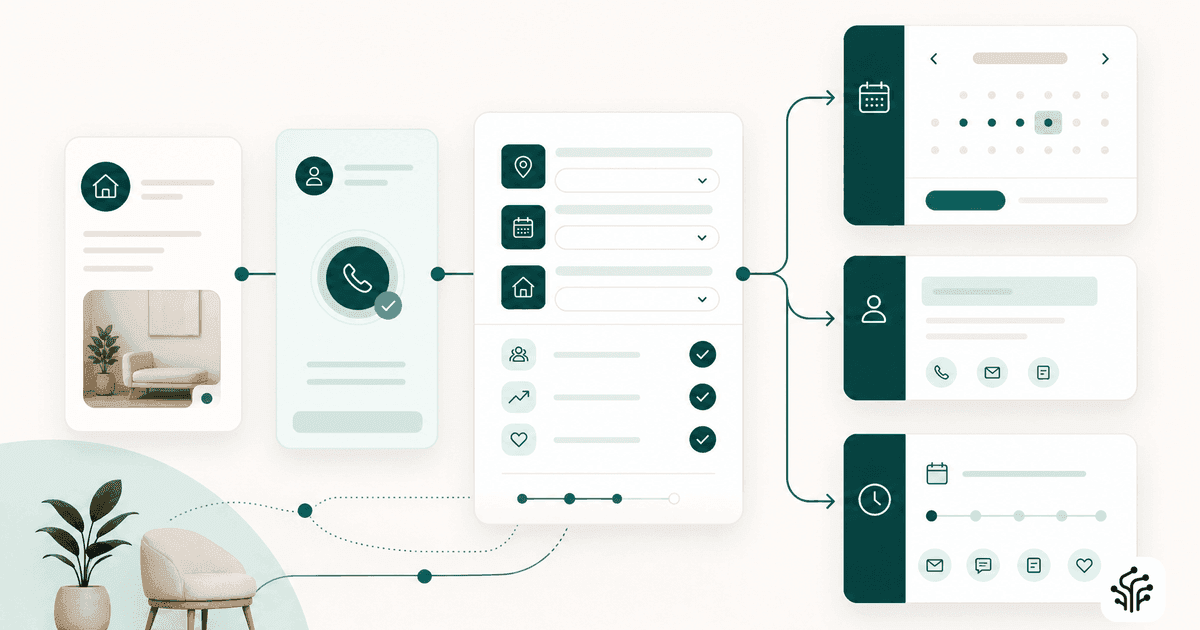
enquiry → ownership → first response → qualification → buying signals → outcome → handoff or nurture
The first call is not meant to complete the sale.
Its job is to establish enough context for the right next action while the buyer's intent is still fresh.
Start with the outcome, not the call
Many follow-up processes begin with a vague instruction: call every new lead. That is a task, not a process. Before anyone calls, decide what a successful first conversation should produce.
For a buyer enquiry, the outcome may be a booked inspection, a qualified lending discussion, a callback at a confirmed time, or a clear reason to pause contact. The right outcome depends on the business and the enquiry source. A website form asking for an appraisal response needs a different conversation from a buyer who has requested details about a specific listing.
The aim of the first call is usually not to force a decision. It is to establish whether there is genuine intent, capture the information needed to help, and make the next step easy to complete. When teams design around those outcomes, calls become more focused and CRM records become more useful.
Respond while the enquiry is still active
Speed matters because buyer intent fades quickly. A person may make several enquiries in one sitting, then take a meeting, collect the kids or simply forget which business they contacted. The first suitable response should happen as soon as practical within your approved contact rules and the customer's stated preferences.
Fast should not mean rushed. A prompt call that gives no context, asks random questions or cannot explain what happens next may create more work than it saves. The caller needs the source of the enquiry, the relevant property, product or service, and enough context to open naturally.
If the buyer does not answer, the process should record the attempt and set the next approved action. This may be another call at a different time, a message through the channel they selected, or assignment to a team member. The key is that no lead is left in an ambiguous status such as "called" with no timing, owner or reason.
Give each lead a clear owner
Shared inboxes and pooled lead queues can work, but only when responsibility is visible. Every enquiry should have a named owner or a defined workflow owner, even when the first contact is handled by an operations team or an AI voice agent.
Ownership prevents the common failure mode where two people assume someone else will call. It also makes it possible to measure response time, contact rates and the quality of follow-up by source. If a lead changes hands, record why: territory, expertise, availability, language needs or a requested relationship manager.
Use a consistent qualification structure
Strong qualification sounds like a helpful conversation, not an interrogation. The buyer should understand why you are asking each question: to show relevant options, prepare for an appointment or ensure the right person follows up.
The fields will vary by sector, but a buyer enquiry process often needs to capture what they are looking for, timing, preferred location or product, budget range where appropriate, readiness to act, and the best way and time to continue the conversation. It should also identify practical blockers, such as needing to sell first, uncertainty about finance, or difficulty attending at usual times.
The trade-off is important. Collect too little and the next team member starts from scratch. Collect too much on the first call and the buyer may disengage. Keep first-contact questions limited to information that changes the next action. More detailed discovery can happen once a meeting is booked or a specialist is involved.
Listen for buying signals and friction
A well-run process captures more than form fields. It records what the buyer actually said that may affect priority or approach. Phrases such as "we need to move before school starts", "we have already inspected three places", or "I can only speak after 6 pm" are useful operational signals.
For a deeper discussion of capturing buying signals from conversations, see how to capture buying signals.
Equally valuable are signs that the lead is not ready, is researching broadly or needs information before committing to a conversation. These are not failed calls. They tell the team whether to book, nurture, route or pause.
A short factual summary is more valuable than a long transcript nobody reads. The next person should be able to see the buyer's goal, constraints, agreed next step and any risk of the lead going cold without replaying an entire call.
Turn every conversation into a defined next action
The biggest weakness in many follow-up workflows is not a lack of calls. It is a weak transition from conversation to action. It is a lack of closure after calls. A conversation ends with "we'll be in touch", and the lead returns to a general queue with no date, no owner and no agreed purpose.
Every completed contact should result in one defined outcome. For example, the lead may be qualified and booked, qualified and assigned for personal follow-up, awaiting a buyer-preferred callback, moved into a relevant nurture workflow, or marked as not proceeding. The labels matter less than using them consistently.
Each outcome should trigger a practical action. A booked appointment needs confirmation details. A handover needs an owner and deadline. A callback needs a specific date and time, not a note to "try again later". A nurture outcome needs a reason and a review point, so leads do not remain there forever.
This is where structured workflows make follow-up easier to manage at scale. Instead of relying on each caller's memory and note-taking style, the process requires key fields, applies outcome rules and sends the record to the right queue. DialoGrove can support this approach by turning calls into transcripts, summaries, captured fields and recommended next steps that a team can review.
Build in review, exceptions and contact controls
Automation can improve consistency, but it should not remove judgement. Buyers may raise unusual questions, sound frustrated, request a specific person or ask not to be contacted further. Your workflow needs clear rules for these exceptions.
For how real estate teams use AI voice agents without replacing the agent relationship, see AI voice agents for real estate.
Set review queues for calls that need human attention, such as unclear qualification, a complaint, a high-value opportunity or a request that falls outside the usual script. Review recordings and transcripts regularly, especially in the first weeks after changing a playbook. This shows whether questions are producing useful answers and whether callers are handling edge cases appropriately.
Contact preferences and do-not-contact requests also need to flow into the source of truth quickly. A process is only controlled when those instructions are visible to everyone who may contact the buyer, including future campaigns and reactivation activity.
Measure the points where leads are lost
A buyer enquiry follow up process should be managed with evidence, not assumptions. Start with a small set of operational measures: time to first attempted contact, time to first meaningful contact, contact rate, qualification rate, booked-next-step rate and the proportion of records with a complete outcome.
Look at these figures by enquiry source, time of day, campaign and team. A high volume of low-quality leads may be a marketing issue rather than a follow-up issue. A low contact rate may point to poor timing, incomplete mobile numbers or an unsuitable channel. A healthy contact rate but weak booking rate may mean the script, offer or handover needs work.
Avoid treating every metric as a target in isolation. Pushing callers to finish calls quickly can reduce the quality of qualification. Chasing bookings at all costs can create appointments that do not attend. The better question is whether the process creates enough qualified, well-informed next steps for the sales team to act on.
Keep improving the workflow in small changes
Do not rebuild the whole process after one difficult week. Review a sample of calls, identify one recurring issue and make a controlled adjustment. You may need to change the opening line, move a question later in the conversation, clarify an outcome definition or shorten the handover summary.
Test changes in a draft environment where possible, then monitor their effect on call outcomes and buyer feedback. The best process is not the most complicated one. It is the one your team can follow consistently, audit clearly and improve without losing sight of the customer experience.
When buyer enquiries are treated as structured journeys rather than a list of numbers to dial, speed and quality no longer need to compete. The result is a calmer operation: fewer leads left waiting, better context for the next person, and a clear reason for every follow-up action.