What Is Lead Qualification Automation?
Lead qualification automation helps teams contact, assess and route leads faster using structured workflows, captured fields, transcripts and clear next actions.
In this guide
- Lead scoring is not qualification — the difference between a number and a workflow
- How AI voice agents bring structured conversation into qualification automation
- Why operational clarity matters more than the demo: review queues, captured fields, next actions
A new enquiry comes in at 4:47 pm. Your team is still on calls, someone leaves at 5, and by the next morning that lead has already spoken to a competitor. That is usually where the question starts: what is lead qualification automation, and can it actually help without creating a messy customer experience?
Lead qualification automation is the use of software, rules, and increasingly AI-driven workflows to assess whether a lead is worth progressing, what they need, how urgent they are, and what should happen next. Instead of relying on a sales rep to manually call, ask the same questions, type notes into the CRM, and decide on a follow-up path, the process is handled in a more structured and consistent way.
That does not mean every lead should be pushed through a fully automated funnel. In practice, lead qualification automation works best when it handles the repetitive parts quickly, captures useful information in a standard format, and then routes the lead to the right human, queue, or next action.
It is not just lead scoring
When people ask what lead qualification automation is, they often compare it to lead scoring. That comparison misses most of what matters.
Lead scoring is only one part of qualification automation. A score may tell you which lead looks promising, but it does not ask the questions, capture the context, summarise the conversation, or route the next action.
At a practical level, lead qualification automation is not just scoring. It is a workflow.
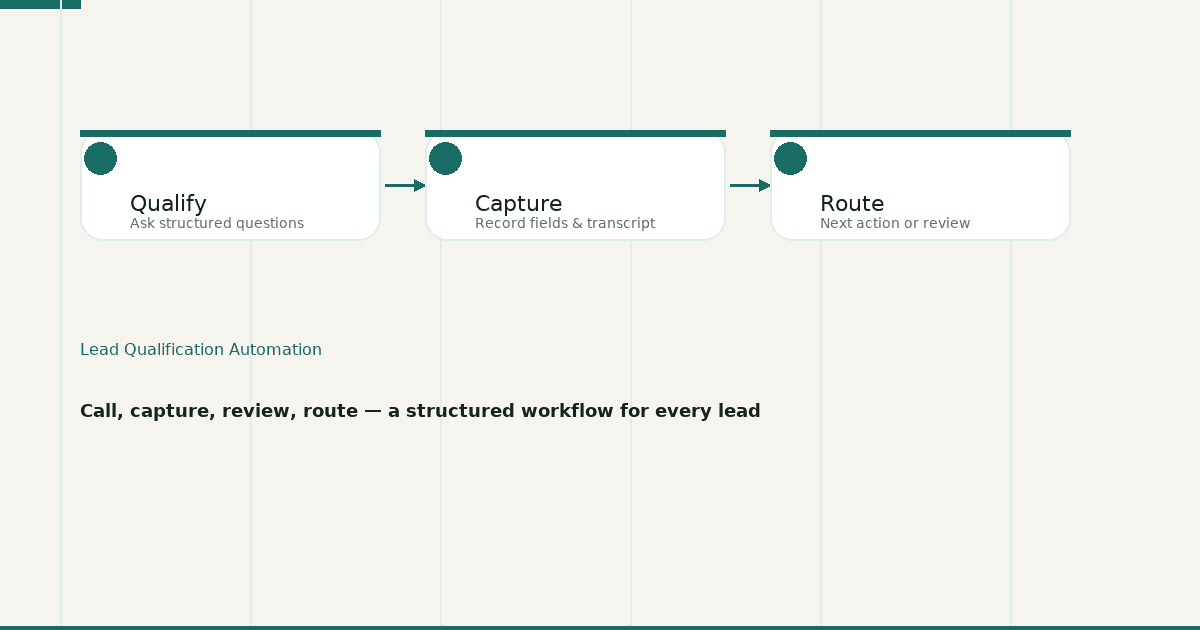
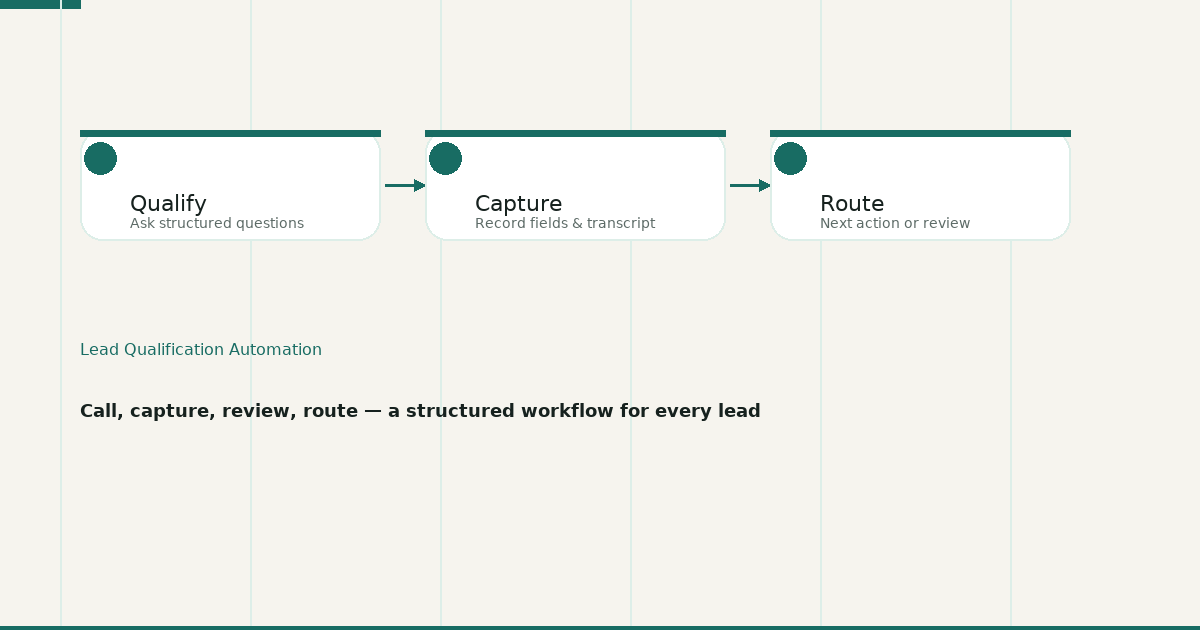
A lead enters the system from a web form, ad campaign, spreadsheet, referral source, old database, or inbound enquiry. The automation then follows a defined process to contact the lead, ask qualifying questions, capture responses, identify signals, assign an outcome, and trigger the next step. That next step might be a booked appointment, a callback task, a nurture sequence, a review queue, or a handover to a salesperson.
| Traditional lead scoring | Lead qualification automation |
|---|---|
| Assigns a score | Captures context and next action |
| Often based on form data | Can include calls, SMS, email or forms |
| Helps prioritise leads | Helps progress leads |
| Usually passive | Actively runs a workflow |
| Can be hard to interpret | Produces structured outcomes |
For businesses that rely on phone conversations, this often includes voice-based qualification rather than just forms and emails. That matters because many leads do not want to fill out long forms, and many important details only come out in conversation. Budget, timing, intent, current situation, and decision-maker status are often clearer on a call than in a checkbox field.
The point is not automation for its own sake. The point is making sure every lead gets a timely, structured, usable first pass.
Why businesses use it
Most teams do not struggle because they have no leads. They struggle because follow-up is inconsistent.
One rep calls straight away. Another waits three hours. Someone asks good questions. Someone else leaves vague notes like "seemed interested" and moves on. A manager looks at the pipeline later and still cannot tell which leads are qualified, which ones need nurturing, and which ones should never have been sent to sales in the first place.
Lead qualification automation reduces that inconsistency. It gives the business a repeatable way to handle the early stage of the lead journey.
That usually improves four things. Speed gets better because outreach can happen faster. Coverage improves because more leads actually get worked. Data quality lifts because information is captured in defined fields rather than scattered across free-text notes. And routing becomes clearer because outcomes are tied to specific next actions.
For high-volume teams, those gains are operational as much as commercial. Better qualification means less wasted rep time, cleaner handovers, and fewer leads going stale while everyone assumes someone else is handling them.
How the process usually works
The exact setup depends on the business, but most qualification automation follows the same basic pattern.
First, the lead is ingested from a source such as a CRM, form, ad platform export, or enquiry list. Then a workflow decides when the lead should be contacted and which qualification path applies. An inbound property enquiry, for example, should not be treated the same way as a dormant database contact or a reactivation lead.
Next comes the actual qualification. That might happen by email, SMS, web form, or phone call. For phone-led businesses, an AI voice agent can ask structured questions, respond within defined limits, and keep the conversation focused on useful business outcomes. It can capture details such as interest level, timeline, location, service need, readiness, or preferred contact time.
After the interaction, the system records outputs. These may include a transcript, call recording, lead summary, captured fields, detected buying signals, call outcome, and recommended next action. From there, the lead can be routed automatically. Hot leads go to a priority queue. Incomplete ones go to follow-up. Low-fit enquiries can be parked or handled differently.
The best systems also include review points. Not every conversation should flow through untouched. Some calls need human checking, especially where answers are unclear, the lead asks unusual questions, or the outcome has higher commercial importance.
What good automation should actually qualify
A lot of businesses make the mistake of automating contact without properly automating qualification. Calling faster is useful, but speed alone does not tell your team what to do next.
A good qualification workflow captures the details that influence action. That often includes need, timing, intent, location, budget range, current situation, eligibility factors, or service fit. It may also identify softer signals such as urgency, frustration with a current provider, readiness to book, or whether the lead is comparing options.
The right questions depend on your sales process. A mortgage broker, real estate group, or appointment-based service business will each define a qualified lead differently. That is why rigid, generic scripts often underperform. The workflow needs to reflect your actual decision points, not someone else's template.
Where automation helps, and where it does not
This is where some of the confusion comes from. Lead qualification automation is useful, but it is not a substitute for judgement.
It is strong at handling repetitive qualification steps, early outreach, consistent question flow, structured note capture, and routing logic. It is weaker when a lead has a complex scenario, wants strategic advice, raises an objection that needs nuance, or sits in a grey area that calls for experience rather than rules.
That trade-off is not a flaw. It is the reason well-designed automation includes guardrails and human oversight. If every edge case is forced through the same path, quality drops. If no part of the process is automated, the team gets buried in manual follow-up.
The sensible middle ground is controlled automation. Use it to handle the volume, surface the right signals, and tee up the next action. Let humans step in where context, trust, or judgement matter most.
What to look for in a lead qualification automation system
If you are assessing options, the main question is not whether a system can contact leads. Most can. The better question is whether it gives you operational control.
You should be able to see what questions are being asked, what data is being captured, how outcomes are being assigned, when human review is triggered, and what happens after the call or interaction. If those parts are hidden, the workflow becomes hard to trust and even harder to improve.
Look for structure rather than novelty. Useful features are things like editable call flows, draft testing, outcome rules, transcript access, captured fields, review queues, do-not-contact controls, and clear routing into your existing process. A flashy demo matters less than whether the workflow produces clean, actionable records your team can actually use.
This is also why many businesses prefer ready-made playbooks over blank-slate tools. Starting with a defined qualification journey is faster, easier to test, and less likely to create inconsistent customer experiences.
Why AI voice is changing the category
For years, lead qualification automation mostly meant forms, scoring models, and email sequences. That still has a place, but it misses something important for phone-led teams: conversation is where qualification often happens.
AI voice agents have changed that by making it possible to run structured, immediate phone follow-up at scale, while still capturing operational outputs from each call. When designed properly, they can help teams respond faster, ask the right questions consistently, and convert conversations into summaries, outcomes, and next steps.
The key phrase there is "when designed properly". AI voice should not be treated as a black box. Businesses need visibility into prompts, fields, outcomes, review logic, and calling controls. That is the difference between automation that supports the team and automation that creates confusion.
This is the model DialoGrove is built around: structured workflows, reviewable outputs, and clear next actions rather than vague AI activity.
The real value is operational clarity
So, what is lead qualification automation really for? It is not just there to save time. Its real value is making the early lead journey more reliable.
When qualification is structured, you know which leads were contacted, what was asked, what was learned, how the lead was classified, and what should happen next. That makes life easier for sales, operations, and customer experience teams alike.
And when the process is visible, reviewed, and tied to real workflows, automation stops feeling risky. It becomes part of a system your team can trust, measure, and improve.
For the readiness framework that determines when a lead should reach a human, see our guide to what makes a lead ready for human follow-up.
For the routing layer that turns qualified outcomes into clear next actions, see our guide to lead routing after qualification.
For a diagnostic look at where lead follow-up workflows quietly break, see our guide to the top lead follow-up workflow mistakes.
For the operational workflow behind faster first contact, see our guide to improving speed to contact.
If your team relies on phone follow-up, start by mapping the first five minutes of the lead journey: who contacts the lead, what gets asked, what gets captured, and what happens next. Read our guide on AI voice agents for real estate to see how structured phone workflows work in practice for one of the most lead-sensitive industries.