How to Improve Speed to Contact Without Sacrificing Lead Quality
Learn how to improve speed to contact by fixing lead intake, assignment, ownership, prioritisation and first-touch workflows without sacrificing lead quality.
In this guide
- 11 practical steps to redesign the workflow so faster contact actually happens consistently
- Why speed to contact is an operating model problem, not a rep performance problem
- How to diagnose delay: trace one lead through arrival → assignment → contact → outcome
A lead enquires at 10:04.
The first call happens at 3:40.
By then, the lead is no longer truly fresh.
They may have spoken to someone else. Their urgency may have changed. They may barely remember what prompted the enquiry in the first place.
When teams ask how to improve speed to contact, the obvious answer is:
Call faster.
That is usually too shallow.
The real problem often sits inside the workflow:
- how the lead enters
- how quickly ownership is assigned
- whether priority is visible
- what happens after the first missed call
- whether the first conversation creates a useful next action
Speed to contact is not just a rep behaviour problem.
It is an operating model problem.
The goal is not to dial as fast as possible.
It is to shorten the time between enquiry and a useful first action.
Why speed to contact breaks down
Most businesses do not lose time in one obvious place.
They lose it in small delays that stack up.
A form submission sits in an inbox.
A lead enters the CRM without an owner.
A rep sees the task but waits until they have time to make a proper call.
The first call goes unanswered.
Nobody knows whether a second attempt happened.
By the time someone reviews the record, the lead has already moved on.
That is why telling a sales team to "respond faster" rarely fixes the underlying problem.
If the process depends on:
- memory
- manual triage
- inconsistent assignment
- ad hoc prioritisation
- vague notes
even good people will struggle to respond consistently.
A better system reduces decision lag.
It makes the first action obvious.
The important trade-off: faster is only better if the contact is useful
There is a risk in treating speed as the only goal.
A rushed first call can still waste the lead.
The caller may:
- know too little about the enquiry
- ask generic questions
- fail to capture useful context
- leave poor notes
- create no clear next step
That simply moves the bottleneck downstream.
The stronger target is:
fast + relevant + structured
A useful first contact should:
- happen at the right time
- match the lead journey
- capture what matters
- end with a defined next action
Speed matters most when it preserves intent and turns it into something the business can act on.
1. Shorten the distance between enquiry and first action
Start by tracing what happens in the first few minutes after a lead enters the business.
Look at every source:
- website forms
- ad leads
- portal enquiries
- referrals
- missed calls
- imported lists
- CRM reactivation campaigns
Then ask:
What happens next, exactly?
Not what should happen.
What actually happens.
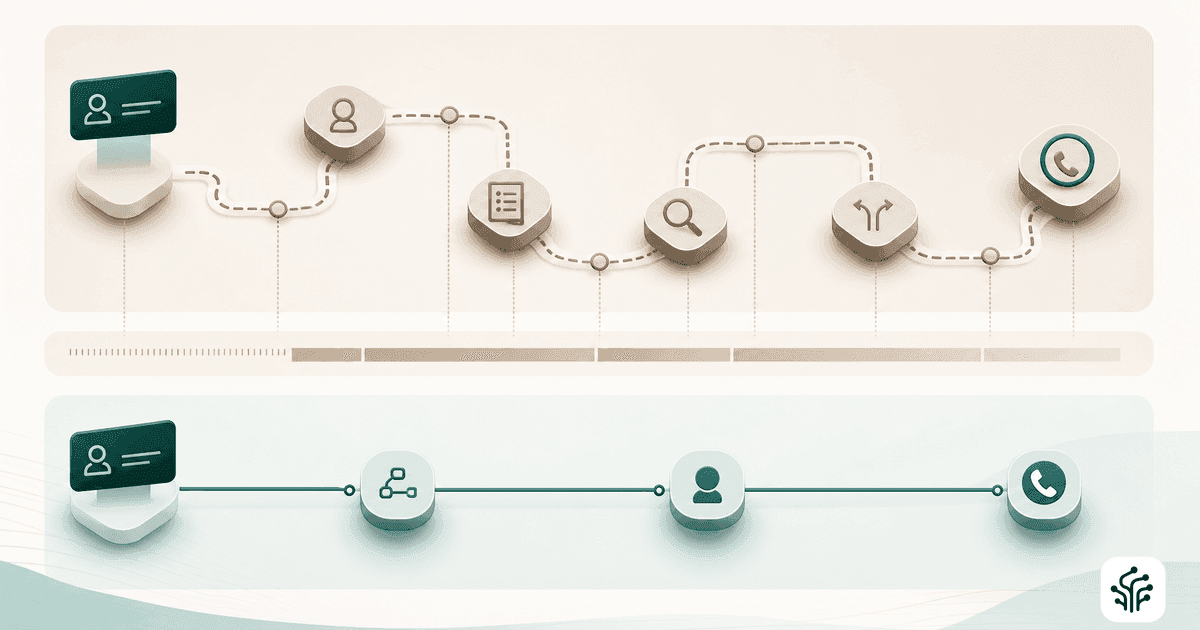
A common pattern looks like:
lead captured → notification sent → someone notices → someone assigns → rep reviews → rep decides what to do → first attempt
Every manual decision adds delay.
A better flow is closer to:
lead captured → journey identified → owner assigned → first action triggered
The fewer ambiguous steps between arrival and action, the more reliable the response time becomes.
2. Give every lead one clear first-touch path
Every new lead should trigger a defined first action.
Not:
Someone should call this.
But:
This lead enters this workflow, with this owner, and this first action.
Depending on the business, the first action might be:
- an immediate call attempt
- a qualification call within a set timeframe
- a scheduled callback
- a structured AI-assisted first touch
- a routed task based on source or urgency
The exact design can vary.
The important part is that the team should not have to decide from scratch every time.
A clear first-touch path removes decision lag.
3. Fix ownership before trying to improve response time
Shared queues often look efficient.
They can also make responsibility vague.
If several people can see the lead, it is easy for everyone to assume someone else will act.
A strong workflow should answer:
- who owns the first action
- when it is due
- what happens if it is missed
Assignment models might include:
- territory
- service type
- round robin
- specialist routing
- campaign ownership
The right model depends on the team.
The principle does not:
one lead → one clear first owner → one immediate next step
Ownership is one of the simplest ways to remove avoidable delay.
4. Use service levels to expose workflow failure
Internal response targets are useful when they reveal where the process is breaking.
For example:
High-intent inbound enquiries should receive a first action within five minutes.
The point is not to create a dashboard target for its own sake.
The point is to make delay visible.
If the target is repeatedly missed, the team can ask:
- Is assignment slow?
- Are leads arriving outside staffed hours?
- Is one source creating a bottleneck?
- Are reps spending too much time preparing?
- Is the first action unclear?
A service level turns a vague complaint into an operational question.
5. Prioritise leads by current intent, not just arrival order
Not every lead deserves the same response sequence.
Some are:
- urgent
- actively comparing options
- ready to book
- asking for a callback now
Others are:
- early in research
- incomplete
- low intent
- better suited to nurture
One of the fastest ways to improve speed to contact is to stop treating every lead as equally urgent.
That starts with enough context to make an early decision.
Useful signals can include:
- enquiry type
- timeframe
- location
- service need
- preferred callback window
- whether there is a clear next action
You do not need to turn the enquiry form into an interrogation.
You need enough information to route the lead into a sensible path.
6. Make the first conversation operationally useful
Fast contact that produces no useful outcome creates another bottleneck.
A strong first conversation should capture:
- reason for enquiry
- current need
- timing
- urgency
- blockers
- readiness
- agreed next action
This is where structured qualification matters.
The goal is not to label someone as simply:
hot
or:
interested
The goal is to create enough context for the next decision.
That might mean:
- route to a person now
- book an appointment
- schedule a later follow-up
- place into nurture
- send for review
For more on the difference between qualification and next action, see how to route qualified leads after the first conversation.
7. Remove manual work from the first-contact window
The first few minutes after a lead arrives should not be consumed by admin.
If the team must:
- search across systems
- copy contact details
- work out which script to use
- check who owns the lead
- find previous notes
- decide what fields matter
the response window is already shrinking.
The first-contact workflow should be stripped back to what matters.
That can include:
- automatic context loading
- clear journey selection
- predefined qualification fields
- visible prior history
- one-click next actions
- structured playbooks
The goal is not more automation for its own sake.
It is less avoidable thinking before the first useful action.
8. Design the first contact around the lead journey
An inbound enquiry should not follow the same process as:
- a dormant database lead
- a missed-call recovery case
- a reactivation campaign
- a previous customer
- a scheduled follow-up
The workflow should match the journey.
That changes:
- timing
- opening context
- questions
- expected outcome
- persistence strategy
Generic scripts tend to create generic conversations.
Better playbooks define a small set of questions tied to business decisions.
For example:
- Is this lead relevant?
- What are they trying to do?
- How soon?
- What is blocking progress?
- Should this be booked, routed, reviewed or nurtured?
A specific workflow makes fast contact easier because the caller does not need to improvise the process.
9. Decide what happens when nobody answers
A fast first attempt is useful.
It is not the whole workflow.
If the first call goes unanswered, what happens next?
A good process should define:
- whether voicemail is left
- when the second attempt happens
- whether another channel is used
- when the lead moves to a later follow-up path
- who owns the next action
Otherwise, the team improves time-to-first-attempt while the lead still disappears after one missed call.
Consistency matters more than heroics.
10. Use automation where it removes delay, not where it removes judgement
AI-assisted first contact can help where teams face:
- fluctuating lead volume
- after-hours enquiries
- slow manual assignment
- repetitive first-touch qualification
Used properly, a structured AI voice workflow can:
- make an immediate first attempt
- follow a defined conversation path
- capture required fields
- record a clear outcome
- pass context to a human
The value is not simply speed.
It is speed with structure.
But automation should not become a black box.
Teams should still be able to see:
- what the system asked
- what it captured
- which outcome it assigned
- why a lead was escalated
- where a human review is required
For a broader view of reviewability, see how human review queues for AI calls should work.
11. Measure the full chain, not just response time
Time-to-first-attempt matters.
It does not tell you whether the workflow is good.
A stronger measurement chain is:
lead arrival → first attempt → first conversation → qualification outcome → next action
Useful measures include:
- time-to-first-attempt
- time-to-first-conversation
- contact rate
- qualification rate
- appointment or handoff rate
- percentage of leads with a clear next action
- percentage of leads that stall after first contact
The important thing is to measure whether faster response produces better movement through the workflow.
If response time improves but qualification quality falls, the process may be too rushed.
If calls happen quickly but records remain vague, the business is still losing value.
Break speed-to-contact performance down by context
Overall averages can hide the real problem.
Break performance down by:
- source
- time of day
- day of week
- lead journey
- owner
- campaign
Some teams discover that the biggest delay is not during business hours.
It is:
- evenings
- weekends
- overflow periods
- handoff between marketing and sales
- one lead source with unclear ownership
Others find that one source produces plenty of volume but weak contactability.
The goal is not simply to make the global average look better.
It is to find where meaningful intent is being lost.
A simple way to diagnose your speed-to-contact problem
Take one recent lead and trace the first hour.
Ask:
At arrival
- Where did the lead enter?
- Was the source recognised?
- Was priority clear?
At assignment
- Who owned the first action?
- How long did assignment take?
- Did anyone have to make a manual decision?
Before contact
- What preparation was required?
- Did the caller have enough context?
- Was the next action obvious?
After the first attempt
- If no one answered, what happened next?
- Was there one owner?
- Was timing explicit?
After the first conversation
- Was the outcome structured?
- Was the next action clear?
- Could another person continue without making the lead repeat themselves?
That exercise usually reveals where the delay really lives.
The practical mindset shift
If you are serious about how to improve speed to contact, stop treating it as a rep performance issue alone.
It is a workflow issue.
Faster follow-up comes from:
- better intake
- clearer routing
- explicit ownership
- less pre-call admin
- structured qualification
- defined no-answer paths
- better visibility
The strongest teams do not rely on good intentions.
They build systems that make prompt contact the default.
Sometimes that means changing rosters.
Sometimes it means redesigning forms.
Sometimes it means fixing assignment logic.
Sometimes it means using a controlled AI first-touch workflow where volume or timing creates a gap.
The setup will differ by business.
The principle does not.
Speed matters most when it leads to a useful conversation and a clear next action.
Leads do not go cold because businesses lack ambition.
They go cold because too much happens between enquiry and action.
Fix that gap, and the rest of the pipeline becomes easier to manage.