How to Route Qualified Leads After the First Conversation
Learn how to route qualified leads based on outcome, readiness, timing and next action so the right person receives the right context at the right time.
In this guide
- Five clear routing destinations: priority follow-up, standard, nurture, review, stop
- Why qualification, readiness and routing are three separate decisions
- A simple four-layer routing framework: outcome → readiness → destination → timing
A lead can be qualified and still get lost.
The first conversation goes well. The need is clear. The timing makes sense. The next step is obvious.
Then the lead lands in a generic queue, waits for the wrong person, or gets followed up without the context that made the conversation useful in the first place.
That is why lead routing matters.
Qualification should not end with a label like "hot", "warm", or "qualified". It should end with a clear decision about who needs to act, what they need to know, and when the next step should happen.
The best routing systems do not simply move records between owners. They carry the meaning of the conversation forward.
What lead routing should actually decide
Lead routing is often treated as an ownership rule.
If the postcode is X, send the lead to one rep.
If the enquiry type is Y, send it to another team.
That is useful, but incomplete.
A strong routing decision should answer four questions:
- Who should handle this lead?
- Why should they handle it?
- How quickly should they respond?
- What should they do next?
Those questions matter because two leads with the same source or territory can require very different follow-up.
One may be ready for a human call today.
Another may need more information.
Another may be better suited to a review queue because the situation is unclear.
Routing is not just movement. It is an operational decision.
Start with the outcome, not the owner
A common mistake is deciding where a lead goes before deciding what happened in the conversation.
The better sequence is:
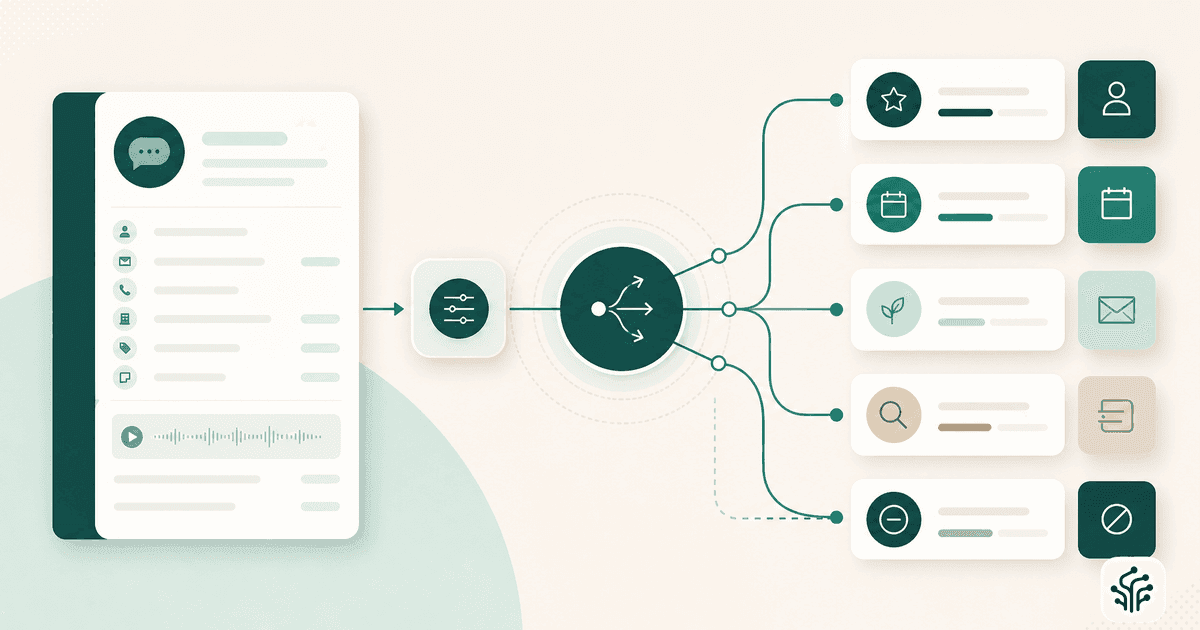
conversation → outcome → next action → owner
For example:
| Conversation outcome | Next action | Route |
|---|---|---|
| Clear need and urgent timing | Human callback | Priority sales queue |
| Interested but timing is later | Scheduled follow-up | Nurture or future callback |
| Wants an appointment | Confirm or book | Calendar workflow |
| Complex or unclear scenario | Human review | Review queue |
| Not interested | Stop active follow-up | Closed or suppression path |
| Asked not to be contacted | Apply opt-out | Do-not-contact workflow |
This makes the routing logic explainable.
The lead is not sent somewhere because a system guessed.
It is sent there because the conversation produced a specific outcome.
Qualified does not always mean immediate human follow-up
A qualified lead can still need a different next step.
Someone may fit the profile but not be ready now.
They may have a real need but be waiting on another decision.
They may want information before speaking to a salesperson.
They may need a specialist rather than a general team member.
This is why human follow-up readiness should be treated separately from qualification.
Qualification answers:
Is this lead relevant?
Readiness answers:
Is a human conversation useful now?
Routing answers:
What should happen next?
Those are related decisions, but they are not the same.
The signals that should influence routing
Good routing uses the context already captured during qualification.
That can include:
Need
What is the lead trying to achieve?
A seller enquiry, buyer question, mortgage scenario, service request, or reactivation conversation may each belong with a different person or workflow.
Timing
How soon does the next step matter?
A lead who needs to act this week should not sit beside someone researching for next year.
Intent
What did the lead actually agree to?
There is a difference between:
- general interest
- asking for information
- agreeing to a callback
- requesting an appointment
- wanting specialist advice
Complexity
Can the next step follow a standard path, or does someone need to interpret the situation?
Complexity is often a reason to route into review rather than force the lead into a normal queue.
Preference
Did the lead ask for a particular callback time, channel, office, or team member?
Routing should preserve that preference.
Risk or uncertainty
Was something unclear, sensitive, contradictory, or outside the workflow?
Those leads may need review before the next automated action.
These are the same kinds of signals covered in buying-signal capture. The difference is that routing turns those signals into action.
The five routes most teams actually need
Most businesses do not need dozens of routing outcomes.
They need a small number of clear paths.
1. Priority human follow-up
Use this when:
- there is a clear need
- timing matters
- the next step requires judgement or relationship
- the reason for urgency is visible
The handoff should include:
- why the lead matters
- what was learned
- what the customer expects next
- when the follow-up should happen
2. Standard follow-up
Use this when the lead is relevant but not urgent.
The next step may be:
- a callback later in the week
- a future check-in
- an information request
- a standard sales task
The important part is that the lead does not disappear into a generic queue without a due date or reason.
3. Nurture or future reactivation
Some leads are real opportunities, just not now.
If timing is months away, immediate sales pressure creates a poor customer experience.
A better route may be:
- scheduled future follow-up
- a nurture workflow
- a reminder based on the lead's stated timeframe
The original context should stay attached so the future conversation does not start from zero.
4. Human review
Use this when the workflow cannot confidently decide what should happen next.
Examples:
- conflicting answers
- unusual requests
- sensitive scenarios
- incomplete but high-value opportunities
- outcomes that do not fit the available categories
A review queue is often better than forcing a false classification.
5. Close, suppress, or stop
Some conversations should not create another sales action.
That includes:
- not interested
- wrong fit
- invalid details
- duplicate record
- explicit opt-out
A good routing system handles these outcomes clearly so the same lead is not accidentally worked again.
What context should travel with the lead
Routing is only useful if the next person receives enough context to act.
At minimum, the handoff should carry:
- lead identity
- reason for enquiry
- key need
- timing
- relevant signals
- agreed next step
- preferred callback time
- open questions
- review flags
- transcript or recording link where appropriate
This does not mean dumping everything into the CRM.
The goal is not more data.
The goal is enough context to continue the conversation without making the customer repeat themselves.
A strong handoff might say:
Seller is considering a move before the school year. Wants an appraisal discussion next week. Partner should be included. Best callback time is Thursday after 6 pm.
That is more useful than:
Qualified seller lead. Follow up.
Why generic queues fail
Generic queues create ambiguity.
Everyone can see the lead, so no one is sure who owns the next step.
Or the owner is assigned, but there is no priority.
Or the priority is high, but no one knows why.
That creates three common problems:
- slow response
- duplicated follow-up
- context loss
A routed lead should have:
- one clear owner or destination
- one clear reason
- one clear next action
- one clear timeframe
If any of those are missing, the route is incomplete.
How automation should help
Automation can make routing faster, but it should not hide the decision logic.
A useful system can take structured outputs from the first conversation and apply routing rules based on:
- outcome
- urgency
- workflow type
- geography
- service line
- availability
- review requirements
The team should still be able to see why the route happened.
That is especially important when AI is involved.
The goal is not:
AI decided this was a hot lead.
The better model is:
The lead said they need to act before the end of the month, asked for a callback, and requires pricing advice. Route to human follow-up.
That is explainable.
It is also easier to audit and improve.
The role of CRM and calendar handoff
Routing often ends in another system.
A qualified lead may need to:
- create or update a CRM record
- assign an owner
- create a task
- book an appointment
- add a follow-up date
- move to a review queue
The quality of that handoff matters.
If the automation only pushes a contact name and phone number, the next team still has to reconstruct the conversation.
Structured routing should carry the useful parts of the first interaction into the system where the human team works.
This is one reason structured call outcomes matter. The route depends on the outcome, and the next person depends on the context behind it.
A simple routing framework
A practical routing decision can be made using four layers:
| Layer | Question |
|---|---|
| Outcome | What happened in the conversation? |
| Readiness | Is human follow-up useful now? |
| Destination | Who or what should receive the lead? |
| Timing | When should the next action happen? |
This is enough for most teams to start.
You do not need a complex scoring model.
You need clear rules that reflect the way your business actually works.
What good looks like
A good routing system makes the next action obvious.
Managers can see:
- which leads need a person now
- which ones are scheduled for later
- which ones need review
- which ones should stop
- why each route was chosen
Reps receive leads with context.
Customers do not have to repeat the same story.
And the business can see where qualified leads are getting stuck.
That is the real value of routing.
Not moving records faster.
Moving the right conversation to the right next step with enough context to act.
Qualification creates the context.
Signals help interpret it.
Readiness tells you whether a human should step in.
For the booking layer where routing meets the calendar, see our guide to automating appointment booking well.
Routing decides what happens next.