How to Automate Appointment Booking Well: Design the Workflow, Not Just the Calendar
Learn how to automate appointment booking by combining qualification, routing, scheduling, review and clean handoff instead of only filling calendar slots.
In this guide
- Why appointment booking is a handoff point, not the finish line
- Three booking paths: book now, qualify then book, review before booking
- A 6-part checklist for booking outcome, readiness, routing, context, exceptions, and follow-through
A lead asks for a call back at 4 pm.
Another fills in a form overnight.
A third spoke to your team last week but never locked in a time.
By the next morning, the pipeline already has gaps.
That is usually where teams start asking how to automate appointment booking.
Not because booking itself is difficult.
Because fast follow-up, qualification, routing, scheduling and handoff are difficult to keep consistent.
The common mistake is to treat appointment booking as a calendar problem.
For many sales and service businesses, it is really a workflow problem.
Someone still needs to:
- respond at the right time
- confirm intent
- ask the right questions
- decide whether the lead should be booked
- offer the right appointment
- send the lead to the right person
- carry useful context into the meeting
If any of that happens late or inconsistently, bookings slip or poor-fit appointments fill the calendar.
The best automation does not just fill empty slots.
It helps the business decide:
Who should be booked, with whom, when, and what needs to happen next?
Appointment booking is a handoff, not the finish line
A calendar event can look like success.
Operationally, it may be the start of another problem.
A booking is only useful if the person receiving it understands:
- who the lead is
- why they enquired
- what they need
- how ready they are
- what was already discussed
- what the lead expects next
Without that context, the next person has to start again.
That creates:
- repeated questions
- poor customer experience
- wasted meeting time
- weak internal handoff
Good appointment automation should therefore connect:
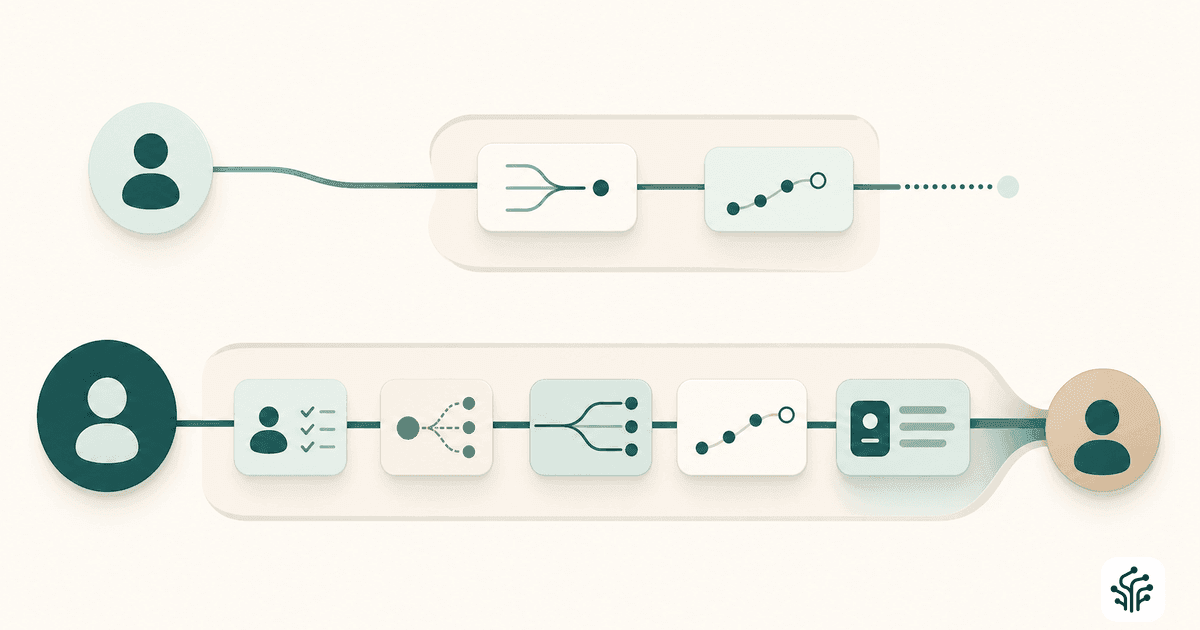
lead intake → contact → qualification → booking decision → calendar → handoff
The calendar is one step in the sequence.
Start by defining what a valid booking actually is
Before automating anything, define the booking outcome.
That sounds obvious.
It often is not.
Ask:
- What type of appointment is this?
- Who should receive it?
- How long should it be?
- What information must be known first?
- Which leads should not be booked yet?
- What happens when the answers are unclear?
A valid appointment might be:
- a discovery call
- an on-site appraisal
- a broker consultation
- a service quote
- a follow-up with an account manager
Each one may need different information.
For example:
Seller appraisal
Possible pre-booking context:
- property address
- reason for selling
- likely timeframe
- appraisal intent
Finance consultation
Possible pre-booking context:
- loan purpose
- current stage
- preferred contact time
- whether the lead is ready for a consultation now
Service quote
Possible pre-booking context:
- location
- job type
- urgency
- service area fit
If the rules are unclear, automation simply moves bad bookings through the process faster.
Build the workflow around booking readiness, not just availability
The practical question is not:
Is there a free time slot?
It is:
Is this the right next step for this lead?
Some people are ready to book immediately.
Others need a short conversation first.
Others should not be booked yet.
That is why qualification should sit before or alongside scheduling.
A useful workflow may need to establish:
- what the lead wants
- whether the service fits
- how soon they want to act
- whether a specific person or team is required
- whether a human should review before booking
The goal is not to make booking harder.
It is to avoid two opposite problems:
Too little control
The calendar fills with:
- poor-fit meetings
- wrong appointment types
- leads booked with the wrong person
- meetings with missing context
Too much friction
Ready leads face:
- long forms
- unnecessary questions
- delayed callbacks
- multiple handoffs
Good automation sits between those extremes.
It keeps the path easy for ready leads while preserving enough structure to protect the team.
Decide which leads can book immediately
Not every booking journey needs the same level of control.
A useful model is to separate three paths.
Book now
Use when:
- the lead source is trusted
- the appointment type is simple
- the criteria are clear
- the risk of a poor booking is low
Qualify, then book
Use when:
- lead quality varies
- the service is more complex
- the team needs key information first
- routing depends on the answers
Review before booking
Use when:
- the answers are mixed
- the case is high value or sensitive
- availability rules are complex
- a senior team member should decide the next step
This makes the workflow easier to understand.
Not every lead needs the same path.
Use structured qualification to support the booking decision
A strong booking workflow does not rely on a vague conversation.
It defines what needs to be captured.
Depending on the use case, that may include:
- need
- timing
- location
- budget range
- service type
- readiness
- preferred times
- special constraints
The point is not to ask more questions.
It is to capture the minimum useful context required for the next decision.
Then the workflow can produce a clear outcome:
book now
route to human
request callback
not ready
review required
That is much more useful than free-text notes such as:
Interested, wants to talk.
For more on structured outcomes, see how structured call outcomes support reliable workflows.
Match the appointment to the right person
Booking is not complete when a time is selected.
The lead also needs the right destination.
Routing may depend on:
- service type
- geography
- team availability
- expertise
- lead readiness
- account ownership
A generic booking process can create internal bottlenecks if every lead lands with the same person.
A better workflow decides:
- which appointment type applies
- who should receive it
- which calendar is valid
- what context should be passed through
For a deeper look at the routing layer, see how to route qualified leads after the first conversation.
Make the booking context visible to the receiving team
The person receiving the appointment should not need to reconstruct the conversation.
A good handoff can include:
- lead details
- appointment type
- reason for enquiry
- key captured fields
- concise summary
- agreed next step
- questions or concerns raised
- review flags where relevant
This is where appointment automation becomes useful operationally.
The value is not:
The calendar event was created.
The value is:
The next person knows what happened and what to do.
Decide where human review belongs
Not every booking workflow should be fully automatic.
Some should be.
Others benefit from a review point.
Human review can be useful when:
- the lead gives conflicting answers
- the conversation goes off the expected path
- the opportunity appears high value
- the customer asks unusual or sensitive questions
- the correct destination is unclear
- a senior team member should take over
The important thing is that review should be designed into the workflow.
Not added later as an informal workaround.
Teams should be able to see:
- what was asked
- what was captured
- which outcome was assigned
- why review was triggered
- what action is waiting
That is the difference between controlled automation and black-box automation.
What a reliable appointment booking workflow looks like
A dependable process usually has six stages.
1. Capture
The lead enters with enough context to start the journey.
2. Contact
The right first action happens at the right time.
3. Qualify
The workflow captures the minimum information needed for the booking decision.
4. Decide
The lead is:
- booked
- routed
- reviewed
- nurtured
- scheduled for later follow-up
5. Schedule
The correct appointment type, person and time are selected.
6. Handoff
The receiving person gets the context they need.
A weakness in any stage can reduce the value of the whole process.
Common appointment booking automation mistakes
Automating the calendar but not the decision
This is the biggest one.
The system can find a free slot.
It cannot tell whether that slot is the right next step unless the workflow defines the rules.
Sending booking links to everyone
Self-serve scheduling works well for some journeys.
It works poorly when:
- qualification matters
- lead intent is unclear
- routing depends on context
- a conversation is needed first
Booking with the wrong person
A meeting can still be a bad outcome if it lands with the wrong team member.
Capturing too little context
A calendar event with no useful notes creates a weak handoff.
Capturing too much before booking
Long forms and excessive qualification can lose ready leads.
No exception path
If the workflow only understands:
- booked
- not booked
it will mishandle real-world edge cases.
No visibility
If the team cannot inspect:
- conversations
- outcomes
- booking decisions
- review cases
they will not trust the workflow.
The tools matter less than the workflow design
Teams often start by asking which scheduling software or AI tool to buy.
The better question is:
What booking process are we trying to make reliable?
A simple service business may only need:
- online scheduling
- reminders
- basic routing
A high-volume sales team may need:
- fast first contact
- qualification
- multiple appointment types
- complex routing
- review
- structured handoff
The tooling should fit the process.
Not the other way around.
Where AI calling can help
AI-assisted calling can be useful when appointment booking depends on a conversation.
For example:
- a lead needs fast first contact
- qualification must happen before booking
- the same questions need to be captured consistently
- the team has after-hours or overflow gaps
A structured AI voice workflow can:
- make a prompt first attempt
- ask a controlled set of questions
- capture required fields
- offer an appropriate booking
- route exceptions for review
- pass useful context to the receiving team
The gain is not just speed.
It is speed with structure.
But AI should not be used to remove judgement where judgement matters.
The workflow should make it clear:
- what the agent can book
- what it must not book
- when a human takes over
- which exceptions need review
Measure whether automation is improving the workflow
Do not measure only the number of appointments created.
A fuller picture includes:
- time to first action
- contact rate
- qualification rate
- booking rate
- show rate
- reschedule rate
- cancellation rate
- manual correction rate
- percentage of bookings with complete context
- downstream conversion by appointment type
Also look for repeated exceptions.
For example:
- booked leads regularly arrive with missing information
- staff reject appointments because they are poor fit
- ready leads are blocked by overly strict rules
- the wrong appointment type is selected
- the same leads keep requiring manual correction
Those are workflow signals.
The goal is not a fuller calendar.
It is a cleaner path from enquiry to useful meeting.
A practical checklist before automating appointment booking
Booking outcome
- What appointment are we trying to create?
- Who should receive it?
- What information must be known first?
Readiness
- Which leads can book immediately?
- Which need qualification?
- Which need review?
Routing
- Which calendar applies?
- What determines the owner?
- What happens when the right person is unavailable?
Context
- What should the receiving person see?
- Which fields matter?
- What summary is useful?
Exceptions
- What happens when the answers are unclear?
- When does a human step in?
- What happens when the lead is not ready?
Follow-through
- Is confirmation sent?
- What happens after a missed appointment?
- Who owns rescheduling?
- Is the next action visible?
If those answers are vague, automation will not fix the process.
The practical mindset shift
Appointment booking is not the finish line.
It is a handoff point.
The best automation does not simply create more meetings.
It makes the path to the right meeting more reliable.
That means:
- faster first action
- better qualification
- clearer booking rules
- better routing
- visible review points
- cleaner handoff context
When the workflow is designed well, the lead gets a faster response and the receiving team gets something useful to act on.
That is what good appointment booking automation should achieve.