Top Lead Follow-Up Workflow Mistakes That Quietly Cost Conversions
Discover the most common lead follow-up workflow mistakes, from slow first action and poor notes to weak handoffs, unclear next steps and overcomplicated automation.
In this guide
- 9 workflow mistakes: from treating every lead the same to measuring activity instead of outcomes
- The end-to-end diagnostic: before first contact, during conversation, after, at management level
- Why busy pipelines can still have weak workflows — and how to spot the difference
A lead comes in at 10:14.
It gets assigned at 11:02.
First contact happens the next day.
By then, the prospect has already spoken to someone else, or forgotten why they enquired in the first place.
That is how lead follow-up workflow mistakes show up in real businesses.
Not as dramatic failures.
As small delays, missing context, vague notes and unclear handoffs that quietly drag down conversion.
For sales and service teams that rely on phone conversations, the problem is rarely effort alone. It is workflow design.
If follow-up depends on memory, manual triage or inconsistent rep habits, good leads go cold and weak leads get too much attention.
The fix is not more activity for its own sake.
It is a tighter process with:
- clearer lead journeys
- faster first action
- better information capture
- explicit next steps
- visible review points
Why lead follow-up breaks even when teams are busy
Many businesses assume follow-up problems come from underperformance.
Sometimes they do.
More often, the workflow makes consistency difficult.
Leads arrive from different sources. Qualification criteria live in someone's head. The CRM fills with notes like:
Left message.
Interested.
Call back later.
Those notes record activity.
They do not explain what happened.
Managers cannot see:
- what was asked
- what the lead actually said
- whether urgency changed
- what should happen next
- who now owns the lead
Reps make judgement calls on the fly.
Some are excellent.
Some are rushed.
The business gets variation where it needs structure.
That is why workflow mistakes matter. They affect speed-to-lead, qualification quality, customer experience and reporting at the same time.
1. Treating every new lead the same
Not every enquiry deserves the same timing, questions or follow-up path.
A new inbound web enquiry is different from:
- an old database contact
- a dormant lead being reactivated
- a missed appointment
- a referral
- a lead returning after a previous conversation
Yet many teams push all of them into one generic queue.
That creates two problems.
First, high-intent leads do not get the urgency they need.
Second, lower-intent or harder-to-reach leads consume too much manual effort too early.
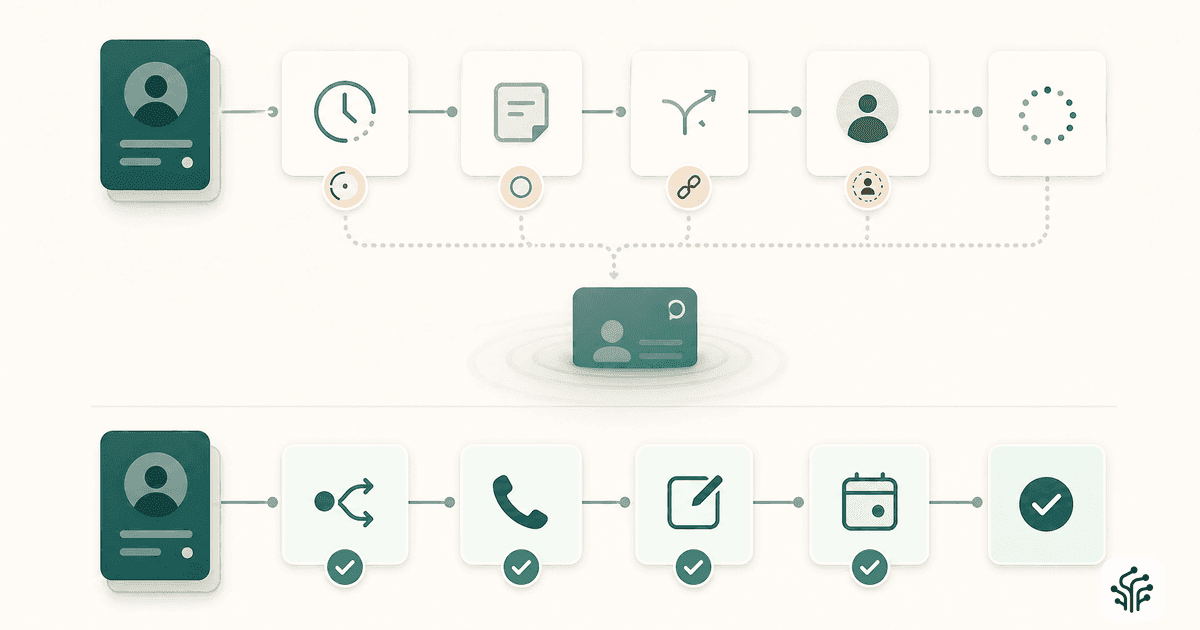
A better workflow separates lead journeys before the first call.
That does not mean creating dozens of complex automations.
It means knowing:
- which lead types need immediate qualification
- which need context refreshed first
- which should enter a nurture path
- which require a specific playbook
If the workflow cannot distinguish between these cases, the team compensates manually.
That rarely scales well.
2. Allowing delay between lead arrival and first action
This is one of the most costly lead follow-up workflow mistakes because it affects the entire journey before the first conversation even begins.
The problem is rarely that teams do not know speed matters.
The problem is that the workflow still allows delay.
Leads:
- sit in inboxes
- wait for assignment
- get reviewed in batches
- are saved for when someone has time to call
That turns speed into a matter of good luck.
A better workflow makes first action explicit.
Depending on the business, that might mean:
- automatic routing
- an immediate call task
- a priority queue
- a structured AI-assisted first touch
- a clear escalation when the first action does not happen
The important point is not that every lead must be called instantly.
It is that the process should decide what should happen and by when.
Speed should be designed into the workflow, not left to memory.
3. Using scripts that do not capture anything useful
A call is only valuable if it produces something the business can act on.
Too many workflows focus on making contact but fail to define what the conversation should capture.
Generic scripts often collect just enough information to sound like qualification without creating a useful next step.
They miss details such as:
- whether the lead is still actively looking
- what changed since the original enquiry
- timing
- urgency
- budget or service fit
- location preferences
- blockers
- what the lead expects next
Without structured capture, the business ends up with recordings nobody reviews and notes that tell the next person very little.
A better workflow defines the information that matters before the call happens.
Then the conversation turns into usable outputs:
- captured fields
- a concise summary
- a clear outcome
- review flags where needed
- a recommended next action
That is the difference between a completed call and a useful conversation.
For a deeper look at this, see how AI agents qualify leads at scale.
4. Leaving next actions open to interpretation
Follow up next week is not a workflow outcome.
Neither is:
Interested.
Those labels sound acceptable until someone else has to act on them.
A strong workflow makes the next step obvious.
If a lead is ready for human follow-up:
- who owns it
- why it matters
- when they should act
- what the lead expects
If the lead is not ready:
- when should they be contacted again
- why that timing was chosen
- what context should be carried forward
If the conversation produced a specific request:
- where is it recorded
- who is responsible
- what happens if nobody acts
The more interpretation the workflow leaves to individuals, the more inconsistency the pipeline accumulates.
Over time, the CRM fills with leads that appear active but have no clear path forward.
That is why qualification should end with a routing or next-action decision, not just a label.
See how to route qualified leads after the first conversation.
5. Allowing poor notes to stand in for qualification
Poor notes are often treated as a reporting problem.
They are really a workflow problem.
When teams rely on free-text updates instead of structured outcomes, quality drops under pressure.
People:
- write less
- skip nuance
- forget important details
- record activity instead of meaning
That becomes risky when multiple people touch the same lead.
A manager reviewing performance, a closer taking over the conversation or an operations team handling the next step all need a reliable record.
If the handoff depends on interpreting a rushed note, context disappears.
This is where structured call outcomes matter.
Captured fields, summaries, dispositions and review flags create consistency without requiring every team member to document conversations equally well every time.
The goal is not more data.
It is better continuity.
6. Automating calls without review points or clear boundaries
Automation can make lead follow-up faster.
It can also make a bad workflow fail more consistently.
One of the more serious mistakes is assuming that automated follow-up should run without:
- review
- testing
- clear boundaries
- visible exception handling
That creates operational risk instead of efficiency.
A workflow may:
- ask the wrong questions
- assign the wrong outcome
- route leads incorrectly
- mishandle edge cases
- continue when a human should step in
The team may not notice until pipeline quality falls or customer feedback turns sour.
Good automation is visible and reviewable.
You should know:
- what the agent is meant to ask
- what it is meant to capture
- which outcomes it can assign
- what it must not do
- when a human review is required
There is no prize for making follow-up opaque.
The goal is faster, more consistent action with accountability still intact.
For more on this, see how a human review queue for AI calls should work.
7. Using the same persistence strategy for every lead
Persistence helps.
Blanket persistence does not.
Some leads need:
- a second attempt the same day
- a callback at a requested time
- a later nurture sequence
- a reactivation path
- a different channel handled outside the call workflow
The mistake is building one rigid cadence and applying it to every lead.
A recent inbound enquiry has different expectations from a dormant lead last contacted six months ago.
The source, intent and previous interaction should shape the follow-up path.
Without that context, teams tend to either:
- under-contact promising leads
- over-contact low-intent leads
Better follow-up is not just faster.
It is more context-aware.
8. Measuring activity instead of outcomes
A team can make plenty of calls and still have a weak follow-up process.
Call volume, attempt counts and talk time tell part of the story.
They do not prove the workflow is working.
More useful questions are:
- Are leads being qualified consistently?
- Are useful buying signals being captured?
- Are ready leads reaching a person quickly?
- Are low-priority leads entering the right nurture path?
- Are appointments and next actions being completed?
- Are review cases visible?
- Where are leads stalling?
If reporting only shows effort, workflow problems stay hidden.
Outcome-based reporting gives teams something operational to improve.
It also makes it easier to compare:
- lead sources
- playbooks
- campaigns
- call approaches
- different lead journeys
without relying on rep anecdotes.
9. Building a workflow nobody can understand or maintain
Some follow-up systems fail because they are too loose.
Others fail because they are too clever.
They depend on:
- fragile automations
- custom fields nobody understands
- decision trees only one person can explain
- hidden dependencies
- manual fixes that never get documented
That may work while a strong operator is babysitting the process.
It becomes a problem when:
- volume rises
- staff change
- a new campaign launches
- the original builder leaves
A workflow should be understandable by the team running it.
People should be able to see:
- what happens
- why it happens
- what gets captured
- how leads move
- where exceptions go
- what can be changed safely
Practical workflows beat impressive ones.
That is one reason structured playbooks are often easier to operate than blank-slate setups.
The easier a workflow is to review, test and maintain, the more likely it is to stay consistent under pressure.
A simple way to diagnose a weak follow-up workflow
A useful test is to take one lead and trace the entire journey.
Ask:
Before first contact
- How did the lead enter?
- Who owned the first action?
- Was timing clear?
- Did the workflow know what type of lead this was?
During the conversation
- What was the goal?
- What needed to be captured?
- What happened if the conversation went off the expected path?
After the conversation
- Was the outcome structured?
- Was the next action clear?
- Was there one owner?
- Was timing explicit?
- Could another person continue without making the lead repeat themselves?
At the management level
- Can we see where leads stall?
- Can we compare outcomes by journey or source?
- Can we identify repeated workflow failures?
If the answers depend on memory or individual habits, the process is not really a workflow yet.
What better lead follow-up looks like
A better workflow is not just quicker.
It is clearer.
It:
- separates lead types early
- triggers the right first action
- asks useful questions
- captures answers in a structured way
- makes the next step explicit
- keeps human judgement where it adds value
- makes exceptions visible
The workflow carries the operational load so the team does not have to rebuild process quality one conversation at a time.
For phone-based sales and service teams, the combination matters.
Fast contact without useful capture creates noise.
Capture without routing creates backlog.
Automation without oversight creates risk.
The strongest follow-up workflows connect all three.
If the pipeline feels busy but unpredictable, the answer is usually not more chasing.
For the practical redesign of intake, assignment and first-touch workflows, see our guide to improving speed to contact.
It is a process that makes better decisions earlier, records them properly and leaves less to chance.