A Practical Guide to AI Calling in Australia
A practical guide to AI calling in Australia, covering suitable use cases, workflow design, reviewability, compliance-conscious deployment and how to evaluate platforms.
In this guide
- Why the workflow matters more than the voice quality
- How to evaluate AI calling platforms beyond demo calls
- A practical rollout approach starting with one repeatable journey
Australian teams often do not have a lead-generation problem.
They have a follow-up problem.
Web enquiries sit untouched. Missed callbacks disappear into personal task lists. Old database leads are never worked properly. Calls happen, but the notes are vague and nobody is certain what should happen next.
That is where AI calling can help.
But a practical guide to AI calling in Australia needs to start with one important distinction:
Calling faster is useful only when the workflow is controlled, the outcome is clear and the next action reaches the right person.
The question is not whether an AI voice agent can place a call.
It can.
The better questions are:
- What job is the call meant to complete?
- What is the agent allowed to do?
- What information should it capture?
- When should a person step in?
- What happens after the conversation?
- Can the team inspect and improve the workflow?
AI calling is most useful when it solves a narrow operational problem rather than trying to replace every human phone conversation.
What AI calling means in practice
For most sales and service teams, AI calling means using a voice agent to handle repeatable phone interactions that already follow a recognisable pattern.
Common examples include:
- first-response follow-up after an enquiry
- lead qualification
- appointment readiness and booking
- old lead reactivation
- missed-call recovery
- confirmation calls
- routing someone to the right team
For a practical breakdown of how AI calling supports lead follow-up, see AI phone calls for leads.
The useful output is not simply:
Call completed.
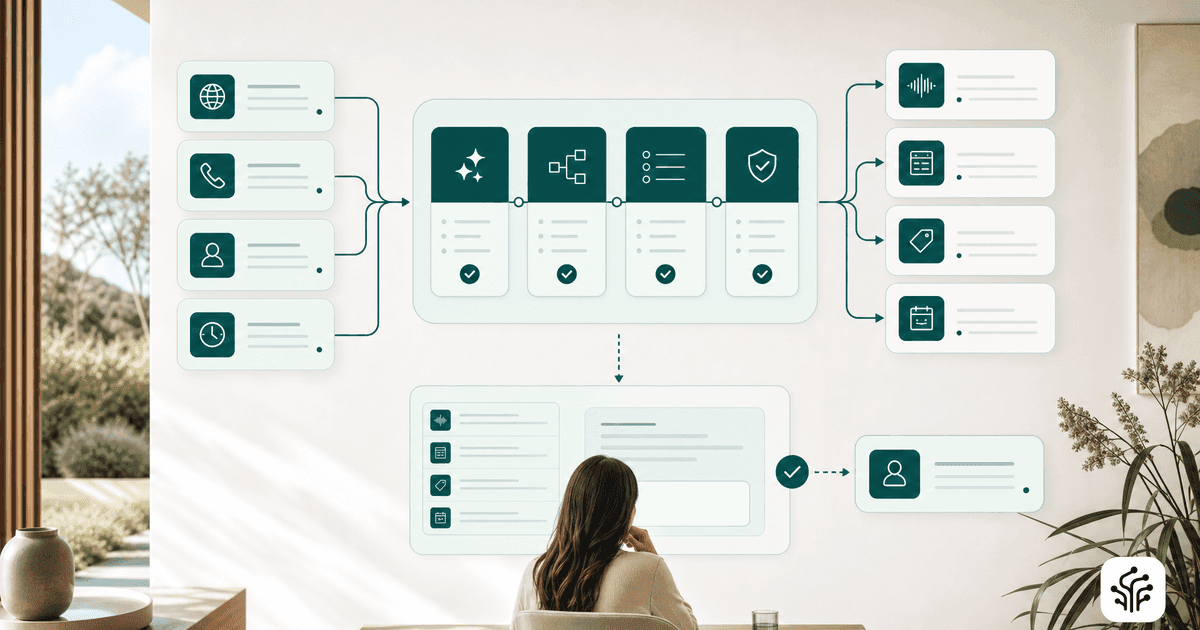
A strong workflow should leave behind:
- a transcript
- a recording
- captured fields
- a concise summary
- a clear outcome
- the next action
- review flags where needed
Without those outputs, a business may create more call activity while reducing operational clarity.
The workflow matters more than the voice
One of the biggest mistakes businesses make is starting with how human the voice sounds.
Voice quality matters.
It is not the foundation.
A better starting point is the customer journey.
Before configuring a call, define:
- what triggers it
- who should be contacted
- what the purpose is
- which questions matter
- what should be captured
- which outcomes exist
- when the workflow should stop
- when a human should take over
For example, a property buyer enquiry workflow might need to understand:
- property or location interest
- timing
- finance position where appropriate
- inspection intent
- whether an agent should follow up now
A finance enquiry workflow might focus on:
- reason for enquiry
- urgency
- high-level readiness
- preferred next step
- whether a human consultation is appropriate
An appointment-led service workflow might need:
- service type
- location
- urgency
- booking readiness
- the right team or calendar
The call should fit the job.
AI calling is strongest when the objective is narrow, the outcomes are defined and the handoff is clear.
Start with repeatable use cases
Not every phone interaction should be automated.
A sensible starting point is the set of calls the business already handles inconsistently because of:
- lead volume
- after-hours demand
- repetitive questions
- manual triage
- limited staff capacity
Strong starting use cases often include:
New enquiry follow-up
Use AI to make the first structured contact quickly, capture intent and route the lead.
Dormant lead reactivation
Use a focused workflow to determine whether circumstances have changed and whether a human conversation is worthwhile.
Appointment readiness
Confirm whether the lead is ready to book, capture the required context and route exceptions for review.
Missed-call recovery
Respond consistently when the original call was not answered or returned.
Post-event or post-inspection follow-up
Capture feedback, interest and next steps while the experience is still fresh.
These workflows are useful because the job is clear.
They are not open-ended relationship conversations.
Where AI calling is a weaker fit
AI calling is less suitable when the conversation depends heavily on:
- negotiation
- emotional sensitivity
- complex advice
- relationship history
- legal or financial interpretation
- local judgement
- complaint resolution
Examples may include:
- complex vendor conversations
- high-value negotiations
- vulnerable customer situations
- disputes
- sensitive complaints
- strategic advice
The better model is:
AI handles the first structured pass. Humans handle relationship depth and judgement.
That boundary should be visible in the workflow.
What Australian teams need to think about before launch
AI calling in Australia is not only a technology decision.
It is also an operational, customer-experience and compliance-conscious decision.
The right setup depends on:
- the industry
- the source of the contact
- the purpose of the call
- consent and contact rules
- internal policies
- data handling
- do-not-contact controls
- escalation requirements
This is not a substitute for legal advice.
The practical product lesson is simpler:
Black-box automation is a poor fit for customer calling.
A team should be able to see:
- what the agent will say
- which information it will collect
- how outcomes are assigned
- which contacts are excluded
- where a human can intervene
- what records are retained
- how exceptions are reviewed
Visibility is not an optional feature.
It is part of safe operation.
For a practical approach to compliance-conscious AI calling, see How to build compliant AI lead outreach.
How to assess an AI calling platform
A polished sample call is not enough.
It does not show:
- how the platform behaves at scale
- how much control the team has
- whether the workflow is maintainable
- whether the outputs are operationally useful
A stronger evaluation looks at the full system.
Workflow design
Can the team define:
- the trigger
- the conversation objective
- required fields
- outcomes
- escalation paths
- next actions
Reviewability
Can managers inspect:
- transcripts
- recordings
- summaries
- structured fields
- outcome decisions
- exceptions
For how reviewability supports operational confidence, see What is an auditable AI call workflow.
Handoff quality
Does the next person receive:
- what the lead asked for
- what was learned
- what was agreed
- what should happen next
Integrations
What happens after the call?
Does the system:
- create a task
- update a lead
- route to a person
- create a review item
- support appointment booking
- feed the team's existing workflow
Behaviour outside the happy path
What happens when a caller:
- interrupts
- changes topic
- gives partial answers
- asks an unexpected question
- requests not to be contacted
- needs a human
No system handles every edge case perfectly.
What matters is whether uncertainty is visible and recoverable.
For how human review queues handle exceptions, see Human review queue for AI calls.
Why structured playbooks are more useful than blank prompts
A blank prompt box can feel flexible.
It can also hide complexity.
Teams need to know:
- what the agent handles
- what it avoids
- what it captures
- how it decides
- what happens next
A structured playbook gives the workflow a visible shape.
For a comparison of structured playbooks against open-ended approaches, see Voice AI platforms vs playbooks.
It can define:
- the scenario
- conversation stages
- captured fields
- guardrails
- outcomes
- handoffs
- review triggers
- post-call actions
That makes the system easier to:
- understand
- test
- approve
- operate
- improve
For practical deployment, predictability is usually more valuable than open-ended cleverness.
Designing calls people will actually respond to
A good AI call is usually shorter and more focused than businesses first imagine.
A common mistake is trying to complete too many jobs in one conversation.
For example:
qualify + discover + persuade + book + collect every possible field
That creates long, awkward calls.
A stronger design chooses one primary outcome.
If the purpose is qualification, qualify.
If the purpose is booking, book.
If the purpose is reactivation, confirm current interest and route the lead.
The tone should also fit the context.
Australian audiences generally respond better to direct, plain language than exaggerated enthusiasm or over-scripted friendliness.
The opening should quickly explain:
- who is calling
- why
- what the conversation is about
Then get to the point.
Test the real conversation, not the script on paper
Good AI calling is usually the result of iteration.
Review:
- where callers interrupt
- which questions create confusion
- where people repeat themselves
- which outcomes are ambiguous
- where the workflow should hand over
- what information the team still lacks after the call
A workflow may look perfect in a configuration screen and still feel awkward in a real conversation.
Testing should include:
- expected calls
- off-topic questions
- partial answers
- unclear audio
- refusal
- do-not-contact requests
- requests for a human
- no-answer paths
The aim is not to prove the agent never fails.
It is to understand how failure is contained and reviewed.
What success looks like after go-live
Do not measure success by call volume alone.
More calls can simply create more noise.
Better indicators include:
- time to first action
- contact rate
- qualification completeness
- percentage of leads with a clear outcome
- correct routing
- human review rate
- appointment or callback completion
- reduction in untouched leads
- manual correction rate
Also inspect where the workflow fails.
For example:
- too many unclear outcomes
- review queues growing too quickly
- missing context after handoff
- leads routed to the wrong person
- repeated customer confusion
These are usually workflow-design signals.
A practical rollout approach
The best rollout is usually narrow.
1. Choose one repeatable journey
Pick a workflow with:
- clear volume
- repeatable questions
- a defined next action
- measurable outcomes
2. Define success before launch
Decide what should improve:
- response time
- qualification consistency
- lead visibility
- handoff quality
- appointment completion
3. Test in a controlled environment
Review real conversations before expanding volume.
4. Keep human review visible
Make exceptions easy to find and correct.
5. Expand only after the first workflow is stable
Do not automate five journeys at once.
A narrow first deployment gives the team a clearer learning loop.
The strongest approach is controlled, not fully automatic
A practical guide to AI calling in Australia should leave teams with one standard:
If you cannot inspect it, review it and improve it, you should not rely on it.
The strongest AI calling systems are not magical.
They are:
- well scoped
- tied to a real workflow
- tested
- visible
- reviewable
- connected to a clear next action
Start with one repeatable journey.
Judge the system by the quality of the outcome after the call.
That is where the real value appears.