How to Build Compliant AI Lead Outreach Without Losing Speed
Learn how to build compliant AI lead outreach with clear contact rules, structured playbooks, reviewable outcomes and faster lead follow-up.
In this guide
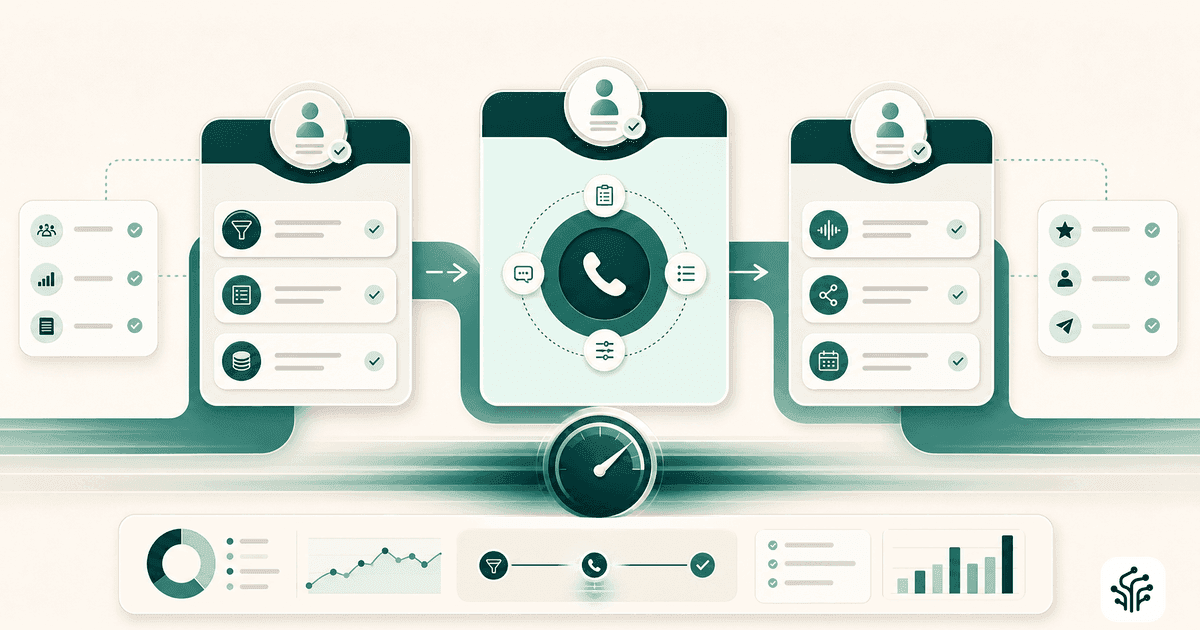
- Three-stage control model: before, during, and after the call
- Why speed without control creates more problems than it solves
- The five building blocks: contact governance, call objective, structured capture, oversight, next actions
A lead comes in at 4:47 pm. Your team is flat out, the rep who owns that territory is on another call, and by the next morning the prospect has already spoken to someone else.
That is the gap compliant AI lead outreach is meant to close. Not by removing people, but by making early follow-up faster, more consistent, and easier to review.
For sales and service teams that rely on phone conversations, speed matters. So does control.
The problem is that many outreach systems optimise for only one side of that equation. They either slow everything down with manual processes, or they automate too aggressively and leave teams exposed to poor scripts, weak records, and unclear guardrails.
The better approach is structured outreach that moves quickly while still showing exactly what was said, what was captured, and what should happen next.
Compliance is not a feature switch. The rules that apply depend on where you operate, how the lead was collected, the purpose of the outreach, and the channels you use.
The role of a well-designed system is not to guarantee compliance. It is to make contact rules, call behaviour, review steps, and outcomes easier to apply, monitor, and improve.
What compliant AI lead outreach actually means
Compliant AI lead outreach starts well before an AI agent makes a call.
It begins with the workflow around the lead.
Where did the lead come from? What was the enquiry about? Is the record current? Has the person opted out? Should this lead be called now, later, or not at all?
If those basics are unclear, faster outreach simply creates faster mistakes.
It also extends into the call itself.
A useful AI voice workflow should follow a defined purpose, whether that is inbound qualification, reactivation, appointment booking, or post-enquiry follow-up.
It should ask approved questions, capture agreed data points, handle opt-outs correctly, and assign outcomes in a consistent way.
If the workflow wanders, records become messy, or edge cases are forced into the wrong outcome, compliance risk is only part of the issue. The larger operational problem is that no one can trust the output.
Then there is what happens after the call.
Teams need transcripts, summaries, dispositions, captured fields, review flags, and clear next actions.
Without that audit trail, outreach becomes hard to review and even harder to improve.
| Stage | What needs control | What the team should be able to see |
|---|---|---|
| Before outreach | Lead source, contact basis, opt-out status, timing | Why this lead entered the workflow |
| During the call | Purpose, approved questions, boundaries, opt-out handling | What the agent can ask, say, and avoid |
| After the call | Outcome, review, routing, next action | What happened and what comes next |
The point is not to turn every process into a compliance checklist.
It is to make the operating rules visible enough that teams can test them, review them, and fix them before problems spread.
Why speed without control causes problems
Most lead-handling issues are not caused by bad intent.
They come from rushed operations.
A team gets a new campaign live, imports an old database, or tries to clear a backlog of web enquiries. The immediate pressure is response time, so outreach gets pushed out before the rules are properly set.
That is where things start to drift.
Contact records may be incomplete. Qualification questions vary from one conversation to the next. Reps enter vague notes into the CRM. Managers cannot tell which leads were contacted, which were interested, and which should be removed from future activity.
Even if call volumes look healthy, the process underneath is weak.
AI can make this better or worse.
If it is treated as a blank prompt with a phone line attached, it introduces new uncertainty at scale.
If it is built around structured playbooks, review queues, clear do-not-contact controls, and defined outcomes, it becomes a way to reduce inconsistency rather than amplify it.
That distinction matters for businesses with high lead flow.
Real estate teams, mortgage brokers, finance businesses, and appointment-based service providers often do not have a lead generation problem. They have a follow-up discipline problem.
They need outreach that is prompt, documented, and operationally reliable.
The building blocks of compliant AI lead outreach
The strongest compliant outreach setups are usually the least flashy.
They focus on the practical controls that keep calling useful.
Before the call
The first layer is contact governance.
Teams need confidence that records entering the workflow are suitable for outreach, current enough to be relevant, and filtered against opt-outs or internal suppression rules.
That can include:
- lead source
- contact basis or permission status
- opt-out history
- suppression lists
- permitted contact window
- campaign purpose
- freshness of the record
Good outreach starts with list discipline, not just call logic.
During the call
The second layer is a defined call objective.
An AI voice agent should not try to do everything in one conversation.
It works best when the goal is specific: confirm interest, qualify a seller, book a meeting, reactivate an old lead, or gather missing details before a human takes over.
Narrower workflows are easier to review, easier to improve, and easier to keep within operational guardrails.
The workflow should make clear:
- what the call is trying to achieve
- which questions are approved
- which claims or topics are out of bounds
- how opt-outs are handled
- when the conversation should escalate
- what should happen when the answer is unclear
After the call
The third layer is structured capture.
Free-text notes are rarely enough.
Teams need fields that matter to the business, such as timing, intent, property status, budget range, preferred location, appointment availability, or reason for no interest.
Structured outputs make downstream action possible.
The fourth layer is human oversight.
Not every call needs intervention, but every workflow needs reviewability.
Managers should be able to inspect transcripts, listen to recordings where appropriate, spot edge cases, and adjust the workflow before problems spread.
The fifth layer is explicit next actions.
A good call does not end with a transcript sitting in a dashboard.
It ends with a routed lead, a booked appointment, a flagged review item, or a defined follow-up task.
Where teams often get compliant AI lead outreach wrong
One common mistake is assuming compliance is just a script issue.
Scripts matter, but the real risk often sits in the workflow around the call.
If contact permissions are unclear, suppression rules are not respected, calling windows are inconsistent, or outcomes are not reviewable, the problem is operational design rather than wording alone.
Another mistake is trying to automate too much too early.
A team may want one AI agent to handle new inbound leads, stale database reactivation, no-answer follow-up, and appointment confirmation.
That usually creates a muddled experience.
Separate workflows with different rules are safer and easier to manage.
There is also a tendency to treat all leads as equal.
They are not.
Fresh inbound enquiries deserve different timing and context from six-month-old records in a CRM.
Likewise, a referral lead should not be approached the same way as someone who completed a broad website form.
Compliant outreach depends on context, not just contact volume.
How to make outreach faster without making it riskier
The practical path is to start with one controlled journey and make it work properly.
For many businesses, that might be post-enquiry follow-up on inbound leads where the objective is to contact quickly, confirm interest, and route qualified prospects to the right team member.
In that setup, the workflow should make visible:
- what the agent will ask
- what data it will collect
- which outcomes it can assign
- when a call should be flagged for human review
That visibility matters because teams can test before going live.
They can hear how the call sounds, adjust awkward language, tighten qualification logic, and check that records are being written back in a useful way.
This is where practical platforms stand apart from generic AI tools.
A workflow built around structured outcomes, review queues, and post-call actions gives managers something they can actually run.
This is the model DialoGrove is built around: defined playbooks, captured fields, reviewable outcomes, and human oversight around the call.
It is also worth being realistic about trade-offs.
Tighter controls can limit flexibility, especially for edge cases.
More review steps can slow rollout.
But those are usually healthy trade-offs for teams that care about consistency, customer experience, and accountability.
What good looks like in day-to-day operations
You know compliant outreach is working when managers can answer basic questions quickly.
Which leads were contacted today?
Which conversations showed buying intent?
Which records need a human callback?
Which outcomes are increasing?
Which calls should be reviewed?
You also see it in customer experience.
Conversations are clearer. Qualification feels more consistent. Fewer leads vanish into vague notes or forgotten callback lists.
Reps spend more time on the leads that actually need a person, rather than chasing every first touch manually.
Most importantly, the process becomes explainable.
If someone asks why a lead was contacted, what happened on the call, or how the next step was assigned, there is a record.
That level of visibility is what turns AI outreach from a risky experiment into a workable operating layer.
For the governance lessons from APRA on continuous assurance, supply-chain visibility and agentic security, see our guide to why AI is not just another technology risk.
Compliant AI lead outreach is not about saying yes to more automation or no to it.
It is about designing outreach that your team can trust when volume rises, response times tighten, and every missed lead starts to show up in the pipeline.