
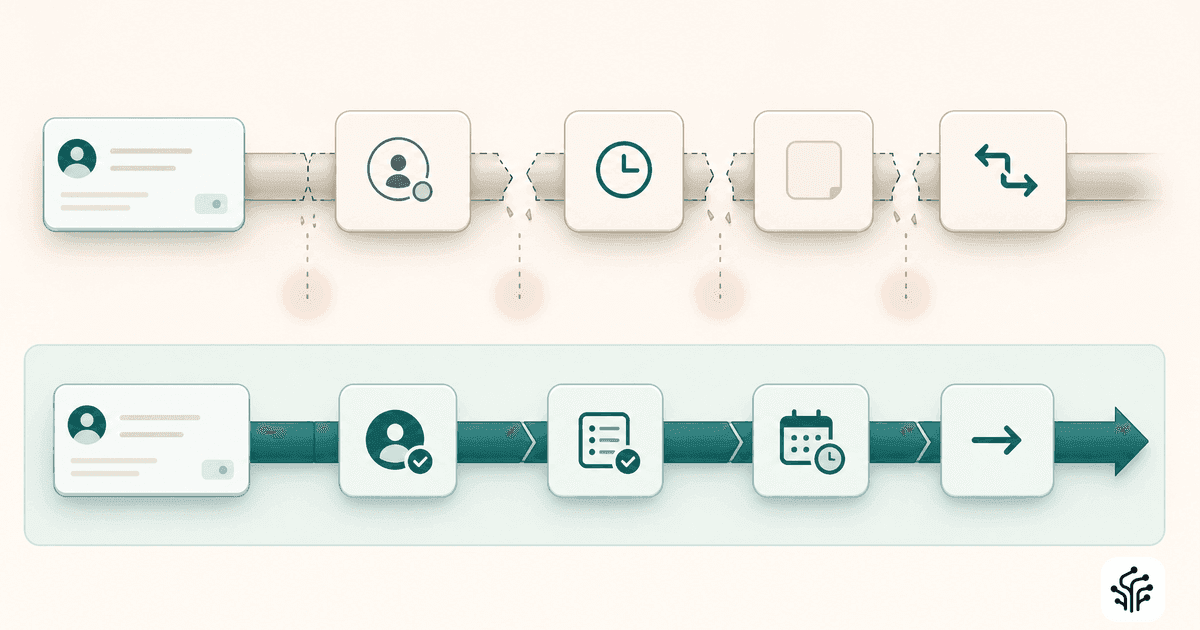
How to Reduce Lead Leakage Across Your Sales Process
Learn how to reduce lead leakage by fixing delayed contact, unclear ownership, inconsistent qualification, weak handoffs and missing reactivation paths.
In this guide
- Why low conversion is not automatically lead leakage
- How to run a 50-lead leakage audit
- 10 operational fixes from arrival to follow-through
A lead does not need to say "no" to become a lost opportunity.
It can:
- sit untouched after an enquiry
- receive one rushed call
- be assigned to the wrong person
- disappear behind a vague CRM note
- miss a promised callback
- go cold because nobody created a later follow-up path
That is lead leakage.
It is not simply the portion of leads that do not convert.
It is the portion that never receives the right response, at the right time, with a visible outcome and next action.
For lead-intensive businesses, leakage rarely comes from one dramatic failure.
It comes from small gaps repeated at scale:
- delayed first contact
- incomplete context
- inconsistent qualification
- poor handoffs
- unclear ownership
- no reactivation path
Reducing lead leakage means building a reliable path from enquiry to outcome and making every break in that path visible.
Start by distinguishing leakage from low conversion
A low conversion rate does not automatically mean the workflow is leaking leads.
Conversion can be affected by:
- market conditions
- pricing
- poor lead fit
- weak demand
- competition
- product or service quality
Leakage is different.
Leakage happens when a viable lead is lost because the process failed to manage it properly.
Examples include:
- no first attempt
- first contact happened too late
- the lead was contacted but nothing useful was recorded
- a callback was promised but not completed
- the lead was qualified but routed incorrectly
- the lead was not ready and no future path was created
This distinction matters because the solution is different.
You do not solve operational leakage by simply asking the team to sell harder.
For a broader look at common follow-up pitfalls, see top lead follow-up workflow mistakes.
Map the full lead journey before changing tools
Before changing scripts, hiring more people or adding automation, map the journey from first enquiry to a clear outcome.
Include every entry point:
- website forms
- referrals
- paid campaigns
- phone enquiries
- missed calls
- old CRM records
- spreadsheet imports
- reactivation lists
Then trace what happens.
A useful lead journey map is:
arrival → ownership → first action → conversation → qualification → next action → handoff → follow-through
At each stage, ask:
- What should happen?
- Who owns it?
- By when?
- What information is required?
- How do we know it happened?
- What happens if it fails?
Lead leakage usually appears where one of those answers is vague.
Run a 50-lead leakage audit
One of the fastest ways to diagnose leakage is to take 50 recent leads and trace them individually.
For each lead, can you identify:
Arrival
- source
- timestamp
- original enquiry
- relevant context
Ownership
- assigned person or workflow
- assignment time
- first-action deadline
Contact
- first attempt
- first conversation
- no-answer follow-up
Qualification
- need
- timing
- readiness
- useful signals
- objections or blockers
Outcome
- what happened
- what should happen next
- who owns it
- when it is due
Follow-through
- callback completed
- appointment confirmed
- handoff accepted
- nurture or reactivation path created
If the answer is unclear for more than a few records, the process is producing leakage even when the team appears busy.
1. Reduce delay before first contact
Intent fades.
A lead who has just submitted an enquiry is easier to engage than someone contacted hours or days later.
But the practical lesson is not that every lead needs the same response.
Different journeys need different service levels.
For example:
- a high-intent inbound enquiry may need an immediate first action
- a referral may need a senior person
- a dormant database segment may enter a planned sequence
- an after-hours enquiry may need a different first-touch workflow
The important thing is that each lead type has:
- a response window
- an owner
- a defined first action
Avoid standards such as:
Follow up quickly.
A measurable expectation makes delay visible and helps managers identify whether the problem is:
- staffing
- assignment
- bad data
- unclear ownership
- an overloaded queue
2. Give every lead one owner
A lead with no clear owner is not in a pipeline.
It is in a queue.
Ownership should be explicit from the moment the lead enters.
The first owner may be:
- a salesperson
- an operations team
- a specialised workflow
- an AI-assisted first-touch process
The important part is that responsibility does not become ambiguous after:
- a missed call
- a handoff
- a shift change
- an absence
- an unsuccessful first attempt
A strong workflow also defines what happens when the owner does not act.
Ownership without accountability still creates leakage.
3. Make every interaction produce a next action
Activity is not progress.
A record marked:
Contacted
does not tell the business what should happen next.
Every interaction should end with a clear outcome.
Examples include:
- book appointment
- call at an agreed time
- send requested information
- route to specialist
- place into nurture
- enter reactivation
- review required
- close with reason
- do not contact
A next action should include:
- owner
- timing
- reason
- context
Follow up later is not enough.
A useful outcome is:
Buyer is waiting for finance approval → assigned agent → contact next Thursday → finance timing recorded.
The more interpretation left to individuals, the more leakage accumulates.
4. Standardise qualification without making calls robotic
Inconsistent qualification creates two forms of leakage.
Strong prospects may be missed because a key signal was never captured.
Weak-fit leads may receive too much attention because the team lacks useful information.
The solution is not a rigid script read word for word.
It is a consistent set of questions and outcome rules tied to the customer journey.
Useful qualification may capture:
- reason for enquiry
- timing
- location
- budget range where appropriate
- current situation
- readiness
- preferred next step
Ask only for information that changes what the team should do.
A long checklist may create complete records while damaging the conversation.
The goal is not maximum data.
It is minimum useful context.
For more on readiness, see what makes a lead ready for human follow-up.
5. Use structured outcomes, not free-text notes alone
Free-text notes are useful for nuance.
They are weak as the only source of operational truth.
Under pressure, people write:
- less
- inconsistently
- after the fact
- without clear next steps
Structured fields help teams identify:
- lead status
- timing
- readiness
- outcome
- review need
- next action
A concise summary can then preserve the nuance.
The combination is stronger than either alone:
structured fields + human-readable summary
This improves:
- routing
- reporting
- continuity
- prioritisation
- coaching
For more on structured outcomes, see structured call outcomes software.
6. Build follow-up around outcomes, not attempts
Call attempts are easy to count.
They are not the same as managing the lead well.
A stronger workflow tracks outcomes such as:
- connected and qualified
- connected and not ready
- callback requested
- no answer
- wrong details
- do not contact
- review required
Each outcome should trigger the correct path.
For example:
Callback requested
- schedule the exact task
- preserve the requested time
- assign one owner
Not ready
- record why
- define a future contact window
- move to nurture or reactivation
No answer
- apply a defined next-attempt path
- avoid endless, context-free retries
Review required
- make the reason visible
- provide the conversation context
- assign the reviewer
This avoids two common forms of leakage:
- repeatedly contacting people without a reason
- abandoning viable leads after one unsuccessful attempt
7. Make the middle of the funnel visible
Lead leakage grows in the dark.
If managers can only see:
- total leads
- total calls
- closed deals
they cannot see where the process is breaking.
A better operational view asks:
- How quickly are leads contacted?
- What percentage receives a meaningful outcome?
- Which sources create qualified conversations?
- Which promised callbacks happen on time?
- Where do leads wait?
- Which handoffs fail?
- Which leads have no next action?
Call recordings, transcripts and structured summaries can support:
- coaching
- quality review
- workflow improvement
- exception analysis
The goal is not to micromanage every conversation.
Sample review is often enough to identify:
- weak questions
- poor handoffs
- unclear outcomes
- repeated process failures
8. Treat reactivation as part of lead management
Not every unconverted lead is a poor lead.
People delay decisions because:
- timing changes
- competing priorities
- finance is not ready
- a property sale falls through
- documents are incomplete
- they need more time
If there is no reactivation path, the business wastes demand it has already paid to generate.
Create separate reactivation workflows for leads that were:
- relevant
- genuinely interested
- not ready at the time
A good reactivation contact should:
- acknowledge the prior context
- have a reason for checking in
- capture what changed
- make it easy to state current interest
- route renewed intent quickly
Reactivation should not mean contacting old records indefinitely.
Timing, contact preferences and do-not-contact controls still matter.
For a practical reactivation framework, see reactivation calling for AI leads.
9. Fix the handoff after qualification
The final gap often sits between a good first conversation and the promised action.
Examples include:
- appointment not confirmed
- specialist receives no context
- callback happens late
- lead is transferred to the wrong team
- nobody accepts ownership
A strong handoff should include:
- conversation summary
- relevant fields
- stated need
- readiness
- agreed next step
- owner
- timing
Test the process from the customer's perspective.
Would they feel that the business:
- listened
- remembered
- acted when it said it would
If the customer has to repeat the same story, the handoff failed even if the CRM was updated.
For more on routing qualified leads effectively, see how to route qualified leads after the first conversation.
10. Use automation to close gaps, not hide them
Automation can reduce lead leakage when it makes the workflow more reliable.
It can also hide problems if the process is unclear.
Useful automation can:
- trigger the first action
- assign ownership
- make a structured first contact
- capture fields
- schedule callbacks
- route leads
- create review items
But automation should remain visible.
The team should know:
- what happened
- why an outcome was assigned
- what is waiting
- where a person needs to act
The goal is not to automate every lead.
It is to prevent good leads from disappearing because nobody noticed the next step.
Measure leakage directly
Do not rely only on conversion rate.
Track indicators such as:
- leads with no first attempt
- leads contacted outside the intended window
- leads with no owner
- leads with no meaningful outcome
- promised callbacks not completed
- appointments without context
- leads marked not ready with no future path
- review items not actioned
- handoffs not accepted
These measures point to the actual operating gaps.
They also make improvement easier because each one has a workflow owner.
A practical lead leakage checklist
Intake
- Are all lead sources visible?
- Is useful context captured?
- Is arrival time recorded?
Ownership
- Does every lead have one owner?
- Is the first action due?
- What happens if it is missed?
Contact
- Is there a clear response window?
- Is the no-answer path defined?
- Are different journeys treated differently?
Qualification
- Are the right questions asked?
- Are signals and readiness captured?
- Is the outcome structured?
Next action
- Is ownership explicit?
- Is timing clear?
- Is the reason preserved?
Handoff
- Does the next person receive context?
- Can they continue without restarting?
- Is acceptance visible?
Reactivation
- Are not-ready leads given a future path?
- Are contact preferences respected?
- Can renewed interest reach a human quickly?
The practical lesson
Reducing lead leakage is not about chasing every record harder.
It is about building a visible, reliable path from enquiry to outcome.
That means:
- faster first action
- clear ownership
- structured qualification
- explicit next steps
- reliable handoffs
- sensible reactivation
- enough visibility to improve the process
When every conversation produces a visible next action, fewer good opportunities are left waiting for someone to notice them.