Missed Call Lead Recovery: Turn Unanswered Calls Into Owned Next Actions
Learn how missed call lead recovery works, including context matching, fast response, qualification, structured outcomes, human review and clear handoff.
In this guide
- Why a missed call is an unresolved intent signal, not just a missed event
- How to design a recovery workflow with context, exclusions and clear outcomes
- Why callback rate alone is not a useful measure of recovery success
Missed Call Lead Recovery: Turn Unanswered Calls Into Owned Next Actions
A missed call is not merely an unanswered phone event. It is an unresolved customer intent signal. For a mortgage broker, property team or appointment-based service business, it may be a buyer ready to talk, a vendor comparing agents, or a customer trying to solve an urgent problem. If nobody responds promptly, the enquiry can move on before a team member even sees the notification.
Missed call lead recovery is the process of identifying unanswered inbound calls, responding through an approved workflow, and turning the conversation into a clear next action. Done well, it is not about calling people repeatedly or removing people from the process. It is about making sure genuine enquiries receive a timely, useful response and that staff know what to do next.
For a broader introduction to AI-driven missed call handling, see AI receptionist for missed calls.
Recovery starts with the event, not the callback
A reliable recovery workflow is:
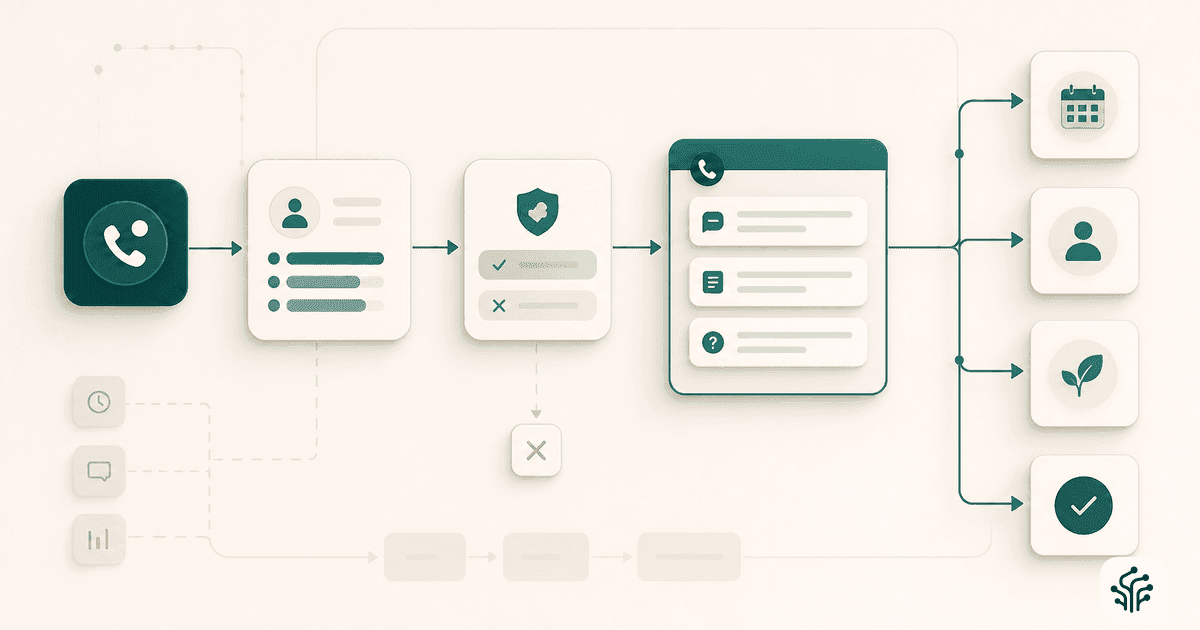
missed call detected → context matched → exclusions checked → first response → intent captured → outcome assigned → next action owned
The callback matters, but the surrounding event data matters just as much.
Without context, the team may respond quickly and still create duplication, confusion or an irrelevant conversation.
Why missed calls create a bigger pipeline problem
Most teams know they should return missed calls. The difficulty is operational. Calls arrive while staff are in appointments, handling other customers, driving between sites or working through a busy queue. The notification lands in a mobile, phone system or CRM, then competes with every other task.
By the time somebody calls back, the context may be gone. Which campaign drove the enquiry? Did the caller leave a voicemail? Have they already submitted a web form? Has another team member tried to contact them? Without a defined process, follow-up becomes dependent on memory and individual habits.
The revenue impact is not limited to the first unanswered call. Slow follow-up creates vague notes, duplicate outreach and poor handovers. Managers cannot easily tell whether a lead was contacted, qualified, booked, disqualified or simply forgotten. That makes pipeline reporting less reliable and prevents teams from prioritising the people who are most likely to progress.
A recovery workflow creates discipline around a moment that is otherwise easy to overlook. It captures the missed event, applies sensible rules, makes the first response quickly, records the outcome and escalates worthwhile conversations to the right person.
What a missed call lead recovery workflow should do
The best workflow depends on the business, its customer expectations and the source of the call. A reception-heavy professional service may need a different approach from a real estate agency responding to campaign enquiries. Still, the workflow should answer the same practical questions: who called, what do we know, what happens now, and who owns the next action?
Start with a clean event and enough context
A missed call should enter one visible queue rather than sit only in a handset log. Match the number against existing records where possible, and include useful context such as the time of call, dialled number, campaign source, property or service of interest, previous contact attempts and any voicemail.
Context matters because a generic callback can feel disconnected. If a caller has already requested an appraisal or asked about a finance scenario, the follow-up should recognise that journey. If there is no existing record, the workflow should create a new lead with the source clearly marked.
Teams should also define exclusions before calling begins. Existing customers with an active case, contacts marked do-not-contact, clearly incorrect numbers and leads already being handled by a staff member should not be pushed through the same recovery sequence. Good automation starts with restraint.
Respond quickly, but use a sensible contact window
Speed-to-lead matters most when intent is fresh. A fast first attempt shows that the business is available and gives the caller an opportunity to continue the conversation while their question is still front of mind.
For a broader discussion of reducing delay before first contact, see how to improve speed to contact.
That does not mean every missed call needs an immediate automated call at any hour. Set calling windows that reflect the audience, local time and internal policy. Where a callback is appropriate, an AI voice agent can make a prompt first attempt using an approved script, identify the reason for the call, ask a small number of relevant questions and offer a handover or booking path when the caller wants one.
If the caller does not answer, the system should record that outcome rather than treating silence as a completed task. The next attempt, a message where permitted, or human review should follow a defined cadence. The right number of attempts depends on the enquiry type and the relationship with the contact. More attempts are not automatically better.
Qualify for an action, not for a perfect profile
The purpose of the first recovery call is usually to establish intent and move the enquiry forward. It is not an interrogation. A property enquiry may need to establish whether the person is buying, selling, renting or seeking an appraisal. A service business may need the service required, preferred timing and location. A finance team may need to confirm the broad reason for the enquiry before arranging a qualified conversation with a specialist.
Keep captured fields tied to decisions. If an answer will not change routing, follow-up or service, it may not belong in the first call. Short, relevant questions tend to produce better conversations and more usable data than a long script designed to collect everything at once.
A structured outcome is equally important. For example, the call may result in a booked appointment, a warm handover, a callback request, a nurture path, an invalid number or a request not to be contacted. These outcomes should be consistent enough that the next person does not have to interpret free-form notes.
Build human review into missed call lead recovery
AI-assisted calling is most useful when the boundaries are clear. It can handle the repeatable first-response work, but people should remain responsible for exceptions, high-value opportunities, complaints, complex questions and decisions requiring judgement.
Review queues are particularly valuable when a caller expresses urgency, asks a question outside the approved workflow, disputes previous contact or provides information that suggests a priority lead. The system should flag the conversation, preserve the transcript and recording where appropriate, and assign a clear owner.
This also helps teams improve the workflow over time. Managers can review calls that did not convert into an outcome, spot questions that confuse callers and refine scripts or qualification fields. That is more useful than treating automation as a black box and hoping the results improve on their own.
DialoGrove is designed around this controlled model: teams can define what an agent asks, what it captures, how outcomes are assigned and when a human needs to step in. The aim is a repeatable operational process, not an unattended calling machine.
Measure the hand-off, not just the callback rate
A returned call is an activity metric, not proof that the enquiry was recovered. It does not show whether recovery is working. Better reporting follows the lead through to a meaningful next step.
Track the time from missed call to first attempt, connection rate, conversation rate, qualification rate, booking or handover rate, and the proportion of records with a complete outcome. Review the reasons leads do not progress as well. A high number of unavailable callers may point to poor timing. Many incomplete records may indicate that the script is too long or staff are bypassing the workflow.
It is also worth comparing sources. Calls from a paid campaign, a local listing, existing customers and a dormant database do not necessarily behave the same way. Segmenting outcomes helps teams decide where rapid recovery has the greatest value and where human attention should be concentrated.
Avoid judging the process on one week of results. Call volumes, seasonality, roster changes and campaign quality can all affect the numbers. Look for sustained improvements in response time, completed outcomes and qualified handovers.
Common mistakes that weaken recovery efforts
The first mistake is treating every missed call as identical. A call from an existing customer, a new website enquiry and a wrong number should not receive the same journey. Basic segmentation prevents wasted effort and awkward customer experiences.
The second is relying on unstructured notes. Notes such as "called back, interested" leave too much ambiguity. A defined outcome, a short summary and an assigned next task make the record useful to sales, service and operations teams.
The third is automating before the process is agreed. If nobody can explain when calls should be made, what the agent can say, which information is required and when a lead goes to a human, technology will only scale inconsistency. Test the workflow with a small lead group first, review real call outcomes and adjust before expanding it.
Finally, do not ignore contact preferences and internal controls. Recovery should respect do-not-contact records, approved calling rules and escalation paths. A fast response is valuable only when it is relevant, considerate and properly managed.
A missed call does not need to become an unowned lead. With clear rules, prompt first contact, structured qualification and visible hand-offs, teams can turn unanswered calls into conversations that somebody is accountable for progressing.