
Phone Lead Qualification Checklist: Ask Only What Changes the Next Action
Use this phone lead qualification checklist to capture need, timing, stakeholders, fit, buying signals and a clear next action without making calls feel like an interrogation.
In this guide
- Why qualification breaks down without a shared process
- Six core checklist areas from context to outcome
- How to turn answers into a clear owned next action
Phone Lead Qualification Checklist: Ask Only What Changes the Next Action
A lead form can tell you who enquired. It rarely tells you whether they are ready to act, what is holding them back, or who needs to be involved. A practical phone lead qualification checklist closes that gap by giving every caller a consistent way to uncover fit, intent and the right next action without turning the conversation into an interrogation.
For sales and service teams, the goal is not to turn a call into an interrogation. It is to make sure the conversation produces an outcome someone can act on. That might be a booked appointment, a properly timed follow-up, a referral to the right team member, or a clear reason to stop pursuing the lead.
For a broader overview of how qualification automation works, see what is lead qualification automation.
The checklist at a glance
A practical qualification journey is:
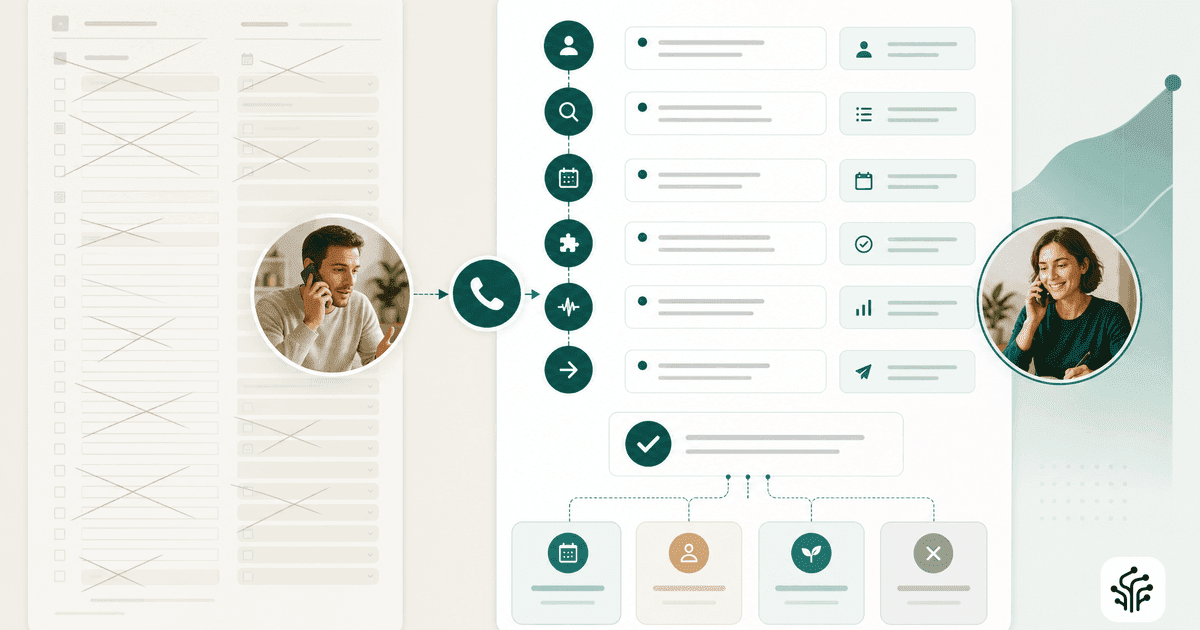
context → need → timing → stakeholders → fit → signals → outcome → next action
The checklist should not force every lead through the same script.
Its job is to make sure the caller captures the minimum information required to decide what should happen next.
Why qualification breaks down on the phone
Most teams do not lack questions. They lack a shared process for deciding which questions matter, when to ask them, and how to record the answer. One rep writes detailed notes. Another logs "keen, call back". A third books a meeting without confirming the decision-maker will attend.
The result is a pipeline full of activity but little confidence. Managers cannot see which leads are genuinely progressing, reps repeat the same discovery work, and promising enquiries cool off while the team works through vague notes.
A checklist creates consistency without forcing every conversation into the same script. It defines the information your business needs to make a sound next-step decision, while allowing the caller to respond naturally to the person in front of them.
Phone lead qualification checklist: prepare before calling
Qualification starts before the phone rings. If the caller does not know where the lead came from, what they asked for, or whether they have already been contacted, the conversation can feel disconnected from the start.
Before each call, check the lead source, enquiry date, campaign or referral context, prior call attempts, CRM notes and any stated preferences. Confirm that contact details are current and that the lead is eligible to be contacted under your organisation's policies and controls.
This preparation matters most for older databases and reactivation campaigns. A lead who enquired two days ago needs a different opening from someone who requested information six months ago. Context helps the caller acknowledge that difference rather than treating every record as new.
For teams using AI voice agents, these checks should be built into the workflow. The agent should receive only the relevant context, follow approved contact rules and know when to stop, escalate or place an interaction into a review queue.
The core questions to cover on the call
The strongest qualification calls move from context to need, then from need to timing, fit and a practical next step. You do not need to ask every question in the first minute. Listen first, then use the checklist to fill the gaps that affect routing and follow-up.
1. Confirm the right person and reason for the enquiry
Start by confirming you are speaking with the intended contact and that it is a suitable time to talk. Then establish why they made the enquiry or why the conversation is relevant.
For example, a property enquiry may relate to buying, selling, leasing or an appraisal. A finance enquiry may concern a new purchase, refinance or a request for general information. The label on a web form is useful, but it should not be treated as the full story.
Record the lead's stated goal in their own words where possible. This gives the next person a more useful starting point than a generic category alone.
2. Understand the current situation and desired outcome
Good qualification identifies the gap between where the lead is now and what they want to achieve. Ask open questions that let them explain their circumstances without pressure.
Useful prompts include: "What are you hoping to achieve?" "What has prompted you to look into this now?" and "What would a good outcome look like for you?"
The answers reveal both relevance and urgency. Someone researching options with no defined timeframe may still be a valid lead, but they should not be handled the same way as someone ready to arrange an appointment this week.
3. Establish timing and priority
Timing is one of the most valuable fields in a qualification workflow, yet it is often captured poorly. "Soon" can mean tomorrow, next month or sometime after a major life decision.
Ask for a practical timeframe and the reason behind it. If the lead is not ready to proceed, find out what needs to happen first. This could be a conversation with a partner, more information, a property sale, internal approval or a change in circumstances.
Timing should shape the next action. Immediate interest might justify a warm handover or appointment invitation. Longer-term interest may call for a scheduled follow-up with useful context, rather than repeated calls that add no value.
For more on when a lead is ready for human follow-up, see what makes a lead ready for human follow-up.
4. Identify decision-makers and stakeholders
A lead can be interested but still unable to move forward without someone else. Establish who will be involved in the decision and whether they need to be part of the next conversation.
This is not about pressuring a person to disclose private details. It is about avoiding preventable delays. If a partner, business owner, family member or colleague needs to assess the option, note that early and plan the next step accordingly.
For appointment-based businesses, this may mean booking a time when all relevant people can attend. For a sales team, it can mean assigning a specialist who is equipped to answer the right questions.
5. Check fit against your service criteria
Not every enquiry is a fit, and forcing poor-fit leads further down the funnel wastes time for both sides. Define the criteria that genuinely affect whether your team can help.
Depending on your business, this could include location, service type, the nature of the request, readiness, available stock, business size or a minimum information requirement. Keep the criteria relevant. A long list of fields that nobody uses later will make calls slower and records less reliable.
Where details are sensitive or require specialist advice, the caller should capture only what is necessary for routing and clearly hand the conversation to the appropriate qualified person.
6. Surface questions, concerns and buying signals
Buying signals are not always direct. A lead may ask about availability, process, appointment times, documentation, implementation timing or what happens next. Those questions usually indicate a different level of intent from someone who only wants broad background information.
Capture concerns with equal care. Price uncertainty, timing, a previous poor experience or uncertainty about suitability can all explain hesitation. A clear concern gives the next team member something useful to address. A vague note such as "not sure" does not.
For a deeper discussion of identifying and capturing buying signals from conversations, see how to capture buying signals.
The objective is understanding, not overcoming every objection or forcing every lead toward a booking on the first call. Some conversations are best progressed by giving the lead time, sending the matter for review or arranging a more detailed discussion.
Turn answers into a clear call outcome
A qualification checklist is only useful if it ends with a clear, owned outcome. Every call should leave the record in one defined state, rather than relying on an individual's interpretation of what happens next.
Your outcome structure may include:
- qualified for an appointment or specialist follow-up
- qualified but not ready, with a dated follow-up task
- needs further information or human review
- not currently suitable
- unable to reach, with an approved next contact attempt
- do not contact or contact preference updated
The exact categories depend on your operation, but they should be mutually clear. If "follow up later" appears too often, it usually means the team has not captured enough information about timing, ownership or the reason for delay.
Pair each outcome with an owner and due date. A booked appointment needs confirmation details. A referral needs a named person or queue. A future follow-up needs a specific date and a note explaining what should be discussed next.
Build the checklist into the workflow, not a separate note-taking exercise
A spreadsheet can be a useful starting point, but it often separates the call from the action that follows it. The caller completes notes, then someone else has to interpret them, update the CRM and decide what to do. That delay is where leads get lost.
A better workflow captures structured fields during or immediately after the call, creates a short lead summary, applies an outcome and triggers the next approved task. Transcripts and recordings can provide useful context for review, particularly when a handover is needed or a manager wants to check how consistently the process is being followed.
This is where controlled AI voice workflows can help. Rather than asking an agent to "qualify leads", define the approved questions, fields, outcomes, escalation points and review requirements first. For a complete guide to designing AI call workflows, see how to design AI call workflows.
DialoGrove is designed around this approach: calls can follow a clear playbook while producing structured outputs that sales and operations teams can actually use.
Human oversight still matters. Review calls that involve uncertainty, sensitive requests, unexpected responses or high-value opportunities. Use those reviews to improve the checklist, not simply to score the call. If a question repeatedly causes confusion, it may need to be rewritten, moved later in the conversation or removed.
Keep the checklist short enough to be used
The trade-off is simple: more fields can improve reporting, but too many fields reduce call quality and completion rates. Start with the information that changes routing, priority or the next conversation. Add fields only when there is a clear operational use for them.
Review your checklist every few weeks against real outcomes. Are booked appointments showing up? Are "qualified" leads being accepted by the sales team? Which answers predict progress, and which fields are routinely blank or ignored?
A well-run qualification process should make the next decision and the next conversation easier, not create more admin. When every conversation ends with a useful record and a clear owner, your team can spend less time chasing context and more time helping the right leads move forward.