How to Design AI Call Workflows That Produce Clear Outcomes
Learn how to design AI call workflows with clear outcomes, structured fields, decision branches, guardrails, human review and owned next actions.
In this guide
- Why outcomes come before the script
- How to map decision points and recovery branches
- How to connect every outcome to a clear owner and next action
A lead submits an enquiry at 4:45 pm on Friday. By Monday morning, three people have looked at it, nobody has called, and the customer has already spoken to another provider. That is not usually a lead generation problem. It is a workflow problem.
Knowing how to design AI call workflows starts with that distinction. Conversion is a downstream result; the workflow itself should first be judged by whether it produces a clear, correct and owned next action. An AI voice agent should not simply make more calls. It should move the right conversation towards a defined operational outcome: a qualified opportunity, a booked appointment, a follow-up task, a clear disqualification, or human review.
The best workflows make the next action obvious. They give customers a consistent experience while giving sales and operations teams a clear view of what was said, what was captured, and what needs to happen next.
Start with the operational outcome, not the script
A common mistake is beginning with a long call script. Scripts matter, but they are not the foundation. Start by deciding what a successful call must produce in your business.
For an inbound property enquiry, the outcome might be a confirmed timeframe, preferred area, budget range and an inspection booking request. For a mortgage broker following up a web form, it could be confirmation that the person wants to proceed, their lending stage, and a handover to a licensed team member. For a service business reactivating old enquiries, it may simply be identifying whether there is current interest and whether a human should call back.
This focus prevents an AI agent from having aimless conversations. It also stops teams from measuring success by call volume alone. A short call that accurately identifies a high-intent lead is more useful than several lengthy calls with vague notes.
Write the workflow outcome as a plain sentence: "After this call, the lead is categorised, key fields are updated, and the correct person or process owns the next action." If the outcome is unclear, the workflow is not ready to build.
For a comparison of structured workflows against open-ended approaches, see voice AI platforms vs playbooks.
Map the call workflow before configuring the agent
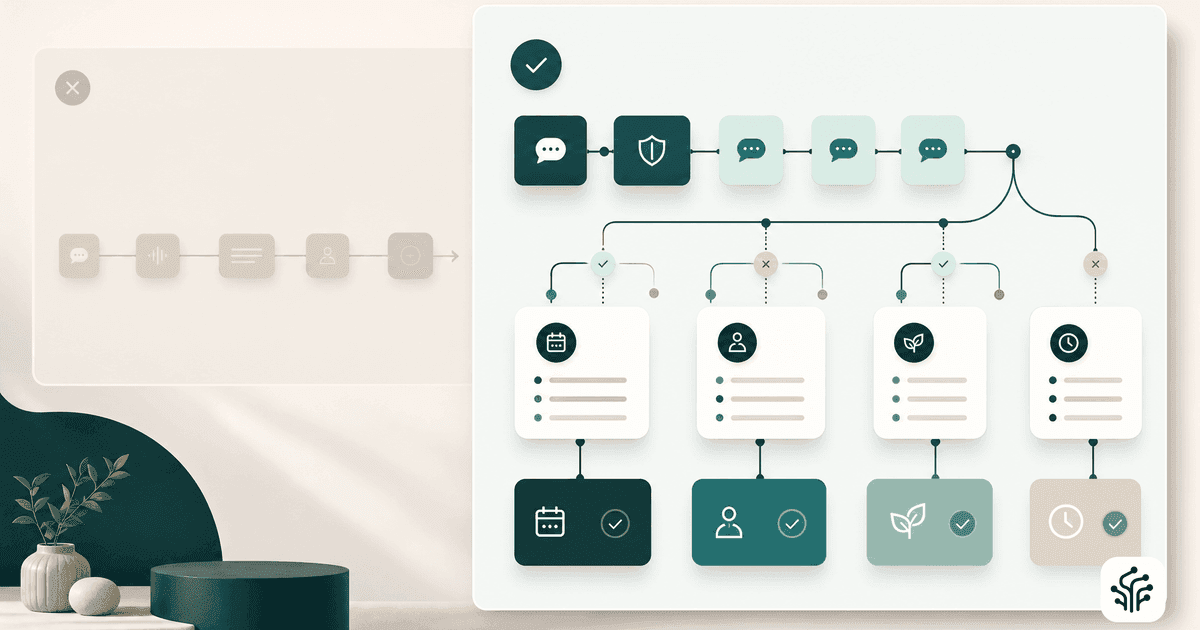
A practical AI call workflow has a sequence. It begins with a trigger, moves through conversation and decision points, then ends with a recorded outcome and follow-up action. Mapping this on paper first makes gaps easier to spot.
For most lead-focused teams, the flow looks like this:
- A lead enters from a form, CRM list, spreadsheet or existing enquiry queue.
- Eligibility checks confirm the contact is appropriate to call under your internal rules, including do-not-contact controls and any required consent or permissions.
- The agent introduces the purpose of the call clearly and follows the approved conversation path.
- The call captures specific fields and detects signals such as urgency, availability, product interest or a request to speak with a person.
- A defined outcome is assigned, with a task, booking, notification or review queue created where needed.
The key is the decision points between those stages. What happens if the person asks for a callback? What if they are busy? What if they are no longer interested? What if they ask a question the agent should not answer? A workflow is controlled by how it handles these ordinary scenarios, not by its best-case path.
Keep outcomes mutually useful
Avoid outcomes such as "good call" or "follow up later". They create ambiguity and force the next team member to listen to recordings or guess what happened.
Use outcomes that lead to action. For example: qualified and ready for adviser contact, appointment requested, callback requested, not currently interested, incorrect details, or human review required. The exact labels will differ by business, but each one should tell the team what happens next and who owns it.
If two outcomes result in the same action, combine them. If one outcome could lead to several actions, make it more specific. This keeps reporting usable and prevents your CRM from becoming a collection of unclear call notes.
For more on how structured outcomes improve routing and reporting, see structured call outcomes software.
Design the conversation around captured fields
Every question should earn its place. Ask it because the answer changes qualification, routing or follow-up - not because it might be nice to know.
Start with the information already available. If a customer has completed an enquiry form, do not ask them to repeat every detail. Confirm what you know, then focus on the missing information that determines the next step. This feels more respectful and reduces call length.
For example, an appointment-based service provider may need only four fields to route an enquiry properly: service required, preferred timing, location, and whether the person wants to book or speak with the team first. A real estate team may instead prioritise buyer or seller status, suburb, budget or price expectation, timing and financing readiness.
Structure questions so answers can be recorded consistently. "What is your situation?" can be useful for context, but it should be followed by a clear field-based question such as "Are you looking to move in the next three months, later this year, or just researching?" The goal is not to force customers into unnatural answers. It is to combine natural conversation with reliable operational data.
Give the agent boundaries, not just instructions
A well-designed agent needs clear rules for what it can say, what it must not say, and when it should hand over to a person. This is particularly important where conversations may touch on pricing, lending, eligibility, legal matters or detailed service advice.
Set approved answers for common questions. Define escalation phrases such as "I'll have a team member help with that" when the caller requests specialist advice, raises a complaint, disputes information, or asks something outside the workflow. The agent should not improvise expertise to keep the conversation moving.
It should also be transparent about its role where appropriate to your process. Trust is easier to maintain when customers understand the purpose of the call and can readily ask to speak with a person.
Design for uncertainty, not just the happy path
Real calls include interruptions, background noise, partial answers, corrections and topic changes.
The workflow should define:
- when to clarify
- which details require exact confirmation
- when best-effort interpretation is acceptable
- how uncertain fields are marked
- when a human should review
- when the agent should stop rather than improvise
A useful principle is that recovery should match the consequence of error. A general preference may tolerate best-effort capture. An appointment time, do-not-contact request or critical handoff detail may require exact confirmation.
Build for imperfect conversations
Real calls are messy. People are driving, distracted, sceptical, in meetings, or halfway through making a decision. A workflow that only works when someone answers every question perfectly will create poor customer experiences and unreliable data.
Design branches for no answer, voicemail, busy contacts, incomplete calls, callback requests, wrong numbers and requests not to be contacted again. Each branch needs a defined action. A callback request might create a task for a sales representative at the requested time. A partial conversation may go to a review queue rather than being automatically labelled unqualified.
For how evidence and traceability support operational confidence, see what is an auditable AI call workflow.
Frequency controls matter too. Repeated attempts in a short period can damage trust, even when the underlying lead list is legitimate. Set sensible attempt limits, calling windows and exclusion rules that reflect your customer experience standards. Your internal policies and professional advice should guide these controls.
Test the workflow against real edge cases
Do not launch a workflow after reading the script once. Run draft calls internally and test the situations that are most likely to break it.
Have someone act as a high-intent lead, someone who is unsure, someone who is busy, and someone who asks an unexpected question. Check whether the agent captures fields accurately, chooses the right outcome, follows escalation rules and produces a useful summary. Listen for language that sounds repetitive, overly formal or too eager to move on.
Then inspect the operational output. A good call transcript is helpful, but the real test is whether a team member can act without replaying the entire conversation. They should see the outcome, captured fields, buying signals, requested follow-up and recommended next step at a glance.
DialoGrove workflows are designed around this kind of visibility: teams can review what the agent will ask, the fields it captures, the outcomes it assigns and the calls that need human attention before scaling activity.
Connect the call to the next action
A call that ends with a transcript but no next step is only half a workflow. Decide what should occur for each outcome before calls begin.
A qualified lead might be assigned to the relevant representative with a concise summary. An appointment request may be sent to the booking process for confirmation. A customer who wants to be contacted later should receive a scheduled task, not an informal note that gets buried. A lead with conflicting information or a sensitive request should go to a review queue.
Keep ownership explicit. "Sales team to follow up" is not ownership. "Assigned to the territory manager within one business hour" is. The right timing depends on lead value, staff capacity and the promise made during the call, but every outcome needs a responsible person or system.
Measure quality before scaling volume
Once the workflow is live, review calls regularly. Look beyond answer rate and total calls. Are captured fields complete? Are qualified leads accepted by the sales team? Are customers frequently asking for clarification? Are certain outcomes overused? How quickly are follow-up tasks completed?
A low qualification rate is not automatically a failure. It may mean the workflow is correctly filtering weak enquiries. But if high-intent leads are repeatedly entering review queues, or sales staff are correcting agent notes, the workflow needs adjustment.
Make changes one at a time where possible. Refine a question, an outcome rule, an escalation trigger or a callback branch, then review the effect. Controlled iteration produces a workflow your team can understand and trust.
The goal is not an agent that talks the most or sounds impressive in a demo. It is a calling process that responds quickly, captures what matters and leaves every worthwhile conversation with a clear owner and next step.